Qatar Industrial Gases Market Summary
The qatar industrial gases market was estimated at USD 218 Million in 2025 and is projected to reach USD 239 Million by 2032, growing at a CAGR of 0.8% from 2026 to 2032.
Qatar Industrial Gases Market Year-wise Growth Rate and Key Drivers
This graph highlights how the Qatar Industrial Gases Market has steadily grown over the past five years, supported by major growth factors.
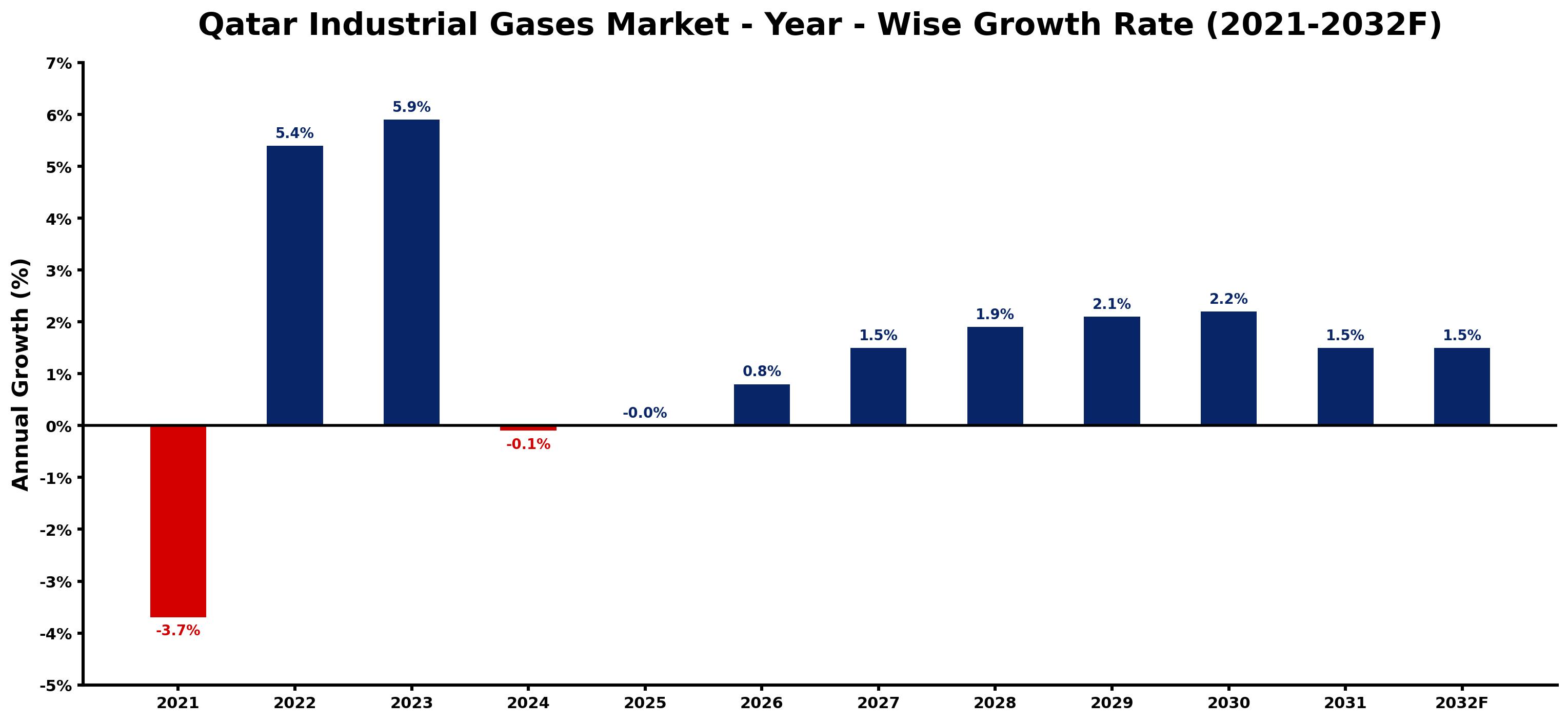
The table below presents the year wise growth rates along with the key drivers influencing the market
| Year | Growth Rate | Major Drivers |
| 2021 | -3.7% | Supply chain disruptions hindered timely deliveries of essential gases, significantly impacting production capabilities and growth. |
| 2022 | 5.4% | New construction projects in Qatar's infrastructure stimulated gas supply requirements significantly. |
| 2023 | 5.9% | Regional collaborations enhanced logistics capabilities for gas distribution across GCC countries. |
| 2024 | -0.1% | Geopolitical tensions led to significant supply chain disruptions, negatively impacting industrial gas availability and pricing. |
| 2025 | -0.0% | Increased investments in oil and gas sectors heightened industrial gas consumption trends. |
| 2026 | 0.8% | Emergence of green technologies prompted industries to explore sustainable gas solutions. |
| 2027 | 1.5% | The demand for specialty gases in healthcare began to diversify market opportunities. |
| 2028 | 1.9% | New players entered the market, intensifying competition and innovation in gas services. |
| 2029 | 2.1% | Rising energy needs fueled by population growth required more reliable gas sources. |
| 2030 | 2.2% | Qatar's focus on economic diversification expanded the industrial gases market landscape. |
| 2031 | 1.5% | Developments in logistics infrastructure facilitated more efficient gas supply chains. |
| 2032 | 1.5% | Innovations in gas applications further drove market expansion in various industry sectors. |
Note - Market size estimations and growth projections presented in this report are based on 6Wresearch's advanced forecasting approach, validated with industry datasets as of June 2026.
Qatar Industrial Gases Market Synopsis
The Qatar Industrial Gases Market is projected to reach 0.8% and witness significant growth during the forecast period (2026-2032). As Qatar progresses towards significant industrial and economic advancements, the demand for industrial gases has intensified across various sectors. These gases, including oxygen, nitrogen, hydrogen, and argon, are vital for industries such as manufacturing, oil and gas, chemicals, healthcare, and food processing, each driving demand in unique ways.
Qatar Industrial Gases Market Growth Drivers
Several key factors contribute to the expansion of the Qatar Industrial Gases Market. Primarily, the nation's robust infrastructure development and numerous construction projects have augmented the need for industrial gases, particularly in welding and metal fabrication applications. Additionally, the healthcare sector is experiencing rapid growth, necessitating the use of medical gases for diverse applications including respiratory therapy and anesthesia.
- Infrastructure initiatives across Qatar have significantly bolstered the demand for gases used in welding and metalworking, crucial for construction projects.
- The healthcare sector's expansion includes a heightened need for medical-grade gases, essential for patient care and surgical procedures.
- The oil and gas industry remains a cornerstone of Qatar's economy, fueling demand for industrial gases in processes such as refining and enhanced oil recovery.
- Technological advancements in gas production and distribution enhance the efficiency and availability of gases across various sectors.
- The growing focus on sustainable industrial practices drives the necessity for gases in cleaner production processes and innovations.
Qatar Industrial Gases Market Challenges and Restraints
Despite its growth outlook, the Qatar Industrial Gases Market faces several challenges. The competitive landscape is characterized by both local and international suppliers striving to secure their market positions. Fluctuations in raw material prices and energy costs pose threats to the profitability of gas suppliers, impacting their operational strategies.
- The competition among local and international suppliers can lead to pricing pressures, affecting profitability margins across the market.
- Price volatility in raw materials necessary for gas production may disrupt supply chains and overall market stability.
- Regulatory changes or increased environmental standards can result in additional compliance burdens for gas suppliers.
- Technological changes may require significant investments, which could be challenging for some smaller suppliers.
- Global economic uncertainties can impact the demand for industrial gases across various sectors, leading to fluctuations in consumption.
Qatar Industrial Gases Market Government Investment and Initiatives
The Qatari government plays a crucial role in shaping the landscape of the industrial gases market through strategic investments and initiatives. Public spending on infrastructure and industrial projects underpins the demand for industrial gases, while government incentives aim to promote the adoption of cleaner production technologies. Development plans that outline visions for sustainable industrialization include support for the healthcare sector, ensuring access to essential medical gases. By fostering an environment conducive to investment, the government is enhancing the market's attractiveness, allowing for innovation and growth in the industrial gases sector.
Qatar Industrial Gases Market Latest Developments (May 2025 - June 2026)
In the period between May 2025 and June 2026, the Qatar Industrial Gases Market has witnessed substantial shifts that reflect broader industry trends. The ongoing post-pandemic recovery has resulted in a gradual normalization of supply chains, positively impacting the availability and distribution of industrial gases. Furthermore, the healthcare sector's demand for medical gases has surged, driven by increased focus on patient care and the introduction of new therapeutic technologies. Additionally, industrial developments aimed at enhancing energy efficiency have prompted investments in advanced gas production techniques, further expanding the market's capabilities.
Qatar Industrial Gases Market - Key Attractiveness of the Report
- 10 Years of Market Numbers
- Historical Data Starting from 2022 to 2025
- Base Year: 2025
- Forecast Data until 2032
- Key Performance Indicators Impacting the Market
- Major Upcoming Developments and Projects
Key Highlights of the Report:
- Qatar Industrial Gases Market Outlook
- Market Size of Qatar Industrial Gases Market, 2025
- Forecast of Qatar Industrial Gases Market, 2032
- Historical Data and Forecast of Qatar Industrial Gases Revenues & Volume for the Period 2022-2032F
- Qatar Industrial Gases Market Trend Evolution
- Qatar Industrial Gases Market Drivers and Challenges
- Qatar Industrial Gases Price Trends
- Qatar Industrial Gases Porter's Five Forces
- Qatar Industrial Gases Industry Life Cycle
- Historical Data and Forecast of Qatar Industrial Gases Market Revenues & Volume By Product Type for the Period 2022-2032F
- Historical Data and Forecast of Qatar Industrial Gases Market Revenues & Volume By Oxygen for the Period 2022-2032F
- Historical Data and Forecast of Qatar Industrial Gases Market Revenues & Volume By Nitrogen for the Period 2022-2032F
- Historical Data and Forecast of Qatar Industrial Gases Market Revenues & Volume By Hydrogen for the Period 2022-2032F
- Historical Data and Forecast of Qatar Industrial Gases Market Revenues & Volume By Carbon Dioxide for the Period 2022-2032F
- Historical Data and Forecast of Qatar Industrial Gases Market Revenues & Volume By Acetylene for the Period 2022-2032F
- Historical Data and Forecast of Qatar Industrial Gases Market Revenues & Volume By Argon for the Period 2022-2032F
- Historical Data and Forecast of Qatar Industrial Gases Market Revenues & Volume By Others for the Period 2022-2032F
- Historical Data and Forecast of Qatar Industrial Gases Market Revenues & Volume By Application for the Period 2022-2032F
- Historical Data and Forecast of Qatar Industrial Gases Market Revenues & Volume By Healthcare for the Period 2022-2032F
- Historical Data and Forecast of Qatar Industrial Gases Market Revenues & Volume By Manufacturing for the Period 2022-2032F
- Historical Data and Forecast of Qatar Industrial Gases Market Revenues & Volume By Metallurgy & Glasses for the Period 2022-2032F
- Historical Data and Forecast of Qatar Industrial Gases Market Revenues & Volume By Food & Beverage for the Period 2022-2032F
- Historical Data and Forecast of Qatar Industrial Gases Market Revenues & Volume By Retail for the Period 2022-2032F
- Historical Data and Forecast of Qatar Industrial Gases Market Revenues & Volume By Chemicals & Energy for the Period 2022-2032F
- Historical Data and Forecast of Qatar Industrial Gases Market Revenues & Volume By Others for the Period 2022-2032F
- Historical Data and Forecast of Qatar Industrial Gases Market Revenues & Volume By Distribution for the Period 2022-2032F
- Historical Data and Forecast of Qatar Industrial Gases Market Revenues & Volume By On-site for the Period 2022-2032F
- Historical Data and Forecast of Qatar Industrial Gases Market Revenues & Volume By Bulk (Liquid Gas Transport) for the Period 2022-2032F
- Historical Data and Forecast of Qatar Industrial Gases Market Revenues & Volume By Cylinder (Merchant) for the Period 2022-2032F
- Qatar Industrial Gases Import Export Trade Statistics
- Market Opportunity Assessment By Product Type
- Market Opportunity Assessment By Application
- Market Opportunity Assessment By Distribution
- Qatar Industrial Gases Top Companies Market Share
- Qatar Industrial Gases Competitive Benchmarking By Technical and Operational Parameters
- Qatar Industrial Gases Company Profiles
- Qatar Industrial Gases Key Strategic Recommendations






































