Qatar Insulated Glass Market Size, Share & Growth Rate
The Qatar Insulated Glass Market was estimated at USD 237 Million in 2025 and is projected to reach USD 315 Million by 2032, growing at a CAGR of 4.1% from 2026 to 2032. This growth trajectory is fueled primarily by the relentless push for energy efficiency in both residential and commercial construction. As Qatar continues to expand its infrastructure and embrace green building practices, insulated glass has emerged as a vital material, helping to regulate indoor climates in the region's extreme heat.
Qatar Insulated Glass Market Year-wise Growth Rate and Key Drivers
This graph highlights how the Qatar Insulated Glass Market has steadily grown over the years, supported by major growth factors.
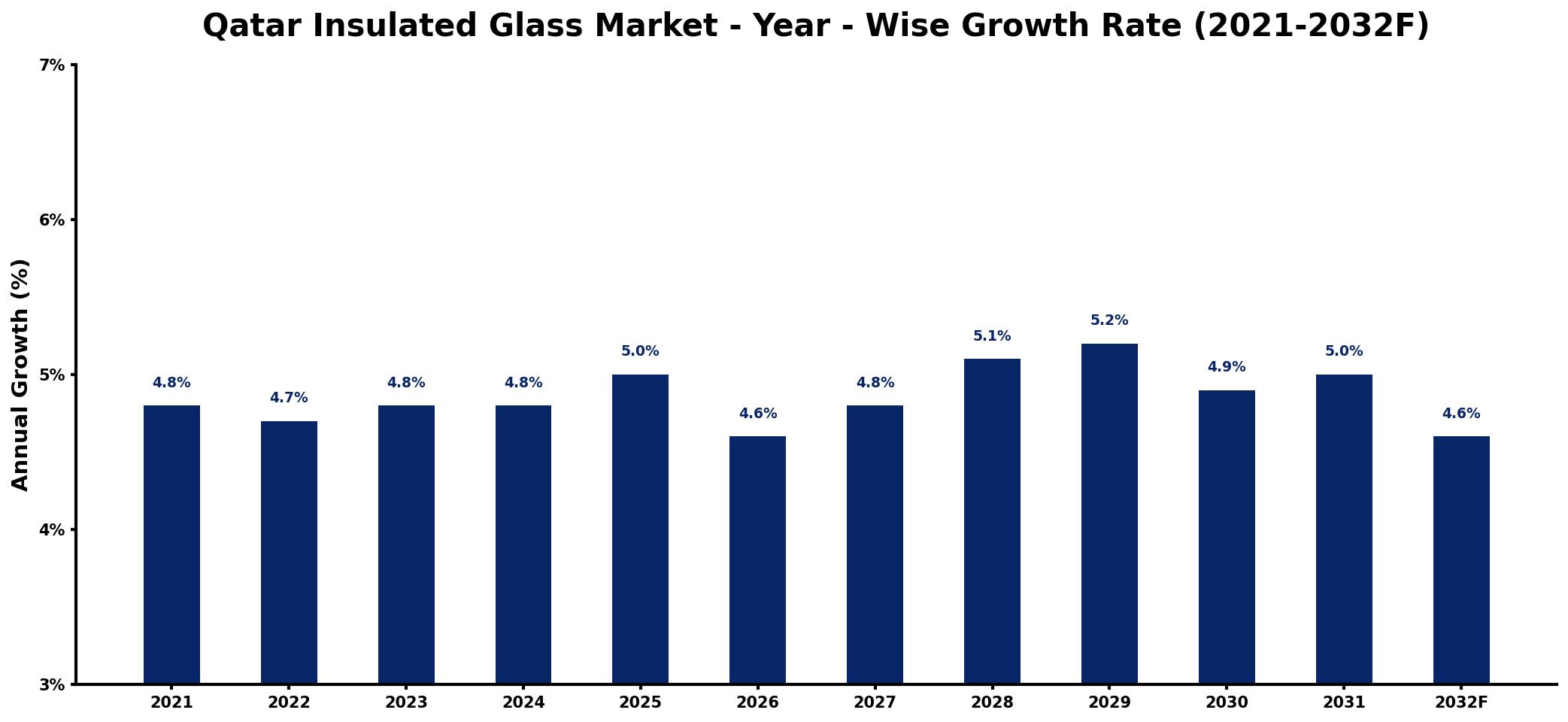
The table below presents the year‑wise growth rates along with the key drivers influencing the market
| Year | Growth Rate | Major Drivers |
| 2021 | 4.8% | Increased construction project investments |
| 2022 | 4.7% | Growing demand for energy efficiency |
| 2023 | 4.8% | Expansion of green building initiatives |
| 2024 | 4.8% | Rise in luxury residential developments |
| 2025 | 5.0% | Enhanced architectural design trends |
| 2026 | 4.6% | Greater focus on sustainability practices |
| 2027 | 4.8% | Boost in commercial building projects |
| 2028 | 5.1% | Increased urbanization and population growth |
| 2029 | 5.2% | Higher interest in smart technologies |
| 2030 | 4.9% | Strengthened regulations for energy conservation |
| 2031 | 5.0% | Rising demand for aesthetic solutions |
| 2032 | 4.6% | Growing preference for innovative materials |
Note: Market size estimations and growth projections presented in this report are based on 6Wresearch's proprietary forecasting methodology, utilizing the latest available industry data, government publications, and primary research inputs.
Qatar Insulated Glass Market Synopsis
In recent years, the Qatar insulated glass market has experienced a significant upsurge, largely influenced by the country's commitment to sustainable building practices. The increasing demand for energy-efficient solutions in the construction sector has accelerated the adoption of insulated glass, which offers superior thermal properties essential for comfort in Qatar's harsh climate.
Looking ahead, the market is poised for further growth as technological advancements in glass manufacturing continue to evolve. With manufacturers innovating to meet rising demand, the market dynamics will likely be shaped by ongoing infrastructure projects and a collective focus on sustainability.
Qatar Insulated Glass Market Key Takeaways
- Qatar's harsh climate is a primary driver for the demand for insulated glass in construction.
- The market is supported by Qatar's commitment to energy efficiency and sustainable building practices.
- Technological advancements are enabling manufacturers to offer innovative insulated glass solutions.
- Despite a temporary dip during the COVID-19 pandemic, demand has rebounded as construction activities resume.
- The market outlook remains optimistic as architects and builders prioritize energy-efficient designs.
Evaluation of Restraints in Qatar Insulated Glass Market
While the Qatar insulated glass market is on an upward trajectory, several restraints could temper its growth. Notably, the initial cost of insulated glass compared to traditional glass options can pose a barrier to adoption among some builders and consumers. Furthermore, ensuring proper installation and maintenance is critical to maximizing the energy-saving benefits associated with insulated glass. As construction standards evolve and emphasize energy efficiency, overcoming these financial and practical hurdles will be essential for sustained market growth.
Qatar Insulated Glass Market Trends
A prominent trend shaping the Qatar insulated glass market is the increasing integration of smart technologies into glass manufacturing. Innovations such as self-tinting glass and insulated units with enhanced solar control are gaining traction. Additionally, a rise in awareness of the environmental impact of building materials is influencing buyers to seek out sustainable options, propelling the insulated glass segment forward. Moreover, architects are increasingly incorporating these solutions into their designs to meet green certification requirements.
Qatar Insulated Glass Market Opportunities
The opportunities within the Qatar insulated glass market are abundant, particularly as the nation accelerates its infrastructure projects. Investments in green building initiatives present a lucrative avenue for growth. Furthermore, as the demand for energy-efficient solutions rises, there is a clear opening for innovative product offerings that cater to a more environmentally conscious consumer base. Manufacturers who can adapt to these changing dynamics stand to benefit significantly from emerging projects and an expanding market landscape.
Government Initiatives in the Qatar Insulated Glass Market
The Qatari government has implemented several initiatives aimed at promoting sustainability and energy efficiency within the construction sector. Incentives for green building practices, along with stringent energy efficiency regulations, are reinforcing the market for insulated glass. Public spending on infrastructure and urban development is also creating a conducive environment for manufacturers and builders to invest in energy-efficient materials. These government-led efforts are pivotal in bolstering demand for insulated glass solutions.
Future Insights of the Qatar Insulated Glass Market
Looking forward to 2026-2032, the Qatar insulated glass market is expected to continue its growth trajectory as demand for energy-efficient construction materials escalates. The ongoing focus on sustainability and the adoption of advanced glazing technologies will play vital roles in this evolution. With the government's commitment to enhancing energy efficiency in building practices, we anticipate that the insulated glass market will adapt and thrive, catering to the needs of a modern, environmentally conscious construction industry.
Qatar Insulated Glass Market Latest Developments (2025 - 2026)
Recent developments within the Qatar insulated glass market indicate a strong push towards innovation and sustainability. Manufacturers are actively exploring new materials and technologies, contributing to an impressive lineup of energy-efficient products. As construction activities ramp back up post-COVID-19, there is a renewed emphasis on the incorporation of insulated glass in both residential and commercial projects. This shift is being met with excitement as architects and builders increasingly recognize the benefits of insulated glass in their designs.
Qatar Insulated Glass Market - Key Attractiveness of the Report
- 10 Years of Market Numbers
- Historical Data Starting from 2022 to 2025
- Base Year: 2025
- Forecast Data until 2032
- Key Performance Indicators Impacting the Market
- Major Upcoming Developments and Projects
Key Highlights of the Report:
- Qatar Insulated Glass Market Outlook
- Market Size of Qatar Insulated Glass Market, 2025
- Forecast of Qatar Insulated Glass Market, 2032
- Historical Data and Forecast of Qatar Insulated Glass Revenues & Volume for the Period 2022-2032F
- Qatar Insulated Glass Market Trend Evolution
- Qatar Insulated Glass Market Drivers and Challenges
- Qatar Insulated Glass Price Trends
- Qatar Insulated Glass Porter's Five Forces
- Qatar Insulated Glass Industry Life Cycle
- Historical Data and Forecast of Qatar Insulated Glass Market Revenues & Volume By Type for the Period 2022-2032F
- Historical Data and Forecast of Qatar Insulated Glass Market Revenues & Volume By Heated Insulating Glass for the Period 2022-2032F
- Historical Data and Forecast of Qatar Insulated Glass Market Revenues & Volume By Tempering Insulating Glass for the Period 2022-2032F
- Historical Data and Forecast of Qatar Insulated Glass Market Revenues & Volume By Custom Insulated Glass for the Period 2022-2032F
- Historical Data and Forecast of Qatar Insulated Glass Market Revenues & Volume By Other Glasses for the Period 2022-2032F
- Historical Data and Forecast of Qatar Insulated Glass Market Revenues & Volume By Application for the Period 2022-2032F
- Historical Data and Forecast of Qatar Insulated Glass Market Revenues & Volume By Doors & Partitions for the Period 2022-2032F
- Historical Data and Forecast of Qatar Insulated Glass Market Revenues & Volume By Kitchen Appliances & Cabinets for the Period 2022-2032F
- Historical Data and Forecast of Qatar Insulated Glass Market Revenues & Volume By Floors & Ceilings for the Period 2022-2032F
- Historical Data and Forecast of Qatar Insulated Glass Market Revenues & Volume By Furniture & Curtain Walls for the Period 2022-2032F
- Historical Data and Forecast of Qatar Insulated Glass Market Revenues & Volume By Railings & Bolted Structures for the Period 2022-2032F
- Historical Data and Forecast of Qatar Insulated Glass Market Revenues & Volume By Automotive Glasses for the Period 2022-2032F
- Historical Data and Forecast of Qatar Insulated Glass Market Revenues & Volume By End User for the Period 2022-2032F
- Historical Data and Forecast of Qatar Insulated Glass Market Revenues & Volume By Residential Buildings for the Period 2022-2032F
- Historical Data and Forecast of Qatar Insulated Glass Market Revenues & Volume By Commercial & Institutional Buildings for the Period 2022-2032F
- Historical Data and Forecast of Qatar Insulated Glass Market Revenues & Volume By Industrial Users for the Period 2022-2032F
- Qatar Insulated Glass Import Export Trade Statistics
- Market Opportunity Assessment By Type
- Market Opportunity Assessment By Application
- Market Opportunity Assessment By End User
- Qatar Insulated Glass Top Companies Market Share
- Qatar Insulated Glass Competitive Benchmarking By Technical and Operational Parameters
- Qatar Insulated Glass Company Profiles
- Qatar Insulated Glass Key Strategic Recommendations






































