Qatar Insurance Telematics Market Size & Growth Rate (2026-2032)
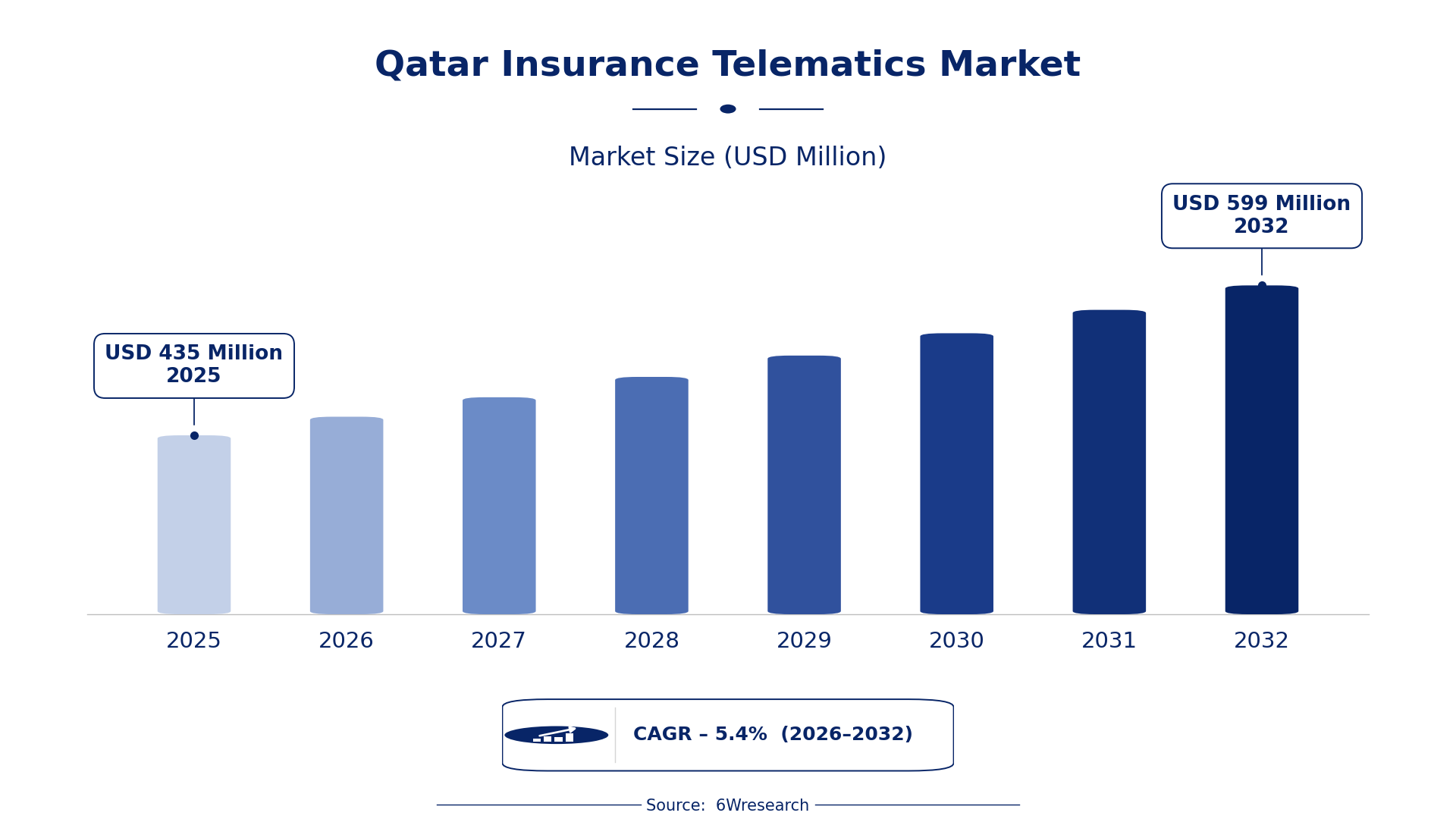
The Qatar Insurance Telematics Market was estimated at USD 435 Million in 2025 and is projected to reach USD 599 Million by 2032, growing at a CAGR of 5.4% from 2026 to 2032.
Qatar Insurance Telematics Market Synopsis
The demand for telematics solutions in Qatar's insurance sector is rapidly rising, as companies seek innovative ways to assess driver behavior and enhance road safety. As insurers increasingly adopt usage-based insurance (UBI) models, the emphasis on data-driven decision-making is reshaping traditional practices.
Collaborations between insurance companies and telematics service providers are becoming commonplace, enabling tailored insurance offerings that cater to individual driving habits. This shift not only improves customer satisfaction but also enhances risk assessment capabilities within the industry.
Qatar Insurance Telematics Market Year-wise Growth Rate and Key Drivers
This graph illustrates the annual growth rates of the Qatar Insurance Telematics Market from 2021 to 2032, highlighting a steady upward trajectory and projected expansion over the forecast period.
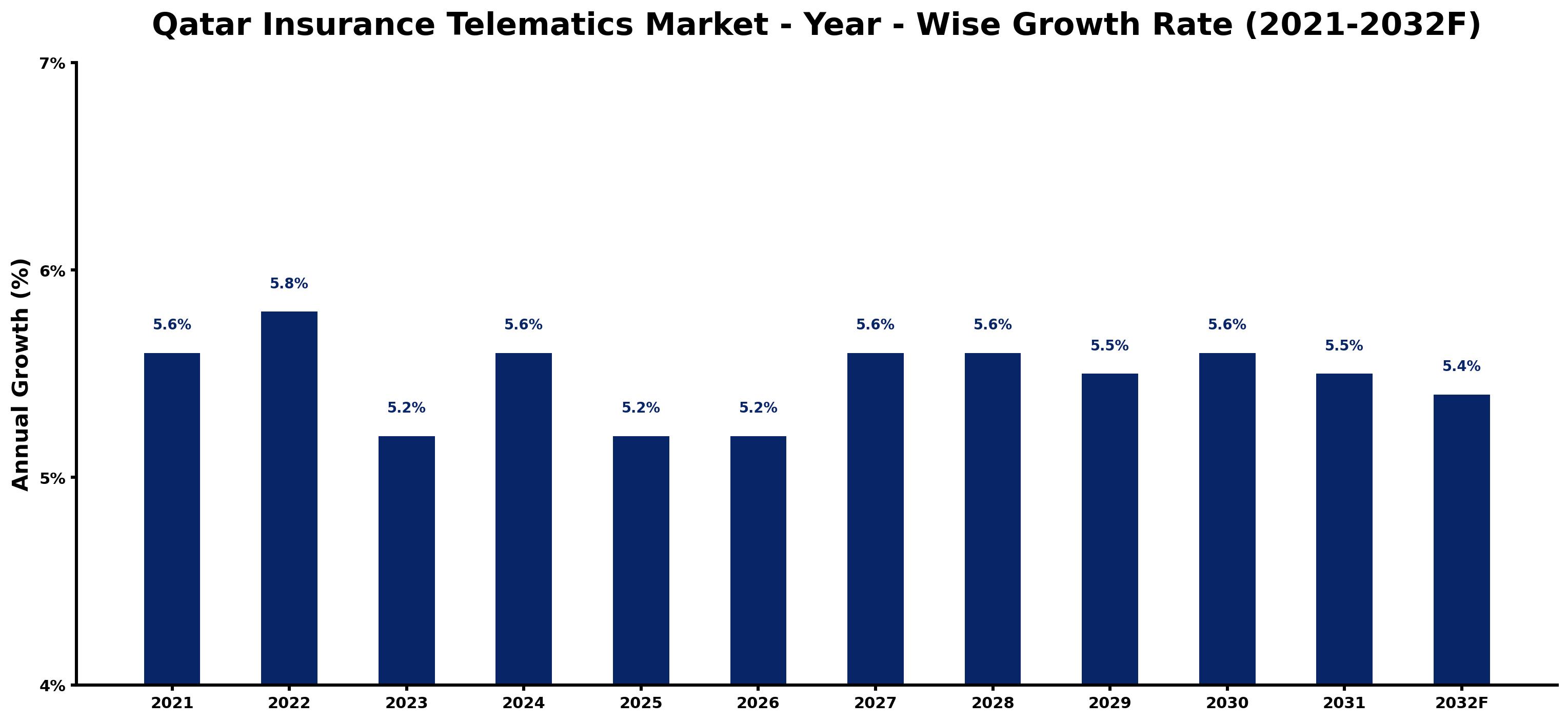
The table below presents the year‑wise growth rates along with the key drivers influencing the market
| Year | Growth Rate | Major Drivers |
| 2021 | 5.6% | Qatar's National Vision 2030 promotes technology in insurance. |
| 2022 | 5.8% | Increased demand for personalized auto insurance solutions. |
| 2023 | 5.2% | Rising smartphone penetration enhances telematics adoption rates. |
| 2024 | 5.6% | Government incentives for smart vehicle insurance programs. |
| 2025 | 5.2% | Growing interest in road safety and driver behavior tracking. |
| 2026 | 5.2% | Increased regulatory focus on reducing road traffic accidents. |
| 2027 | 5.6% | Public awareness campaigns on benefits of telematics data. |
| 2028 | 5.6% | Qatar's advanced infrastructure supports telematics connectivity. |
| 2029 | 5.5% | Partnerships between insurers and tech firms expand offerings. |
| 2030 | 5.6% | Emergence of data analytics firms boosting telematics insights. |
| 2031 | 5.5% | Cost-efficiency of telematics solutions attracts new customers. |
| 2032 | 5.4% | Local demand for innovative insurance solutions drives growth. |
Note: Market size estimations and growth projections presented in this report are based on 6Wresearch's proprietary forecasting methodology, utilizing the latest available industry data, government publications, and primary research inputs.
Qatar Insurance Telematics Market Key Takeaways
Below are some of the specific key takeaways from the market, including:
- The increasing integration of telematics technology is transforming insurance underwriting processes.
- Government initiatives are promoting the adoption of telematics to enhance road safety and insurance practices.
- Data privacy and regulatory compliance remain critical challenges for insurers implementing telematics solutions.
- The COVID-19 pandemic has altered driving behaviors, influencing telematics data and insurance pricing.
- Key players are focusing on technological advancements to improve telematics offerings and customer engagement.
Evaluation of Restraints in Qatar Insurance Telematics Market
Several factors are constraining the growth of the Qatar Insurance Telematics Market. One of the primary concerns is the balance between effective data collection and privacy protection. Insurers must comply with local regulations that dictate how driver data can be used, which can hinder the full potential of telematics technology. Additionally, the initial costs associated with implementing telematics solutions can deter smaller insurance providers from adopting these systems, limiting competition and innovation in the market.
Qatar Insurance Telematics Market Trends
A noticeable trend is the shift towards personalized insurance policies based on actual driving behavior, which is becoming a standard offering among insurers. This approach not only fosters customer loyalty but also encourages safer driving habits. Another trend is the integration of advanced analytics and artificial intelligence into telematics platforms, allowing for more precise risk assessments and dynamic pricing models that can respond to changing driving patterns in real-time.
Qatar Insurance Telematics Market Opportunities
There are significant opportunities for growth in the Qatar Insurance Telematics Market, particularly in enhancing the user experience through mobile applications that track and report driving habits. on top of that, as the government continues to champion road safety initiatives, insurers can capitalize on these programs to offer discounts or incentives for safer driving. The potential for partnerships with automotive manufacturers to embed telematics devices in vehicles also presents a lucrative avenue for market expansion.
Government Initiatives in the Qatar Insurance Telematics Market
The Qatari government is actively supporting the integration of telematics in the insurance sector as part of its broader road safety and digital transformation agenda. This focus on enhancing road safety through technology is driving the adoption of telematics solutions across the insurance industry, aligning public policy with market needs.
- A national road safety initiative launched in early 2023 aims to promote the use of telematics in insurance to reduce traffic accidents.
- Current regulations are being updated to support the integration of telematics data for more accurate risk assessment and pricing.
- A planned public-private partnership expected to enhance data-sharing protocols among insurers and telematics service providers is set for rollout by late 2025.
- In 2024, the government initiated a campaign to raise awareness among drivers about the benefits of telematics for insurance premiums.
- Upcoming infrastructure projects are expected to facilitate better connectivity for telematics devices, enhancing data collection capabilities.
Future Insights of the Qatar Insurance Telematics Market
Looking ahead to 2026-2032, the Qatar Insurance Telematics Market is likely to experience accelerated growth as more insurers recognize the value of data-driven insights. The push for smarter, safer driving will continue to be a focal point, with technology evolving to provide deeper analytics and more interactive customer experiences. As regulatory frameworks become clearer and more supportive, expect increased participation from smaller insurers, broadening the competitive landscape.
Qatar Insurance Telematics Market Latest Developments
Recent developments in the Qatar Insurance Telematics Market reflect a growing commitment to integrating advanced technology into traditional insurance practices. Over the past year, insurers have been increasingly adopting telematics solutions to enhance risk assessment and improve customer engagement.
- A major insurance provider launched a new telematics-based mobile app in Q1 2024, allowing customers to track their driving habits and receive personalized feedback.
- An ongoing initiative began in mid-2023, where telematics data is being integrated into policy pricing models, enhancing accuracy and competitiveness.
- A strategic partnership between a technology vendor and an insurance company is currently underway, focusing on developing AI-driven telematics solutions for real-time risk assessment.
- Plans for a new telematics device rollout have been announced, expected to begin in late 2025, aimed at enhancing data collection from vehicles.
- An industry conference held in early 2024 focused on showcasing innovations in telematics, drawing attention to the potential for insurance applications.
Qatar Insurance Telematics Market - Key Attractiveness of the Report
- 10 Years of Market Numbers
- Historical Data Starting from 2022 to 2025
- Base Year: 2025
- Forecast Data until 2032
- Key Performance Indicators Impacting the Market
- Major Upcoming Developments and Projects
Key Highlights of the Report:
- Qatar Insurance Telematics Market Outlook
- Market Size of Qatar Insurance Telematics Market, 2025
- Forecast of Qatar Insurance Telematics Market, 2032
- Historical Data and Forecast of Qatar Insurance Telematics Revenues & Volume for the Period 2022-2032F
- Qatar Insurance Telematics Market Trend Evolution
- Qatar Insurance Telematics Market Drivers and Challenges
- Qatar Insurance Telematics Price Trends
- Qatar Insurance Telematics Porter's Five Forces
- Qatar Insurance Telematics Industry Life Cycle
- Historical Data and Forecast of Qatar Insurance Telematics Market Revenues & Volume By End User for the Period 2022-2032F
- Historical Data and Forecast of Qatar Insurance Telematics Market Revenues & Volume By Small for the Period 2022-2032F
- Historical Data and Forecast of Qatar Insurance Telematics Market Revenues & Volume By Medium Enterprises for the Period 2022-2032F
- Historical Data and Forecast of Qatar Insurance Telematics Market Revenues & Volume By Large Enterprises for the Period 2022-2032F
- Historical Data and Forecast of Qatar Insurance Telematics Market Revenues & Volume By Deployment Type for the Period 2022-2032F
- Historical Data and Forecast of Qatar Insurance Telematics Market Revenues & Volume By Cloud for the Period 2022-2032F
- Historical Data and Forecast of Qatar Insurance Telematics Market Revenues & Volume By On-Premises for the Period 2022-2032F
- Historical Data and Forecast of Qatar Insurance Telematics Market Revenues & Volume By Organization Size for the Period 2022-2032F
- Historical Data and Forecast of Qatar Insurance Telematics Market Revenues & Volume By Small and Medium Enterprises (SMEs) for the Period 2022-2032F
- Historical Data and Forecast of Qatar Insurance Telematics Market Revenues & Volume By Large Enterprises for the Period 2022-2032F
- Qatar Insurance Telematics Import Export Trade Statistics
- Market Opportunity Assessment By End User
- Market Opportunity Assessment By Deployment Type
- Market Opportunity Assessment By Organization Size
- Qatar Insurance Telematics Top Companies Market Share
- Qatar Insurance Telematics Competitive Benchmarking By Technical and Operational Parameters
- Qatar Insurance Telematics Company Profiles
- Qatar Insurance Telematics Key Strategic Recommendations






































