Qatar Internal Combustion Engines Market Summary
The qatar internal combustion engines market was estimated at USD 136 Million in 2025 and is projected to reach USD 149 Million by 2032, growing at a CAGR of 1.5% from 2026 to 2032.
Qatar Internal Combustion Engines Market Year-wise Growth Rate and Key Drivers
This graph highlights how the Qatar Internal Combustion Engines Market has steadily grown over the past five years, supported by major growth factors.
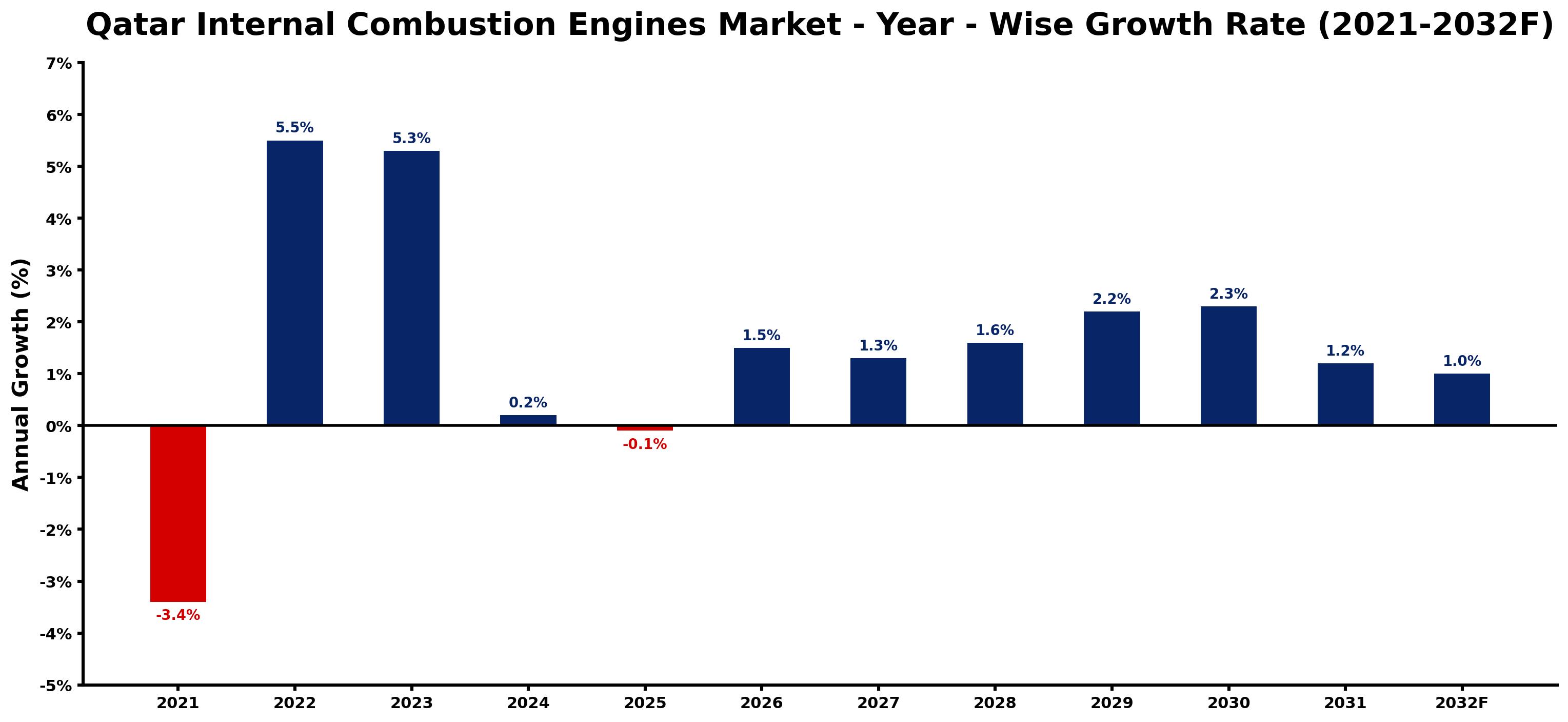
The table below presents the year wise growth rates along with the key drivers influencing the market
| Year | Growth Rate | Major Drivers |
| 2021 | -3.4% | Declining oil prices led to reduced investments in traditional energy technologies, including internal combustion engines. |
| 2022 | 5.5% | Demand for high-performance engines surged due to increased construction activity across Qatar. |
| 2023 | 5.3% | Legacy engine models faced scrutiny as companies sought efficiency in equipment fleets. |
| 2024 | 0.2% | Infrastructure projects initiated by the FIFA World Cup spurred engine procurement across industries. |
| 2025 | -0.1% | Shifting preferences towards electric vehicles decreased demand for internal combustion engines amid increasing environmental awareness. |
| 2026 | 1.5% | Technological partnerships emerged, enhancing engine efficiency and sustainability in operational practices. |
| 2027 | 1.3% | The shift towards hybrid solutions began influencing traditional engine market dynamics significantly. |
| 2028 | 1.6% | Fuel diversification strategies prompted a reevaluation of engine designs and applications in Qatar. |
| 2029 | 2.2% | Environmental standards became more stringent, pushing for innovation within combustion engine technologies. |
| 2030 | 2.3% | Urbanization trends necessitated more robust engines for heavy machinery in rapidly developing zones. |
| 2031 | 1.2% | Research investment into alternative fuels gained traction, impacting traditional engine usage patterns. |
| 2032 | 1.0% | Regional collaboration on energy projects stimulated growth in the internal combustion engine market. |
Note - Market size estimations and growth projections presented in this report are based on 6Wresearch's advanced forecasting approach, validated with industry datasets as of June 2026.
Qatar Internal Combustion Engines Market Synopsis
The Qatar Internal Combustion Engines Market is projected to reach 1.5% and witness significant growth during the forecast period (2026-2032). The industrial sector in Qatar has been evolving rapidly, with a marked increase in demand for internal combustion engines (ICEs) driven by substantial government and private investments aimed at advancing energy infrastructure. This expansion is essential to meet the growing electricity needs across various sectors, further fueling the internal combustion engines market.
Qatar Internal Combustion Engines Market Growth Drivers
The internal combustion engines market in Qatar is primarily supported by several key factors:
- Urbanization continues to rise, resulting in an increased demand for automotive vehicles, contributing positively to vehicle sales in Qatar.
- Attractive government initiatives designed to enhance energy infrastructure are leading to a growth in power generation requirements, thereby boosting the internal combustion engines sector.
- Technological advancements in engine efficiency, along with the development of fuel-efficient designs, are increasing consumer interest and driving market adoption.
- The automotive sector's expansion necessitates a higher production rate of ICEs, further propelling market growth.
- Companies are increasingly investing in research and development to cater to the stringent emission regulations, providing further opportunities for market development.
Qatar Internal Combustion Engines Market Challenges and Restraints
Despite the positive outlook for the Qatar internal combustion engines market, several challenges exist:
- The rise of electric vehicle (EV) technology presents a significant challenge to the traditional ICE market, as consumers are shifting towards more sustainable alternatives.
- High initial investment costs associated with developing and enhancing ICE technology can deter new market entrants and smaller manufacturers.
- Global trends towards stricter environmental regulations are creating pressure on ICE manufacturers to adapt quickly or potentially face restrictions.
- Volatility in fuel prices may lead to fluctuations in demand as consumers weigh the cost-effectiveness of ICEs against emerging technologies.
- The ongoing impact of the COVID-19 pandemic has disrupted supply chains, resulting in delays and uncertainties that could influence market growth trajectories.
Qatar Internal Combustion Engines Market Government Investment and Initiatives
The government of Qatar is actively fostering the growth of the internal combustion engines market through various initiatives and investments aimed at enhancing the country's energy infrastructure. These initiatives include:
- Significant public spending on energy projects that involve the construction of power plants and infrastructure, which increases the demand for internal combustion engines.
- The introduction of incentive programs encouraging local and international businesses to invest in energy-efficient technologies.
- Collaboration with private sectors aimed at developing innovative solutions to boost the efficiency of power generation systems, further integrating internal combustion engines.
- Adoption of policies that promote a balance between fossil fuel use and transitioning to more sustainable energy sources, which nonetheless support the continued relevance of ICEs in various applications.
- Investment in workforce training and development programs to enhance skills within the energy sector, ensuring a knowledgeable workforce capable of driving advancements in ICE technology.
Qatar Internal Combustion Engines Market Latest Developments (May 2025 - June 2026)
The period from May 2025 to June 2026 has been marked by several noteworthy developments within the Qatar internal combustion engines market. These developments include:
- Continued investments in technological advancements aimed at improving engine performance while reducing environmental impact.
- Emergence of new partnerships between private companies and government entities to enhance research capabilities and foster innovation.
- Increased focus on regulatory compliance as manufacturers enhance their engines to meet emerging emission standards.
- Development of hybrid solutions that combine traditional internal combustion engines with electric propulsion, reflecting market adaptability in response to consumer preferences.
- Ongoing initiatives aimed at building a robust supply chain that can withstand global economic fluctuations while ensuring steady provision of ICEs to the market.
Qatar Internal Combustion Engines Market - Key Attractiveness of the Report
- 10 Years of Market Numbers
- Historical Data Starting from 2022 to 2025
- Base Year: 2025
- Forecast Data until 2032
- Key Performance Indicators Impacting the Market
- Major Upcoming Developments and Projects
Key Highlights of the Report:
- Qatar Internal Combustion Engines Market Outlook
- Market Size of Qatar Internal Combustion Engines Market, 2025
- Forecast of Qatar Internal Combustion Engines Market, 2032
- Historical Data and Forecast of Qatar Internal Combustion Engines Revenues & Volume for the Period 2022-2032F
- Qatar Internal Combustion Engines Market Trend Evolution
- Qatar Internal Combustion Engines Market Drivers and Challenges
- Qatar Internal Combustion Engines Price Trends
- Qatar Internal Combustion Engines Porter's Five Forces
- Qatar Internal Combustion Engines Industry Life Cycle
- Historical Data and Forecast of Qatar Internal Combustion Engines Market Revenues & Volume By Fuel for the Period 2022-2032F
- Historical Data and Forecast of Qatar Internal Combustion Engines Market Revenues & Volume By Petroleum for the Period 2022-2032F
- Historical Data and Forecast of Qatar Internal Combustion Engines Market Revenues & Volume By Natural Gas for the Period 2022-2032F
- Historical Data and Forecast of Qatar Internal Combustion Engines Market Revenues & Volume By End-Users for the Period 2022-2032F
- Historical Data and Forecast of Qatar Internal Combustion Engines Market Revenues & Volume By Automotive for the Period 2022-2032F
- Historical Data and Forecast of Qatar Internal Combustion Engines Market Revenues & Volume By Aircraft for the Period 2022-2032F
- Historical Data and Forecast of Qatar Internal Combustion Engines Market Revenues & Volume By Marine for the Period 2022-2032F
- Qatar Internal Combustion Engines Import Export Trade Statistics
- Market Opportunity Assessment By Fuel
- Market Opportunity Assessment By End-Users
- Qatar Internal Combustion Engines Top Companies Market Share
- Qatar Internal Combustion Engines Competitive Benchmarking By Technical and Operational Parameters
- Qatar Internal Combustion Engines Company Profiles
- Qatar Internal Combustion Engines Key Strategic Recommendations






































