Qatar Managed Mobility Services Market Size & Growth Rate (2026-2032)
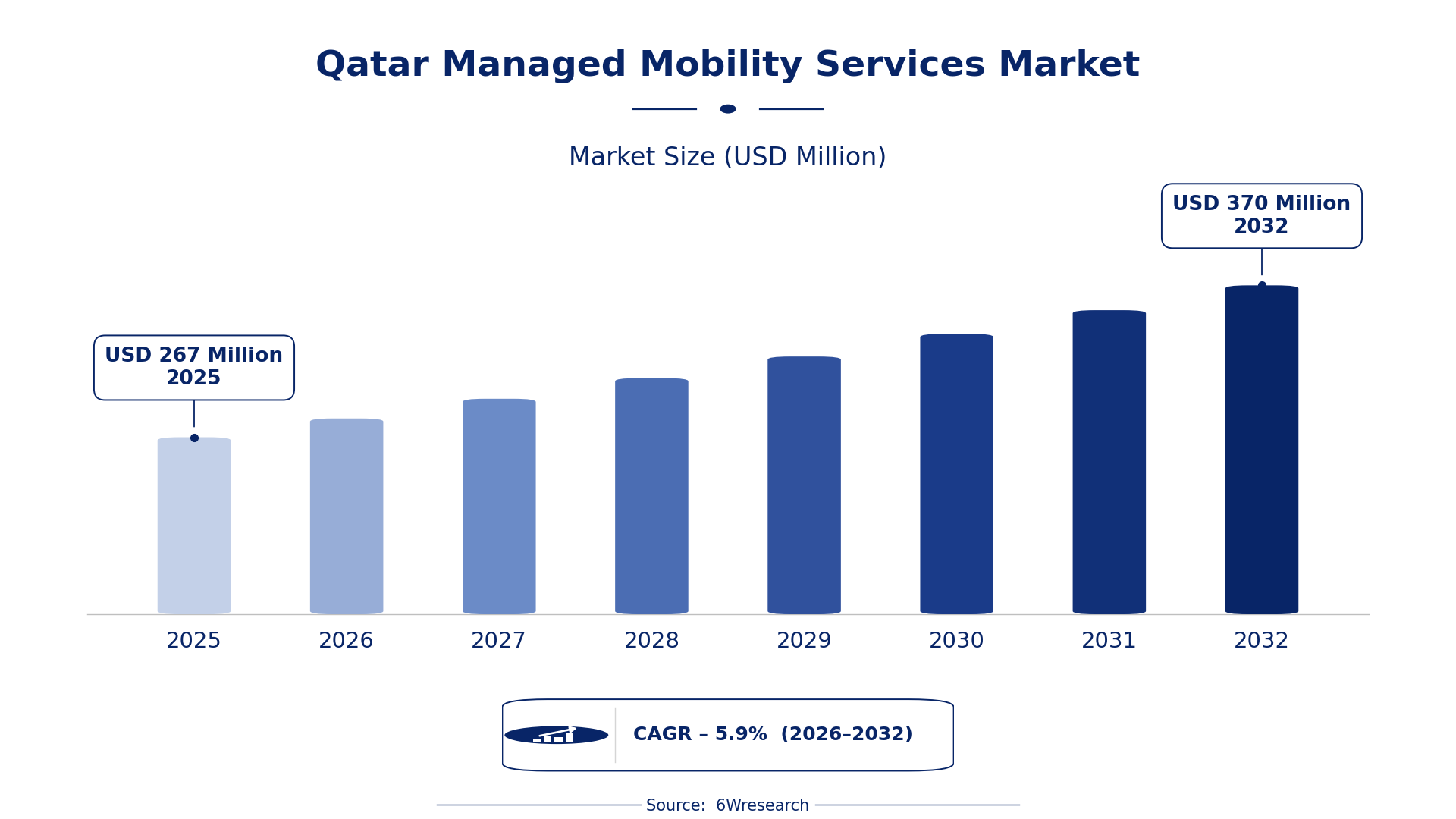
The Qatar Managed Mobility Services Market was estimated at USD 267 Million in 2025 and is projected to reach USD 370 Million by 2032, growing at a CAGR of 5.9% from 2026 to 2032.
Qatar Managed Mobility Services Market Synopsis
The Qatar Managed Mobility Services Market has gained considerable traction recently, driven by an uptick in mobile device adoption across various sectors. As businesses increasingly recognize the advantages of managed services, expectations for optimized efficiency are on the rise, propelling further interest in these solutions.
Looking ahead, the market is set to evolve with greater emphasis on security and compliance, particularly as remote work becomes more entrenched. Organizations are not just looking for mobility solutions but are prioritizing comprehensive strategies that encompass device management, application security, and efficient operational workflows.
Qatar Managed Mobility Services Market Year-wise Growth Rate and Key Drivers
This graph illustrates the annual growth rates of the Qatar Managed Mobility Services Market from 2021 to 2032, highlighting a steady upward trajectory and projected expansion over the forecast period.
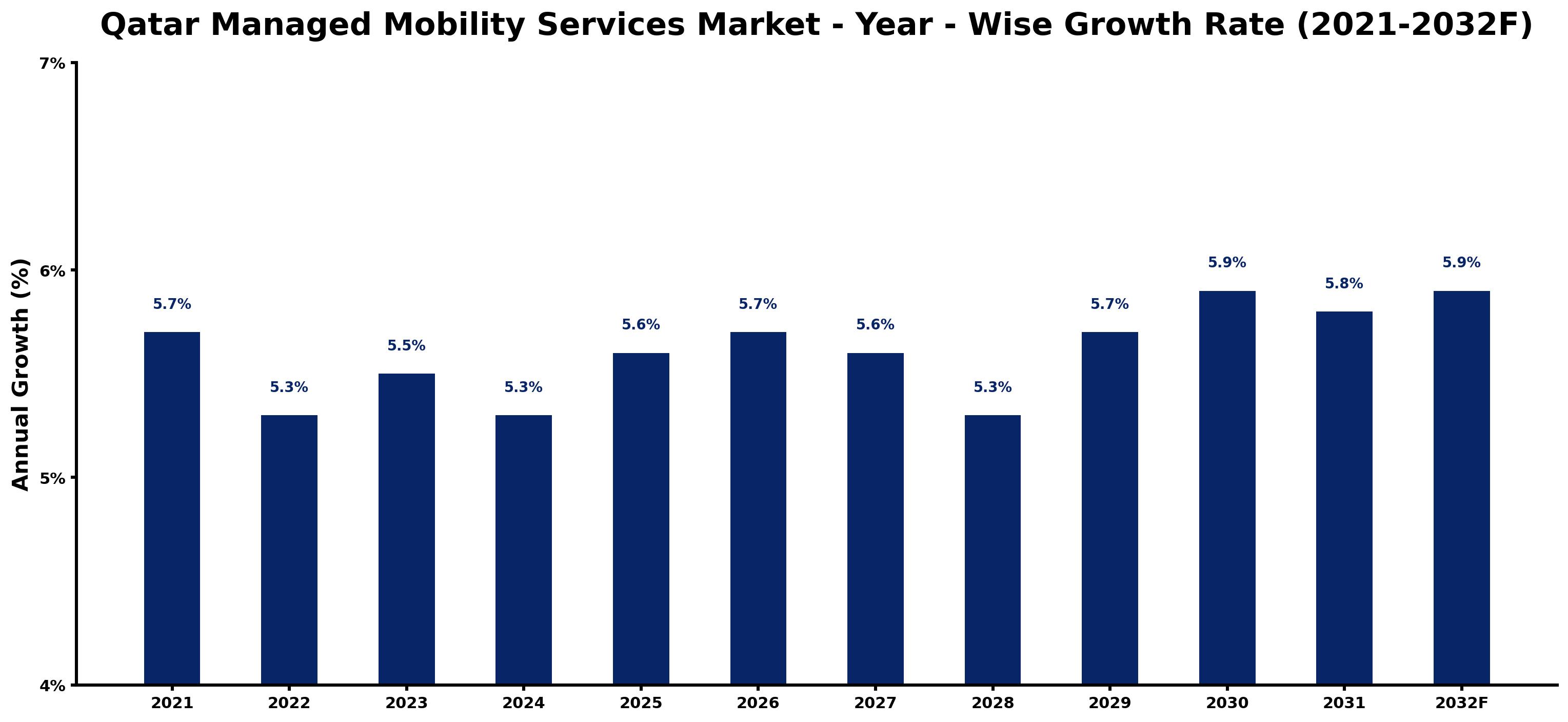
The table below presents the year‑wise growth rates along with the key drivers influencing the market
| Year | Growth Rate | Major Drivers |
| 2021 | 5.7% | Qatar National Vision 2030 drives digital innovation priorities. |
| 2022 | 5.3% | Increased demand for remote working solutions amidst pandemic. |
| 2023 | 5.5% | Rising smartphone adoption enhancing mobility services accessibility. |
| 2024 | 5.3% | Boost in Qatar's GDP fueling enterprise mobility investments. |
| 2025 | 5.6% | Youthful population eager for advanced mobility technology. |
| 2026 | 5.7% | Government initiatives promoting smart city applications and services. |
| 2027 | 5.6% | Enhanced public transport systems integrating managed mobility offerings. |
| 2028 | 5.3% | Focus on sustainability driving eco-friendly mobility solutions. |
| 2029 | 5.7% | Growing expatriate workforce increasing managed services demand. |
| 2030 | 5.9% | Local firms prioritizing efficiency through digital mobility platforms. |
| 2031 | 5.8% | Infrastructural improvements supporting seamless mobility service integration. |
| 2032 | 5.9% | Collaborations between tech firms and government agencies enhancing offerings. |
Note: Market size estimations and growth projections presented in this report are based on 6Wresearch's proprietary forecasting methodology, utilizing the latest available industry data, government publications, and primary research inputs.
Qatar Managed Mobility Services Market Key Takeaways
Below are some of the specific key takeaways from the market, including:
- The demand for integrated mobility solutions continues to rise as organizations navigate the complexities of mobile device management.
- Enhanced security measures are becoming crucial due to increasing cybersecurity threats targeting mobile environments.
- Growth is particularly evident in sectors such as healthcare and logistics, where mobile solutions streamline operations.
- Remote work is driving innovation in managed services, leading to more tailored offerings for specific business needs.
- The convergence of mobility services with cloud solutions is fostering new opportunities for efficiency and cost management.
Evaluation of Restraints in Qatar Managed Mobility Services Market
The Qatar Managed Mobility Services Market is not without its limitations. Organizations face integration hurdles as they attempt to align new mobility solutions with existing IT infrastructures. Furthermore, rapid advancements in mobile technologies necessitate continual updates and adaptations, posing a challenge for many firms. The necessity of comprehensive cybersecurity measures adds another layer of complexity, as businesses must invest in robust solutions to protect sensitive data and ensure compliance with regulatory standards. These factors can hinder market growth, particularly for smaller organizations that may lack the necessary resources to adapt quickly.
Qatar Managed Mobility Services Market Trends
Several trends are shaping the future of the Qatar Managed Mobility Services Market. The rise of remote work has intensified the need for comprehensive device and application management, enabling organizations to maintain productivity regardless of employee location. Additionally, the integration of Artificial Intelligence (AI) and Machine Learning (ML) into mobility solutions is enhancing operational efficiencies, making it easier to manage large fleets of devices. Sustainability is also gaining traction, as businesses seek eco-friendly mobility solutions that align with their corporate social responsibility goals.
Qatar Managed Mobility Services Market Opportunities
The market presents various opportunities for growth and investment. Companies are increasingly looking for tailored mobility solutions that meet their specific needs, paving the way for specialized service providers. With the expansion of the Internet of Things (IoT), there is potential for managed mobility services to integrate with smart devices, enhancing data management and operational efficiency. Additionally, as government initiatives aimed at digitization gain momentum, organizations can capitalize on funding and support for adopting managed mobility solutions.
Government Initiatives in the Qatar Managed Mobility Services Market
Government policy in Qatar is playing a crucial role in shaping the Managed Mobility Services Market. A concerted push for digital transformation across various sectors is leading to favorable regulatory conditions for managed services. The government’s focus on enhancing IT infrastructure is crucial, as it supports business needs for mobility solutions while promoting a secure digital environment.
- A national digital transformation initiative launched recently aims to upgrade IT systems across public and private sectors, enhancing mobile connectivity and service delivery.
- Currently underway is a cybersecurity framework that mandates stricter data protection protocols, impacting how managed mobility services are implemented across industries.
- Future plans include a strategic programme expected to foster collaboration between private firms and government agencies to enhance mobile infrastructure by 2027.
- A recently completed initiative focused on improving the digital literacy of employees in various sectors to better utilize mobility solutions.
Future Insights of the Qatar Managed Mobility Services Market
Looking towards 2026-2032, the Qatar Managed Mobility Services Market is expected to experience sustained growth as businesses embrace more sophisticated mobility strategies. Advances in technology will drive demand for more secure, integrated mobility solutions that simplify management and enhance user experiences. As the market matures, competition among service providers will likely increase, leading to innovation and potentially lower costs for consumers. The convergence of mobility services with broader digital transformation efforts will shape future investments and partnerships.
Qatar Managed Mobility Services Market Latest Developments
In recent months, the Qatar Managed Mobility Services Market has seen dynamic activity with several noteworthy developments. Key players are refining their offerings to adapt to the shifting landscape of mobile device management, emphasizing security and compliance. With organizations prioritizing efficient mobile operations, service providers are stepping up their game to meet evolving client needs.
- A leading regional operator unveiled an advanced security solution for mobile devices in late 2025, designed to address emerging cyber threats.
- An initiative began in early 2026 that focuses on enhancing integration capabilities between existing IT infrastructure and new mobility solutions.
- In Q3 2025, a major technology vendor launched a comprehensive training programme for IT professionals to better manage mobile resources and applications.
- A collaborative project is currently underway, expected to establish a national framework for secure mobile communications by 2026.
Qatar Managed Mobility Services Market - Key Attractiveness of the Report
- 10 Years of Market Numbers
- Historical Data Starting from 2022 to 2025
- Base Year: 2025
- Forecast Data until 2032
- Key Performance Indicators Impacting the Market
- Major Upcoming Developments and Projects
Key Highlights of the Report:
- Qatar Managed Mobility Services Market Outlook
- Market Size of Qatar Managed Mobility Services Market, 2025
- Forecast of Qatar Managed Mobility Services Market, 2032
- Historical Data and Forecast of Qatar Managed Mobility Services Revenues & Volume for the Period 2022-2032F
- Qatar Managed Mobility Services Market Trend Evolution
- Qatar Managed Mobility Services Market Drivers and Challenges
- Qatar Managed Mobility Services Price Trends
- Qatar Managed Mobility Services Porter's Five Forces
- Qatar Managed Mobility Services Industry Life Cycle
- Historical Data and Forecast of Qatar Managed Mobility Services Market Revenues & Volume By Function for the Period 2022-2032F
- Historical Data and Forecast of Qatar Managed Mobility Services Market Revenues & Volume By Device Management for the Period 2022-2032F
- Historical Data and Forecast of Qatar Managed Mobility Services Market Revenues & Volume By Application Management for the Period 2022-2032F
- Historical Data and Forecast of Qatar Managed Mobility Services Market Revenues & Volume By Security Management for the Period 2022-2032F
- Historical Data and Forecast of Qatar Managed Mobility Services Market Revenues & Volume By Maintenance & Support for the Period 2022-2032F
- Historical Data and Forecast of Qatar Managed Mobility Services Market Revenues & Volume By Organization Size for the Period 2022-2032F
- Historical Data and Forecast of Qatar Managed Mobility Services Market Revenues & Volume By SMEs for the Period 2022-2032F
- Historical Data and Forecast of Qatar Managed Mobility Services Market Revenues & Volume By Large Enterprises for the Period 2022-2032F
- Historical Data and Forecast of Qatar Managed Mobility Services Market Revenues & Volume By Industry Vertical for the Period 2022-2032F
- Historical Data and Forecast of Qatar Managed Mobility Services Market Revenues & Volume By Healthcare for the Period 2022-2032F
- Historical Data and Forecast of Qatar Managed Mobility Services Market Revenues & Volume By Manufacturing for the Period 2022-2032F
- Historical Data and Forecast of Qatar Managed Mobility Services Market Revenues & Volume By Logistics and Transportation for the Period 2022-2032F
- Historical Data and Forecast of Qatar Managed Mobility Services Market Revenues & Volume By Retail for the Period 2022-2032F
- Historical Data and Forecast of Qatar Managed Mobility Services Market Revenues & Volume By Financial Services for the Period 2022-2032F
- Historical Data and Forecast of Qatar Managed Mobility Services Market Revenues & Volume By Telecom and IT for the Period 2022-2032F
- Historical Data and Forecast of Qatar Managed Mobility Services Market Revenues & Volume By Media and Entertainment for the Period 2022-2032F
- Historical Data and Forecast of Qatar Managed Mobility Services Market Revenues & Volume By Travel and Hospitality for the Period 2022-2032F
- Qatar Managed Mobility Services Import Export Trade Statistics
- Market Opportunity Assessment By Function
- Market Opportunity Assessment By Organization Size
- Market Opportunity Assessment By Industry Vertical
- Qatar Managed Mobility Services Top Companies Market Share
- Qatar Managed Mobility Services Competitive Benchmarking By Technical and Operational Parameters
- Qatar Managed Mobility Services Company Profiles
- Qatar Managed Mobility Services Key Strategic Recommendations






































