Qatar Mechanical Seal Market Size, Share & Growth Rate
The Qatar Mechanical Seal Market was estimated at USD 1043 Million in 2025 and is projected to reach USD 1490 Million by 2032, growing at a CAGR of 5.2% from 2026 to 2032. This growth trajectory is primarily fueled by the burgeoning industrial landscape in Qatar, particularly within the oil & gas, petrochemical, and water treatment sectors. The increasing focus on minimizing operational downtime and enhancing equipment reliability underpins the heightened demand for mechanical seals.
Qatar Mechanical Seal Market Year-wise Growth Rate and Key Drivers
This graph highlights how the Qatar Mechanical Seal Market has steadily grown over the years, supported by major growth factors.
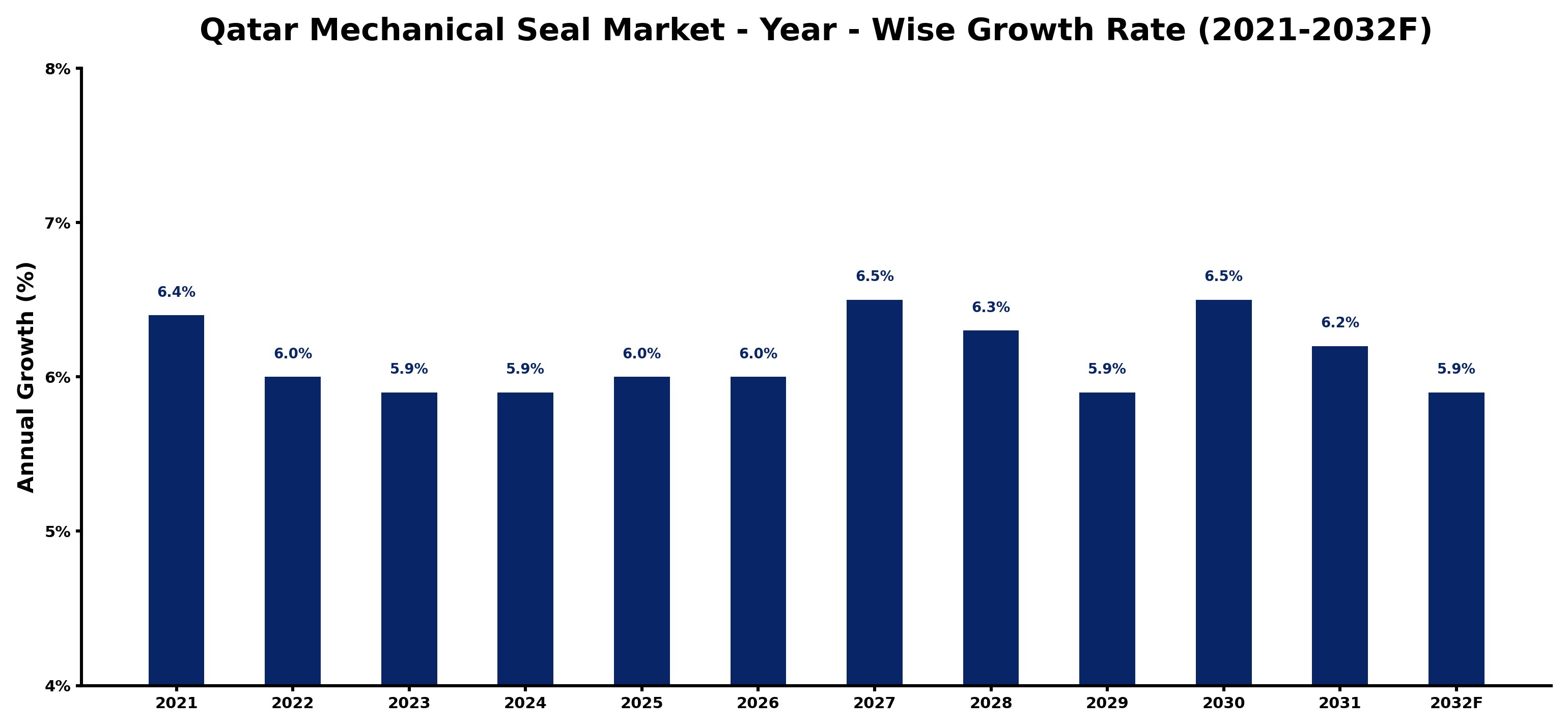
The table below presents the year‑wise growth rates along with the key drivers influencing the market
| Year | Growth Rate | Major Drivers |
| 2021 | 6.4% | Rapid growth in telecom and data center sectors |
| 2022 | 6.0% | Government infrastructure modernization initiatives |
| 2023 | 5.9% | Expansion of commercial construction activities |
| 2024 | 5.9% | Increasing industrial infrastructure investments |
| 2025 | 6.0% | Government infrastructure modernization initiatives |
| 2026 | 6.0% | Expansion of transportation and logistics networks |
| 2027 | 6.5% | Increasing adoption of advanced technologies |
| 2028 | 6.3% | Expansion of commercial construction activities |
| 2029 | 5.9% | Growing renewable energy integration projects |
| 2030 | 6.5% | Increasing industrial infrastructure investments |
| 2031 | 6.2% | Expansion of manufacturing activities |
| 2032 | 5.9% | Increasing adoption of advanced technologies |
Note - Market size estimations and growth projections presented in this report are based on 6Wresearch's advanced forecasting approach, validated with industry datasets as of June 2026.
Qatar Mechanical Seal Market Synopsis
In Qatar, mechanical seals play a pivotal role in ensuring the efficiency of critical equipment such as pumps and compressors, directly impacting industrial productivity. The diversification of the industrial base is driving unique requirements that propel the demand for advanced sealing solutions tailored to specific applications.
As industries expand and innovate, the importance of reliable sealing technologies becomes increasingly evident. Mechanical seals not only prevent leakage but also contribute to the sustainability initiatives within sectors focusing on energy efficiency and reduced environmental impact.
Qatar Mechanical Seal Market Key Takeaways
- Significant growth driven by expansion in oil & gas, petrochemicals, and water treatment sectors.
- Focus on enhancing operational reliability is leading to increased adoption of advanced sealing technologies.
- Challenges related to installation and maintenance require targeted training and expertise.
- Diverse industrial applications demand a wide variety of seal designs and materials, complicating supplier offerings.
- COVID-19 pandemic temporarily hindered growth, but recovery is underway as economic activities resume.
Evaluation of Restraints in Qatar Mechanical Seal Market
Despite the optimistic growth outlook, the Qatar Mechanical Seal market faces notable restraints. One primary challenge is the need for skilled personnel who can effectively install and maintain mechanical seals. Inadequate training can lead to improper installations, increasing the likelihood of leakage and operational inefficiencies. Furthermore, the diverse nature of Qatar's industrial sectors introduces variability in sealing requirements, which poses manufacturing and inventory management issues for suppliers. The competition posed by alternative sealing solutions also adds complexity to market dynamics.
Qatar Mechanical Seal Market Trends
The Qatar Mechanical Seal market is currently influenced by several emerging trends. Notably, there is a growing shift toward sustainable practices, prompting industries to adopt energy-efficient sealing technologies. Additionally, advancements in materials science have led to the development of seals that provide improved longevity and performance under extreme conditions. Smart technologies that monitor seal performance in real-time are also gaining traction, enhancing maintenance schedules and reducing unexpected downtime.
Qatar Mechanical Seal Market Opportunities
The mechanical seal market in Qatar presents considerable opportunities for growth and investment. With the country's industrial base diversifying, there is a growing need for innovative sealing solutions across various sectors. Investing in research and development to create high-performance seals tailored to the specific demands of the oil, gas, and water treatment industries could yield substantial returns. Additionally, as sustainability becomes a priority, opportunities exist for manufacturers to develop seals that align with environmental regulations and energy efficiency goals.
Government Initiatives in the Qatar Mechanical Seal Market
The Qatari government is actively promoting policies aimed at enhancing industrial efficiency and sustainability. Initiatives to bolster the oil and gas sector, alongside investments in water management and treatment facilities, create a favorable environment for the mechanical seal market. Government support for technological advancements and public spending on infrastructure projects serve to further stimulate demand for mechanical seals, ensuring a robust market growth trajectory.
Future Insights of the Qatar Mechanical Seal Market
Looking ahead to the period from 2026 to 2032, the Qatar Mechanical Seal market is expected to experience significant evolution. As the industrial landscape continues to diversify, the demand for specialized mechanical seals is likely to increase. The integration of smart technologies and innovations focused on energy efficiency will play a crucial role in shaping future developments. Additionally, the ongoing commitment to sustainability within key sectors is anticipated to drive further investments in advanced sealing solutions, positioning the market for sustained growth.
Qatar Mechanical Seal Market Latest Developments (May 2025 - June 2026)
Recent developments in the Qatar Mechanical Seal market indicate a robust recovery from the impacts of the COVID-19 pandemic. Industries are ramping up investments in maintenance and modernization of equipment, reflecting a renewed focus on operational efficiency. There is also a noticeable increase in collaborations between companies and research institutions to innovate sealing technologies that are both cost-effective and sustainable.
Qatar Mechanical Seal Market - Key Attractiveness of the Report
- 10 Years of Market Numbers
- Historical Data Starting from 2022 to 2025
- Base Year: 2025
- Forecast Data until 2032
- Key Performance Indicators Impacting the Market
- Major Upcoming Developments and Projects
Key Highlights of the Report:
- Qatar Mechanical Seal Market Outlook
- Market Size of Qatar Mechanical Seal Market, 2025
- Forecast of Qatar Mechanical Seal Market, 2032
- Historical Data and Forecast of Qatar Mechanical Seal Revenues & Volume for the Period 2022-2032F
- Qatar Mechanical Seal Market Trend Evolution
- Qatar Mechanical Seal Market Drivers and Challenges
- Qatar Mechanical Seal Price Trends
- Qatar Mechanical Seal Porter's Five Forces
- Qatar Mechanical Seal Industry Life Cycle
- Historical Data and Forecast of Qatar Mechanical Seal Market Revenues & Volume By Type for the Period 2022-2032F
- Historical Data and Forecast of Qatar Mechanical Seal Market Revenues & Volume By Cartridge Seals for the Period 2022-2032F
- Historical Data and Forecast of Qatar Mechanical Seal Market Revenues & Volume By Balanced and Unbalanced Seals for the Period 2022-2032F
- Historical Data and Forecast of Qatar Mechanical Seal Market Revenues & Volume By Pusher and Non-Pusher for the Period 2022-2032F
- Historical Data and Forecast of Qatar Mechanical Seal Market Revenues & Volume By Conventional Seals for the Period 2022-2032F
- Historical Data and Forecast of Qatar Mechanical Seal Market Revenues & Volume By Others for the Period 2022-2032F
- Historical Data and Forecast of Qatar Mechanical Seal Market Revenues & Volume By Industry for the Period 2022-2032F
- Historical Data and Forecast of Qatar Mechanical Seal Market Revenues & Volume By Metal & Mining for the Period 2022-2032F
- Historical Data and Forecast of Qatar Mechanical Seal Market Revenues & Volume By Food& Beverage for the Period 2022-2032F
- Historical Data and Forecast of Qatar Mechanical Seal Market Revenues & Volume By Oil & Gas for the Period 2022-2032F
- Historical Data and Forecast of Qatar Mechanical Seal Market Revenues & Volume By Energy & Power for the Period 2022-2032F
- Historical Data and Forecast of Qatar Mechanical Seal Market Revenues & Volume By Aerospace for the Period 2022-2032F
- Historical Data and Forecast of Qatar Mechanical Seal Market Revenues & Volume By Marine for the Period 2022-2032F
- Historical Data and Forecast of Qatar Mechanical Seal Market Revenues & Volume By Construction & Manufacturer for the Period 2022-2032F
- Historical Data and Forecast of Qatar Mechanical Seal Market Revenues & Volume By Others for the Period 2022-2032F
- Qatar Mechanical Seal Import Export Trade Statistics
- Market Opportunity Assessment By Type
- Market Opportunity Assessment By Industry
- Qatar Mechanical Seal Top Companies Market Share
- Qatar Mechanical Seal Competitive Benchmarking By Technical and Operational Parameters
- Qatar Mechanical Seal Company Profiles
- Qatar Mechanical Seal Key Strategic Recommendations






































