Qatar Medical Consumables Market Size Growth Rate
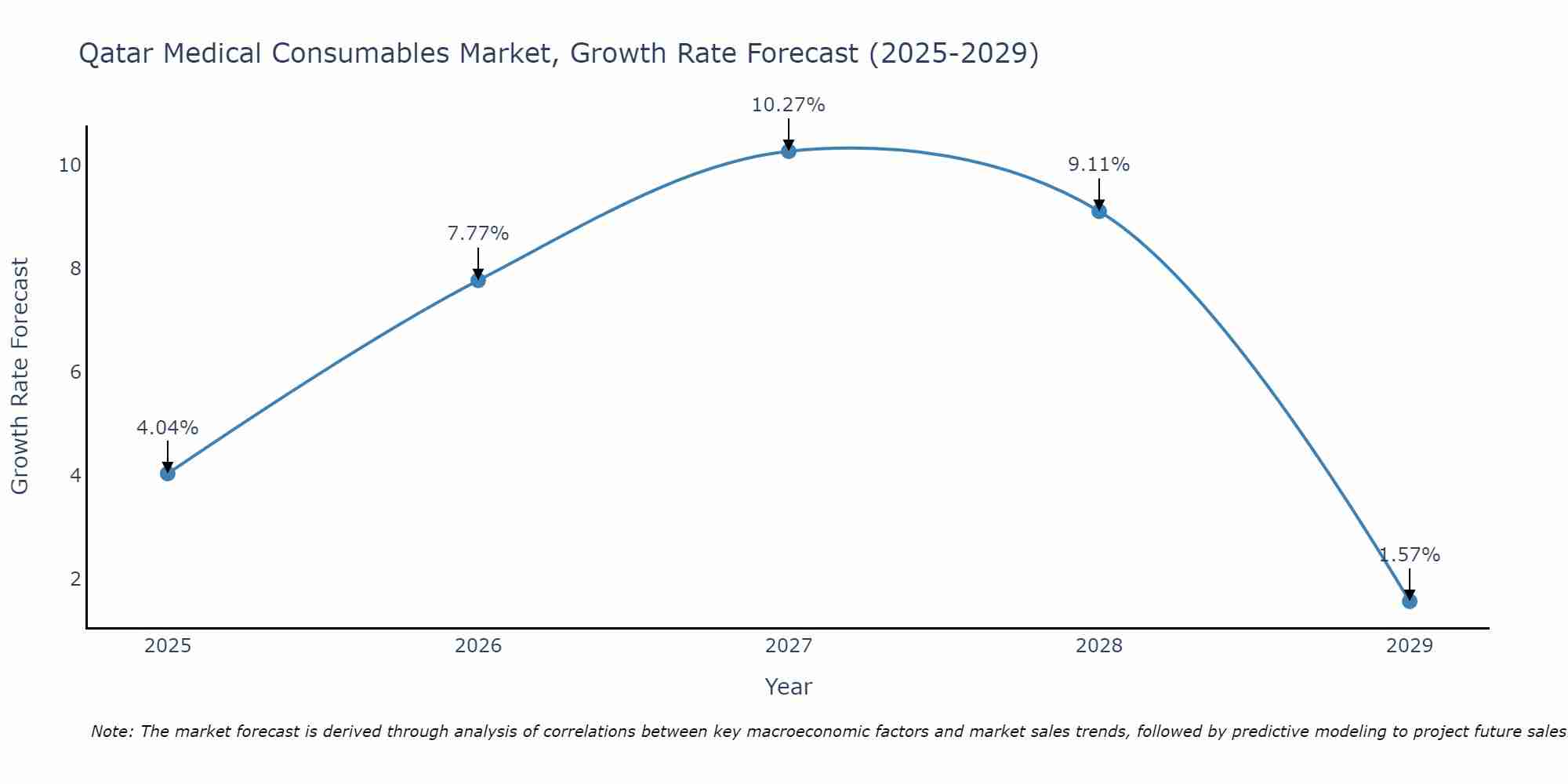
The Qatar Medical Consumables Market is projected to witness mixed growth rate patterns during 2025 to 2029. Starting at 4.04% in 2025, the market peaks at 10.27% in 2027, and settles at 1.57% by 2029.
Qatar Medical Consumables Market Synopsis
Qatar Medical Consumables Market IS PROJECTED TO GROW IN THE FUTURE. Qatar is a peninsular Arab country situated in Western Asia, occupying the small Qatar Peninsula on the northeastern coast of the Arabian Peninsula. It is one of the fastest growing countries in terms of population and economy due to its growth-oriented government policies and high oil prices. It has been witnessing an increasing demand for medical consumables such as needles, syringes, catheters, cotton swabs, gauze bandages, gloves among others with an expanding healthcare sector. High prevalence rate of chronic diseases coupled with rising expenditure on healthcare infrastructure development are anticipated to drive growth in medical consumables market over the forecast period 2025-2031.
Drivers of The Market
The prevalence rate of various chronic diseases such as diabetes mellitus (DM) and cardiovascular disorders (CVDs) have been increasing significantly across Qatar owing to changing lifestyle habits like physical inactivity & unhealthy diet along with genetic factors. This rapid rise has further increased focus on preventive measures which include timely diagnosis through advanced diagnostic techniques that involves use of medical consumables for tests or procedures leading to higher consumption rates across hospitals & clinics. In order to improve health outcomes within Qatar population by providing quality care services at affordable costs throughout different regions and communities thereby raising overall standards; government is continuously making efforts towards modernizing existing healthcare systems while simultaneously introducing new technologies including telemedicine & EMR through its National Health Strategy 2018-2022 plan. These initiatives will eventually lead to enhanced utilization levels for medical consumables due their widespread usage within hospitals & clinics leading to market expansion over forthcoming years.
Challenges of The Market
Despite stringent regulations from authorities regarding certification & approval mechanism before launch into market; availability counterfeit products especially those related directly with patient safety remains a major concern hampering industry growth prospects over 2025-2031 time frame. Under these circumstances, manufacturers must ensure proper documentation process while ensuring supply chain transparency so as minimize instances associated with fake product sales.
Covid-19 Impact of the Market
The COVID-19 pandemic had a profound impact on the Qatar medical consumables market. As the country faced an unprecedented healthcare crisis, the demand for medical consumables surged to combat the spread of the virus. Items such as personal protective equipment (PPE), masks, gloves, and sanitizers witnessed a tremendous spike in demand, leading to supply shortages and price hikes. The government and healthcare authorities took measures to ramp up production and imports to meet the soaring requirements. Additionally, the pandemic spurred investments in local manufacturing capabilities to enhance the country`s self-sufficiency in essential medical consumables.
Key Highlights of the Report:
- Qatar Medical Consumables Market Outlook
- Market Size of Qatar Medical Consumables Market, 2024
- Forecast of Qatar Medical Consumables Market, 2031
- Historical Data and Forecast of Qatar Medical Consumables Revenues & Volume for the Period 2021-2031
- Qatar Medical Consumables Market Trend Evolution
- Qatar Medical Consumables Market Drivers and Challenges
- Qatar Medical Consumables Price Trends
- Qatar Medical Consumables Porter's Five Forces
- Qatar Medical Consumables Industry Life Cycle
- Historical Data and Forecast of Qatar Medical Consumables Market Revenues & Volume By Type for the Period 2021-2031
- Historical Data and Forecast of Qatar Medical Consumables Market Revenues & Volume By Blood Bags for the Period 2021-2031
- Historical Data and Forecast of Qatar Medical Consumables Market Revenues & Volume By IV Solutions for the Period 2021-2031
- Historical Data and Forecast of Qatar Medical Consumables Market Revenues & Volume By Syringes for the Period 2021-2031
- Historical Data and Forecast of Qatar Medical Consumables Market Revenues & Volume By IV Catheters for the Period 2021-2031
- Historical Data and Forecast of Qatar Medical Consumables Market Revenues & Volume By Urine Catheters for the Period 2021-2031
- Historical Data and Forecast of Qatar Medical Consumables Market Revenues & Volume By Urine Bags for the Period 2021-2031
- Historical Data and Forecast of Qatar Medical Consumables Market Revenues & Volume By Wound Care for the Period 2021-2031
- Historical Data and Forecast of Qatar Medical Consumables Market Revenues & Volume By Applications for the Period 2021-2031
- Historical Data and Forecast of Qatar Medical Consumables Market Revenues & Volume By Hospitals for the Period 2021-2031
- Historical Data and Forecast of Qatar Medical Consumables Market Revenues & Volume By Clinics for the Period 2021-2031
- Qatar Medical Consumables Import Export Trade Statistics
- Market Opportunity Assessment By Type
- Market Opportunity Assessment By Applications
- Qatar Medical Consumables Top Companies Market Share
- Qatar Medical Consumables Competitive Benchmarking By Technical and Operational Parameters
- Qatar Medical Consumables Company Profiles
- Qatar Medical Consumables Key Strategic Recommendations






































