Qatar Medium Density Fiberboard Market Size, Share & Growth Rate
The Qatar Medium Density Fiberboard Market was estimated at USD 164 Million in 2025 and is projected to reach USD 231 Million by 2032, growing at a CAGR of 5.0% from 2026 to 2032. This growth is primarily fueled by Qatar's ongoing construction boom, which continues to drive demand for MDF in furniture and interior applications. Furthermore, the national push for economic diversification and increased manufacturing activity underpins this positive trajectory.
Qatar Medium Density Fiberboard Market Year-wise Growth Rate and Key Drivers
This graph highlights how the Qatar Medium Density Fiberboard Market has steadily grown over the years, supported by major growth factors.
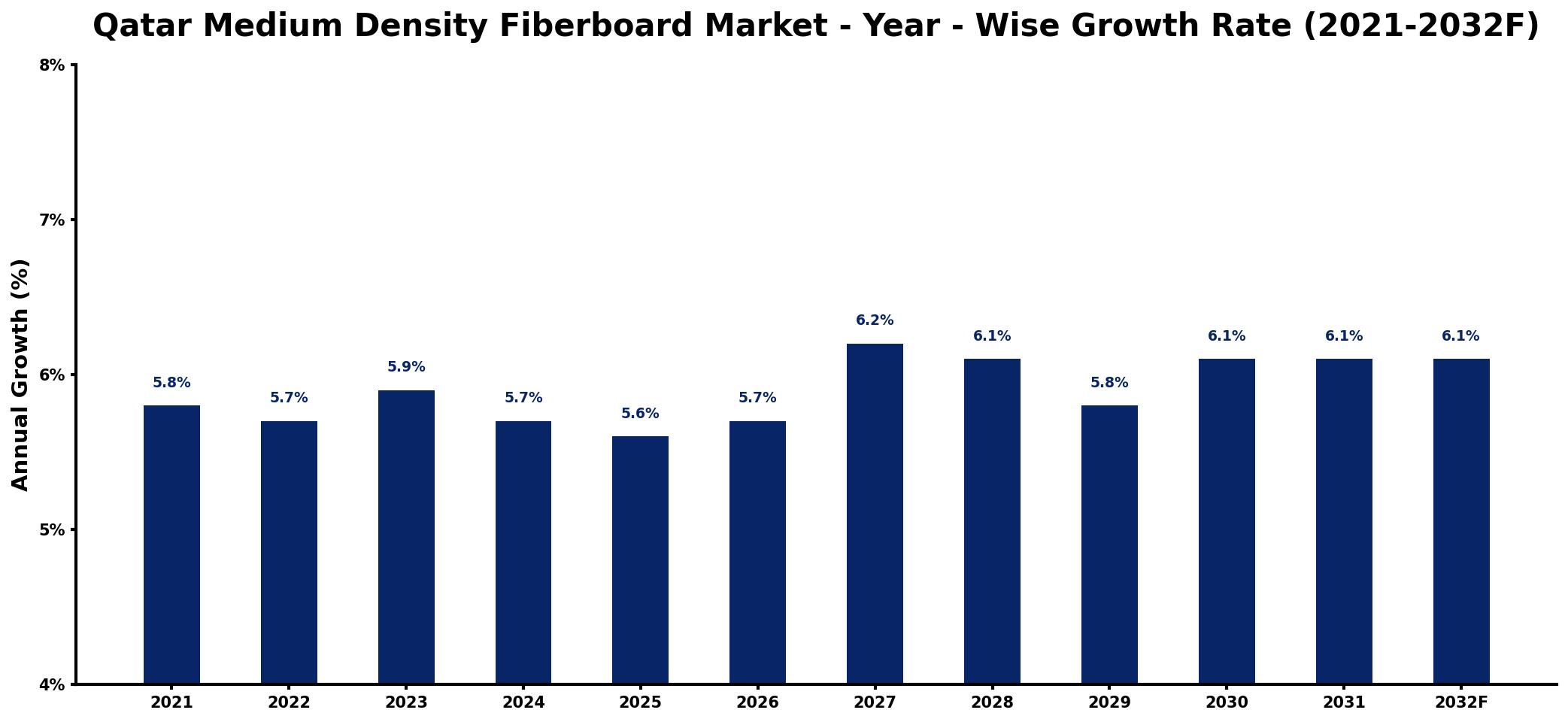
The table below presents the year‑wise growth rates along with the key drivers influencing the market
| Year | Growth Rate | Major Drivers |
| 2021 | 5.8% | Rising construction sector investments |
| 2022 | 5.7% | Increased residential housing demand |
| 2023 | 5.9% | Growing eco-friendly building materials |
| 2024 | 5.7% | Expansion of furniture manufacturing industry |
| 2025 | 5.6% | Surge in interior design projects |
| 2026 | 5.7% | Demand for innovative architectural solutions |
| 2027 | 6.2% | Strengthened export opportunities abroad |
| 2028 | 6.1% | Increased urbanization and population growth |
| 2029 | 5.8% | Enhanced government infrastructure initiatives |
| 2030 | 6.1% | Growing preference for sustainable materials |
| 2031 | 6.1% | Rising awareness of design aesthetics |
| 2032 | 6.1% | Increased investments in manufacturing technology |
Note: Market size estimations and growth projections presented in this report are based on 6Wresearch's proprietary forecasting methodology, utilizing the latest available industry data, government publications, and primary research inputs.
Qatar Medium Density Fiberboard Market Synopsis
The medium density fiberboard market in Qatar is currently experiencing a surge in demand, bolstered by the vibrant construction sector and a growing appetite for innovative furniture solutions. As the market expands, it is also evolving, with shifts towards more sustainable production practices.
Looking ahead, the market is set to capitalize on emerging opportunities linked to economic diversification and infrastructural developments. The increasing focus on eco-friendly materials will also play a pivotal role in shaping the future of the MDF landscape in Qatar.
Qatar Medium Density Fiberboard Market Key Takeaways
- The market is projected to grow at a CAGR of 5.0% from 2026 to 2032.
- Demand is driven primarily by the construction sector and increased manufacturing activities.
- Sustainable practices are becoming increasingly important in MDF production.
- Qatar's economic diversification efforts are creating new applications for MDF.
- Competitive pressures exist from alternative materials, necessitating innovation in the MDF sector.
Evaluation of Restraints in Qatar Medium Density Fiberboard Market
Despite its promising outlook, the Qatar Medium Density Fiberboard Market faces notable constraints. A significant reliance on imported raw materials has led to price volatility and potential supply chain disruptions, which can impact the overall cost and availability of MDF products. Furthermore, there are growing environmental concerns surrounding the use of traditional MDF, pushing both manufacturers and consumers towards seeking more sustainable alternatives. The increasing competition from other materials such as plywood and particleboard also presents a challenge, compelling MDF producers to continuously innovate to maintain market share.
Qatar Medium Density Fiberboard Market Trends
Current trends in the Qatar Medium Density Fiberboard Market indicate a clear shift toward sustainability, with manufacturers increasingly looking to eco-friendly practices and materials. The demand for multifunctional and aesthetically pleasing MDF products in residential and commercial applications is also on the rise. Additionally, advancements in technology related to MDF production are enhancing quality, reducing costs, and expanding the range of applications available in the market.
Qatar Medium Density Fiberboard Market Opportunities
The market for medium density fiberboard in Qatar presents various growth and investment opportunities. As the construction sector continues to expand, there will be substantial demand for MDF in both furniture and industrial packaging applications. Furthermore, tapping into the rising consumer preference for sustainable and eco-friendly products can create niche markets for innovative MDF solutions. Collaboration with local manufacturers to develop new product lines can also facilitate market entry for international companies.
Government Initiatives in the Qatar Medium Density Fiberboard Market
The Qatari government is actively promoting initiatives to bolster the construction sector, which directly supports the medium density fiberboard market. Public spending on infrastructure and housing projects continues to rise, driven by Qatar's National Vision 2030, which aims to diversify the economy and foster sustainable development. Policies encouraging eco-friendly practices in manufacturing are further incentivizing the production of sustainable MDF products.
Future Insights of the Qatar Medium Density Fiberboard Market
From 2026 to 2032, the Qatar Medium Density Fiberboard Market is poised for significant growth, reflecting the ongoing developments in the construction and real estate sectors. The emphasis on sustainability will continue to play a crucial role, encouraging manufacturers to innovate and adapt to new environmental regulations. As demand evolves, opportunities for customization and improved product features are expected to drive market dynamics, positioning the MDF sector for a robust future in Qatar.
Qatar Medium Density Fiberboard Market Latest Developments (2025 - 2026)
Recent developments in the Qatar Medium Density Fiberboard Market suggest a strong focus on sustainable practices and product innovation. Industry stakeholders are exploring collaborative approaches to improve the supply chain and enhance the quality of MDF products. Moreover, the governments commitment to large-scale construction projects is fostering an environment conducive to market growth, leading to increased investment in manufacturing capabilities.
Qatar Medium Density Fiberboard Market - Key Attractiveness of the Report
- 10 Years of Market Numbers
- Historical Data Starting from 2022 to 2025
- Base Year: 2025
- Forecast Data until 2032
- Key Performance Indicators Impacting the Market
- Major Upcoming Developments and Projects
Key Highlights of the Report:
- Qatar Medium Density Fiberboard Market Outlook
- Market Size of Qatar Medium Density Fiberboard Market, 2025
- Forecast of Qatar Medium Density Fiberboard Market, 2032
- Historical Data and Forecast of Qatar Medium Density Fiberboard Revenues & Volume for the Period 2022-2032F
- Qatar Medium Density Fiberboard Market Trend Evolution
- Qatar Medium Density Fiberboard Market Drivers and Challenges
- Qatar Medium Density Fiberboard Price Trends
- Qatar Medium Density Fiberboard Porter's Five Forces
- Qatar Medium Density Fiberboard Industry Life Cycle
- Historical Data and Forecast of Qatar Medium Density Fiberboard Market Revenues & Volume By Type for the Period 2022-2032F
- Historical Data and Forecast of Qatar Medium Density Fiberboard Market Revenues & Volume By Standard for the Period 2022-2032F
- Historical Data and Forecast of Qatar Medium Density Fiberboard Market Revenues & Volume By Moisture Resistant for the Period 2022-2032F
- Historical Data and Forecast of Qatar Medium Density Fiberboard Market Revenues & Volume By Fire-Rated for the Period 2022-2032F
- Historical Data and Forecast of Qatar Medium Density Fiberboard Market Revenues & Volume By Application for the Period 2022-2032F
- Historical Data and Forecast of Qatar Medium Density Fiberboard Market Revenues & Volume By Furniture for the Period 2022-2032F
- Historical Data and Forecast of Qatar Medium Density Fiberboard Market Revenues & Volume By Construction & Flooring for the Period 2022-2032F
- Historical Data and Forecast of Qatar Medium Density Fiberboard Market Revenues & Volume By Interior Designing for the Period 2022-2032F
- Historical Data and Forecast of Qatar Medium Density Fiberboard Market Revenues & Volume By Packaging Systems for the Period 2022-2032F
- Historical Data and Forecast of Qatar Medium Density Fiberboard Market Revenues & Volume By Others for the Period 2022-2032F
- Qatar Medium Density Fiberboard Import Export Trade Statistics
- Market Opportunity Assessment By Type
- Market Opportunity Assessment By Application
- Qatar Medium Density Fiberboard Top Companies Market Share
- Qatar Medium Density Fiberboard Competitive Benchmarking By Technical and Operational Parameters
- Qatar Medium Density Fiberboard Company Profiles
- Qatar Medium Density Fiberboard Key Strategic Recommendations






































