Qatar Men Formal Shoe Market (2026-2032) | Value, Trends, Revenue, Growth, Forecast, Companies, Outlook, Analysis, Share, Industry & Size
Market Forecast By Shoe Type (Oxfords, Derby, Loafers, Boots), By Leather Type (Patent Leather, Pebble & Full Grain, Top Grain, Suede Leather) And Competitive Landscape
| Product Code: ETC039562 | Publication Date: Jul 2023 | Updated Date: Jun 2026 | Product Type: Report | |
| Publisher: 6Wresearch | Author: Ravi Bhandari | No. of Pages: 70 | No. of Figures: 35 | No. of Tables: 5 |
Qatar Men Formal Shoe Market Summary
The qatar men formal shoe market was estimated at USD 447 Million in 2025 and is projected to reach USD 584 Million by 2032, growing at a CAGR of 5.0% from 2026 to 2032.
Qatar Men Formal Shoe Market Year-wise Growth Rate and Key Drivers
This graph highlights how the Qatar Men Formal Shoe Market has steadily grown over the past five years, supported by major growth factors.
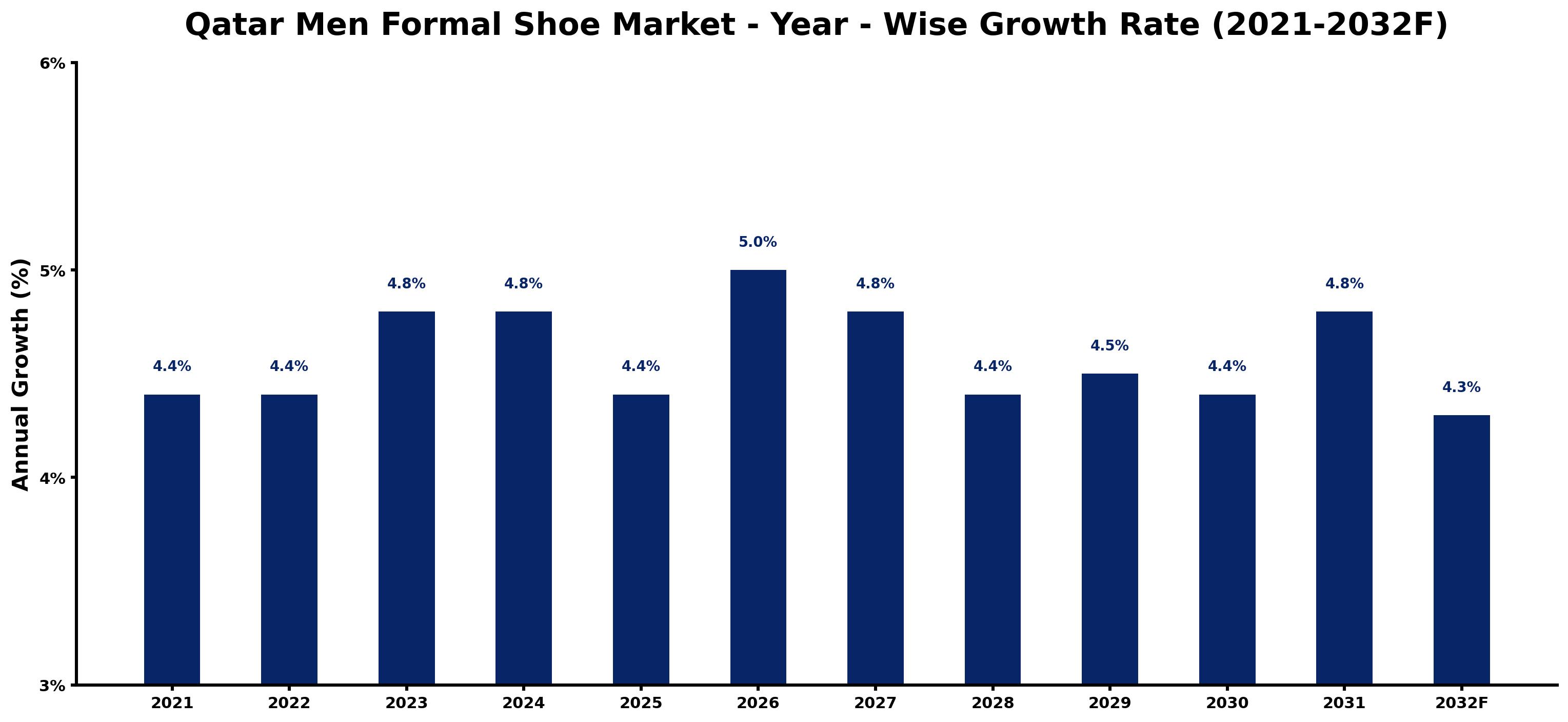
The table below presents the year wise growth rates along with the key drivers influencing the market
| Year | Growth Rate | Major Drivers |
| 2021 | 4.4% | Post-lockdown retail revitalization sets the stage for renewed consumer confidence. |
| 2022 | 4.4% | Luxury spending among Qatar's affluent population highlights cultural appreciation for formal wear. |
| 2023 | 4.8% | E-commerce platforms expand, offering diverse choices for discerning male consumers. |
| 2024 | 4.8% | The FIFA World Cup catalyzes increased global brand visibility within Qatar's market. |
| 2025 | 4.4% | Urban development projects in Doha boost demand for stylish, professional footwear options. |
| 2026 | 5.0% | Rising expatriate population influences contemporary fashion trends among local men. |
| 2027 | 4.8% | Corporate culture shift towards formal attire encourages investment in high-quality shoes. |
| 2028 | 4.4% | Sustainable materials gain traction, appealing to environmentally conscious consumers in Qatar. |
| 2029 | 4.5% | International brands establish local presence, enhancing market competition and variety. |
| 2030 | 4.4% | Increased focus on personal branding drives men to invest in premium footwear. |
| 2031 | 4.8% | Social media marketing influences purchasing decisions, reshaping traditional shopping behavior. |
| 2032 | 4.3% | Fashion collaborations between local designers and global brands elevate market prestige. |
Note - Market size estimations and growth projections presented in this report are based on 6Wresearch's advanced forecasting approach, validated with industry datasets as of June 2026.
Qatar Men Formal Shoe Market Synopsis
The Qatar Men Formal Shoe Market is projected to reach 5.0% and witness significant growth during the forecast period (2026-2032). This sector encompasses a wide range of formal footwear styles, including oxfords, derbies, loafers, and dress boots, essential for formal occasions, business gatherings, and office environments. The market's evolution is influenced by distinct socioeconomic factors and the cultural significance of formal dressing in Qatar.
Qatar Men Formal Shoe Market Growth Drivers
Several key drivers are propelling the growth of the Qatar Men Formal Shoe Market. Primarily, the robust economic development and rising per capita income in Qatar are influencing consumer behavior towards premium footwear. The corporate landscape in Qatar, characterized by an influx of multinational companies, fosters a professional culture that necessitates formal shoe attire.
- The increasing number of business ventures and corporate entities in Qatar contributes to a heightened demand for formal footwear that aligns with professional standards.
- Changing fashion trends favoring sophisticated and stylish designs encourage men to invest in high-quality formal shoes that complement their outfits.
- Social events, including weddings and formal gatherings, amplify the demand for formal shoes, as they serve an essential role in men's fashion during such occasions.
- As consumers become more discerning about product quality and craftsmanship, the market sees a surge in demand for well-constructed shoes that provide both comfort and style.
- The growing availability of online shopping platforms allows consumers easier access to a broader spectrum of formal shoe options, enhancing market growth.
Qatar Men Formal Shoe Market Challenges and Restraints
Despite the positive growth trajectory, the Qatar Men Formal Shoe Market faces certain challenges that could impede its expansion. Fluctuations in demand due to seasonality present significant hurdles, particularly as consumers tend to purchase formal shoes during specific peak periods like holidays and wedding seasons.
- The competitive landscape, comprising both local and international brands, necessitates a strong differentiation strategy to capture consumer interest.
- Price sensitivity among consumers may restrict sales of high-end formal shoe products, affecting overall market revenues.
- The aftermath of the Covid-19 pandemic continues to cast a shadow on consumer spending habits, with many still cautious about discretionary purchases.
- Supply chain disruptions can affect product availability, particularly for premium brands reliant on international sourcing.
- The fast-paced changes in fashion trends pose a challenge for manufacturers who must continuously innovate to align with consumer preferences.
Qatar Men Formal Shoe Market Impact of Covid-19
The Covid-19 pandemic has had a pronounced effect on the retail and fashion sectors, including the Qatar Men Formal Shoe Market. Lockdowns and travel restrictions led to reduced foot traffic in physical retail stores, significantly impacting sales of formal footwear.
- Consumer priorities shifted during the pandemic, with spending on non-essential items, like formal shoes, declining in favor of essential goods.
- The closure of brick-and-mortar establishments during lockdown periods forced manufacturers to pivot towards e-commerce, altering traditional sales channels.
- Following the easing of restrictions, the market witnessed a gradual recovery, highlighting the resilience of consumer interest in formal footwear.
- The pandemic has reinforced the importance of quality and comfort in footwear, as consumers seek products that meet both aesthetic and practical needs.
- Long-term effects include a lasting shift in purchasing behavior, with many customers favoring online shopping platforms for convenience.
Qatar Men Formal Shoe Market Government Investment and Initiatives
The Qatari government has initiated several programs and investments aimed at bolstering the economy and, indirectly, the Qatar Men Formal Shoe Market. Initiatives designed to enhance the business environment, such as the Qatar National Vision 2030, encourage economic diversification and support sectors like retail.
- Public spending on infrastructure improvements contributes to increased consumer footfall in shopping districts, benefiting formal shoe retailers.
- Government policies focused on attracting foreign investments help to enhance the competitive landscape, potentially leading to increased product variety in the footwear market.
- Support for e-commerce development through regulatory measures aids formal shoe retailers in reaching a wider audience, facilitating market expansion.
- Training programs for local artisans in shoe manufacturing ensure quality production, preserving traditional craftsmanship while meeting modern demand.
- Incentives for startups in the fashion and retail sectors enhance innovation and encourage the launch of new formal shoe lines.
Qatar Men Formal Shoe Market Latest Developments (May 2025 - June 2026)
Recent developments in the Qatar Men Formal Shoe Market from May 2025 to June 2026 indicate a dynamic industry landscape. Companies are increasingly adopting sustainable practices in shoe production, reflecting a global shift towards eco-friendly products.
- Innovations in materials and manufacturing processes are becoming prominent, with brands integrating sustainable materials into their formal shoe collections.
- There has been a noticeable increase in collaboration between designers and local artisans to create unique, culturally inspired shoe designs that cater to local tastes.
- Digital marketing strategies have gained traction, enabling brands to engage with customers effectively through social media and online channels.
- The emphasis on comfort and functionality in formal shoe designs has led to a reimagining of traditional styles, enhancing their appeal among younger consumers.
- As the market continues to recover from the pandemic, participation in international trade fairs and exhibitions has resumed, allowing for greater networking opportunities and exposure to global trends.
Qatar Men Formal Shoe Market - Key Attractiveness of the Report
- 10 Years of Market Numbers
- Historical Data Starting from 2022 to 2025
- Base Year: 2025
- Forecast Data until 2032
- Key Performance Indicators Impacting the Market
- Major Upcoming Developments and Projects
Key Highlights of the Report:
- Qatar Men Formal Shoe Market Outlook
- Market Size of Qatar Men Formal Shoe Market, 2025
- Forecast of Qatar Men Formal Shoe Market, 2032
- Historical Data and Forecast of Qatar Men Formal Shoe Revenues & Volume for the Period 2022-2032F
- Qatar Men Formal Shoe Market Trend Evolution
- Qatar Men Formal Shoe Market Drivers and Challenges
- Qatar Men Formal Shoe Price Trends
- Qatar Men Formal Shoe Porter's Five Forces
- Qatar Men Formal Shoe Industry Life Cycle
- Historical Data and Forecast of Qatar Men Formal Shoe Market Revenues & Volume By Shoe Type for the Period 2022-2032F
- Historical Data and Forecast of Qatar Men Formal Shoe Market Revenues & Volume By Oxfords for the Period 2022-2032F
- Historical Data and Forecast of Qatar Men Formal Shoe Market Revenues & Volume By Derby for the Period 2022-2032F
- Historical Data and Forecast of Qatar Men Formal Shoe Market Revenues & Volume By Loafers for the Period 2022-2032F
- Historical Data and Forecast of Qatar Men Formal Shoe Market Revenues & Volume By Boots for the Period 2022-2032F
- Historical Data and Forecast of Qatar Men Formal Shoe Market Revenues & Volume By Leather Type for the Period 2022-2032F
- Historical Data and Forecast of Qatar Men Formal Shoe Market Revenues & Volume By Patent Leather for the Period 2022-2032F
- Historical Data and Forecast of Qatar Men Formal Shoe Market Revenues & Volume By Pebble & Full Grain for the Period 2022-2032F
- Historical Data and Forecast of Qatar Men Formal Shoe Market Revenues & Volume By Top Grain for the Period 2022-2032F
- Historical Data and Forecast of Qatar Men Formal Shoe Market Revenues & Volume By Suede Leather for the Period 2022-2032F
- Qatar Men Formal Shoe Import Export Trade Statistics
- Market Opportunity Assessment By Shoe Type
- Market Opportunity Assessment By Leather Type
- Qatar Men Formal Shoe Top Companies Market Share
- Qatar Men Formal Shoe Competitive Benchmarking By Technical and Operational Parameters
- Qatar Men Formal Shoe Company Profiles
- Qatar Men Formal Shoe Key Strategic Recommendations
Frequently Asked Questions About the Market Study (FAQs):
The market includes a variety of formal shoe styles, such as oxfords, derbies, loafers, and dress boots, tailored for business and formal occasions.
Economic growth, increased corporate activities, changing fashion trends, and special occasions contribute significantly to the demand for men's formal footwear.
The pandemic led to reduced consumer spending and significant shifts toward online retail channels, impacting sales dynamics in the formal shoe market.
The government is investing in economic diversification and has implemented policies to support the retail sector, encouraging growth in the men’s formal shoe market.
6Wresearch actively monitors the Qatar Men Formal Shoe Market and publishes its comprehensive annual report, highlighting emerging trends, growth drivers, revenue analysis, and forecast outlook. Our insights help businesses to make data-backed strategic decisions with ongoing market dynamics. Our analysts track relevent industries related to the Qatar Men Formal Shoe Market, allowing our clients with actionable intelligence and reliable forecasts tailored to emerging regional needs.
Yes, we provide customisation as per your requirements. To learn more, feel free to contact us on sales@6wresearch.com
1 Executive Summary |
2 Introduction |
2.1 Key Highlights of the Report |
2.2 Report Description |
2.3 Market Scope & Segmentation |
2.4 Research Methodology |
2.5 Assumptions |
3 Qatar Men Formal Shoe Market Overview |
3.1 Qatar Country Macro Economic Indicators |
3.2 Qatar Men Formal Shoe Market Revenues & Volume, 2022 & 2032F |
3.3 Qatar Men Formal Shoe Market - Industry Life Cycle |
3.4 Qatar Men Formal Shoe Market - Porter's Five Forces |
3.5 Qatar Men Formal Shoe Market Revenues & Volume Share, By Shoe Type, 2022 & 2032F |
3.6 Qatar Men Formal Shoe Market Revenues & Volume Share, By Leather Type, 2022 & 2032F |
4 Qatar Men Formal Shoe Market Dynamics |
4.1 Impact Analysis |
4.2 Market Drivers |
4.3 Market Restraints |
5 Qatar Men Formal Shoe Market Trends |
6 Qatar Men Formal Shoe Market, By Types |
6.1 Qatar Men Formal Shoe Market, By Shoe Type |
6.1.1 Overview and Analysis |
6.1.2 Qatar Men Formal Shoe Market Revenues & Volume, By Shoe Type, 2022-2032F |
6.1.3 Qatar Men Formal Shoe Market Revenues & Volume, By Oxfords, 2022-2032F |
6.1.4 Qatar Men Formal Shoe Market Revenues & Volume, By Derby, 2022-2032F |
6.1.5 Qatar Men Formal Shoe Market Revenues & Volume, By Loafers, 2022-2032F |
6.1.6 Qatar Men Formal Shoe Market Revenues & Volume, By Boots, 2022-2032F |
6.2 Qatar Men Formal Shoe Market, By Leather Type |
6.2.1 Overview and Analysis |
6.2.2 Qatar Men Formal Shoe Market Revenues & Volume, By Patent Leather, 2022-2032F |
6.2.3 Qatar Men Formal Shoe Market Revenues & Volume, By Pebble & Full Grain, 2022-2032F |
6.2.4 Qatar Men Formal Shoe Market Revenues & Volume, By Top Grain, 2022-2032F |
6.2.5 Qatar Men Formal Shoe Market Revenues & Volume, By Suede Leather, 2022-2032F |
7 Qatar Men Formal Shoe Market Import-Export Trade Statistics |
7.1 Qatar Men Formal Shoe Market Export to Major Countries |
7.2 Qatar Men Formal Shoe Market Imports from Major Countries |
8 Qatar Men Formal Shoe Market Key Performance Indicators |
9 Qatar Men Formal Shoe Market - Opportunity Assessment |
9.1 Qatar Men Formal Shoe Market Opportunity Assessment, By Shoe Type, 2022 & 2032F |
9.2 Qatar Men Formal Shoe Market Opportunity Assessment, By Leather Type, 2022 & 2032F |
10 Qatar Men Formal Shoe Market - Competitive Landscape |
10.1 Qatar Men Formal Shoe Market Revenue Share, By Companies, 2025 |
10.2 Qatar Men Formal Shoe Market Competitive Benchmarking, By Operating and Technical Parameters |
11 Company Profiles |
12 Recommendations |
13 Disclaimer |
Global Go To Market Strategy - 2030
Export potential enables firms to identify high-growth global markets with greater confidence by combining advanced trade intelligence with a structured quantitative methodology. The framework analyzes emerging demand trends and country-level import patterns while integrating macroeconomic and trade datasets such as GDP and population forecasts, bilateral import–export flows, tariff structures, elasticity differentials between developed and developing economies, geographic distance, and import demand projections. Using weighted trade values from 2020–2024 as the base period to project country-to-country export potential for 2030, these inputs are operationalized through calculated drivers such as gravity model parameters, tariff impact factors, and projected GDP per-capita growth. Through an analysis of hidden potentials, demand hotspots, and market conditions that are most favorable to success, this method enables firms to focus on target countries, maximize returns, and global expansion with data, backed by accuracy.
By factoring in the projected importer demand gap that is currently unmet and could be potential opportunity, it identifies the potential for the Exporter (Country) among 190 countries, against the general trade analysis, which identifies the biggest importer or exporter.
To discover high-growth global markets and optimize your business strategy:
Click Here
Request Primary Research & Report
- Single User License$ 1,995
- Department License$ 2,400
- Site License$ 3,120
- Global License$ 3,795

Leadership Perspectives from Industry Events
Search
6Wresearch in the News
 Forbes
Citing 6Wresearch analytics to map global infrastructure and pharmaceutical industry trajectories.
 Bloomberg Law
Direct syndication of 6Wresearch's macro data points, capturing complex supply chain shifts.
 Reuters
Tracking industrial manufacturing adjustments and electronic security ecosystem scaling.
 Mint
Mint
Utilizing deep-tech sector market sizing to analyze global automation and robotics.
 The Economic Times
Anchoring features on industrial IoT growth metrics and connected smart-grid devices.
 Business Standard
Featuring strategic evaluations of Advanced Driver Assistance Systems (ADAS) and AI road safety.
 The Hindu
Spotlighting core commercial metrics ranging from unmanned aerial vehicles (UAVs) to consumer durables.
 Financial Express
Anchoring quarterly reviews on cross-border real estate tech and structural hardware manufacturing.
 Yahoo Finance
Syndicating the tracker's $30.1 billion untapped-market findings, spotlighting Japan, the US and China as India's top new-potential importers.
 India Today
Carrying the release on smartphones leading India's export potential to $94 billion by 2031, per 6WExportGTM data.
 Dailyhunt
Distributing the tracker findings to its regional readership, framing India's export diversification into Japan and Mexico.
 PR Newswire Original release
Publishing the full India Export Attractiveness Tracker 2026, detailing new trade corridors across iron ore, LCVs and pharmaceuticals.
 The Industrial
Highlighting the tracker's read on India's semiconductor ambitions and long-term chip-assembly export potential.
 PTI News
Reporting on the $66.81 billion pharmaceuticals export opportunity flagged in the tracker, amid looming US generic-drug tariffs.
 Tribune India
Covering the tracker's tariff-versus-regulation analysis across India's mature export markets in the US, China and UAE.
 ANI News
Amplifying the report's findings on polished diamonds, refined petroleum and medicines as India's core export engines.
 International Business Magazine
Covering the report's insight into how AEB, blind spot detection, and driver monitoring are reshaping India's ADAS market.
 Focus Gaming News
Highlighting the research forecast for Egypt's gambling market, projecting steady growth through 2032.
Thought Leadership and Analyst Meet





Our Clients








Latest Reports
- Global Whey Protein Market (2025-2031)
- Bahrain Vehicle-Supported Bicycle Drive Chains Market (2026-2032)
- Azerbaijan Vehicle-Supported Bicycle Drive Chains Market (2026-2032)
- Australia Vehicle-Supported Bicycle Drive Chains Market (2026-2032)
- Argentina Vehicle-Supported Bicycle Drive Chains Market (2026-2032)
- Algeria Vehicle-Supported Bicycle Drive Chains Market (2026-2032)
- Zimbabwe Vehicle-Grade Aluminum Materials Market (2026-2032)
- Zambia Vehicle-Grade Aluminum Materials Market (2026-2032)
- Yemen Vehicle-Grade Aluminum Materials Market (2026-2032)
- Vanuatu Vehicle-Grade Aluminum Materials Market (2026-2032)
Industry Events and Analyst Meet

EV India Expo 2026

HIMTEX 2026

India Refining Summit 2026

India EV Show 2026

EV tech India Expo 2026
Whitepaper
- Middle East & Africa Commercial Security Market Click here to view more.
- Middle East & Africa Fire Safety Systems & Equipment Market Click here to view more.
- GCC Drone Market Click here to view more.
- Middle East Lighting Fixture Market Click here to view more.
- GCC Physical & Perimeter Security Market Click here to view more.


