Qatar Microbial Products Market Size, Share & Growth Rate
The Qatar Microbial Products Market was estimated at USD 1079 Million in 2025 and is projected to reach USD 1540 Million by 2032, growing at a CAGR of 5.2% from 2026 to 2032. This upward trajectory is primarily fueled by the increasing demand from the pharmaceutical and healthcare sectors, where innovative microbial solutions are becoming essential for research and drug development. Additionally, the rising awareness of eco-friendly practices across industries enhances the appeal of microbial products, positioning them as integral components in sustainable development strategies.
Qatar Microbial Products Market Year-wise Growth Rate and Key Drivers
This graph highlights how the Qatar Microbial Products Market has steadily grown over the years, supported by major growth factors.
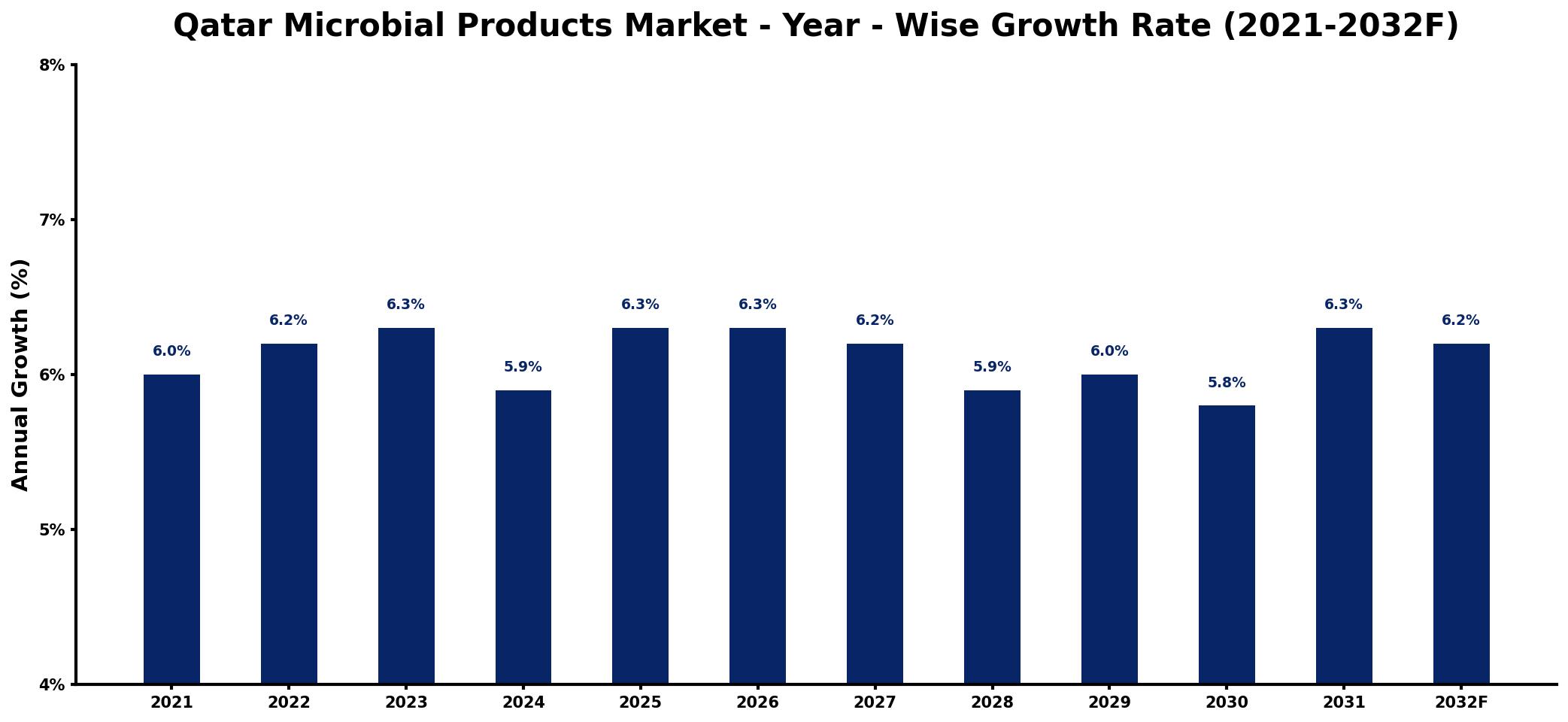
The table below presents the year‑wise growth rates along with the key drivers influencing the market
| Year | Growth Rate | Major Drivers |
| 2021 | 6.0% | Increased healthcare sector investments |
| 2022 | 6.2% | Rising agricultural biotechnology demand |
| 2023 | 6.3% | Growing environmental sustainability focus |
| 2024 | 5.9% | Emerging biomanufacturing technologies adoption |
| 2025 | 6.3% | Expanding biopharmaceutical research initiatives |
| 2026 | 6.3% | Heightened interest in biofuels development |
| 2027 | 6.2% | Strengthened food safety regulations implementation |
| 2028 | 5.9% | Boosted waste management solutions demand |
| 2029 | 6.0% | Enhancing soil health awareness campaigns |
| 2030 | 5.8% | Increased organic farming practices prevalence |
| 2031 | 6.3% | Growing global climate change initiatives |
| 2032 | 6.2% | Rising interest in circular economy |
Note: Market size estimations and growth projections presented in this report are based on 6Wresearch's proprietary forecasting methodology, utilizing the latest available industry data, government publications, and primary research inputs.
Qatar Microbial Products Market Synopsis
In recent years, the Qatar Microbial Products Market has gained significant traction, reflecting a burgeoning interest in sustainable solutions. With applications ranging from agriculture to pharmaceuticals, these products, including enzymes, biofertilizers, and biopesticides, are being increasingly recognized for their role in promoting eco-conscious practices.
The demand for microbial products is closely tied to Qatar's commitment to advancing its biotechnology sector. This emphasis on innovation, coupled with governmental support for research and development, provides a strong foundation for the market's future growth. Moreover, societal shifts towards green alternatives are aligning market dynamics favorably for microbial solutions.
Qatar Microbial Products Market Key Takeaways
- The market is projected to grow substantially, driven by advancements in biotechnology and increased demand from healthcare.
- Key applications include biofertilizers and biopesticides, which are crucial in promoting sustainable agriculture.
- Increased public awareness of the benefits of microbial solutions is contributing to market growth.
- Challenges related to safety standards and public perception remain but can be addressed through innovation and transparency.
- Qatar's strategic investments in research and development are fostering an enabling environment for market expansion.
Evaluation of Restraints in Qatar Microbial Products Market
Despite its promising trajectory, the Qatar Microbial Products Market faces several constraints that may hinder its full potential. Rigorous quality control and safety standards are paramount, particularly in the pharmaceutical domain where product efficacy and public trust are critical. Furthermore, market participants must navigate concerns over microbial resistance, which can adversely affect consumer confidence. To effectively tackle these barriers, a focus on robust research and adherence to international regulations will be essential in ensuring that safety concerns are met with transparent practices.
Qatar Microbial Products Market Trends
The market is currently witnessing several noteworthy trends that are shaping demand and technology. An increasing shift towards sustainable agricultural practices has heightened interest in biofertilizers and biopesticides, as these products offer environmentally friendly alternatives to traditional chemicals. Additionally, innovations in microbial technology, particularly in enzyme production, are paving the way for enhanced efficiency in various applications. Consumer preferences are also evolving, with a growing inclination towards products that emphasize sustainability and minimal environmental impact.
Qatar Microbial Products Market Opportunities
Significant growth and investment opportunities are emerging within the Qatar Microbial Products Market, particularly in sectors focused on biotechnology and healthcare. The increasing need for innovative treatments, coupled with Qatars strategic push towards becoming a regional biotech hub, presents ripe possibilities for companies offering microbial solutions. The agriculture sector also holds immense potential, as more farmers adopt sustainable practices. Moreover, collaborative efforts between research institutions and private enterprises can drive innovations, further unlocking market value.
Government Initiatives in the Qatar Microbial Products Market
The Qatari government is actively fostering an environment conducive to the growth of the microbial products market through various initiatives. Policymaking that supports research and development, combined with funding for biotechnology projects, reinforces the country's commitment to sustainable practices. Furthermore, public spending directed towards enhancing agricultural productivity and healthcare efficiency aligns well with the objectives of the microbial products sector, ensuring a comprehensive approach to market growth.
Future Insights of the Qatar Microbial Products Market
Looking ahead to the years 2026-2032, the Qatar Microbial Products Market is set to flourish amid increasing demand for sustainable solutions and innovations in biotechnology. The anticipated growth trajectory will be further bolstered by ongoing governmental support and investments in research. As awareness around microbial products continues to grow among consumers and industries alike, the market is likely to see enhanced applications across various sectors, reinforcing its role in both ecological sustainability and industrial advancement.
Qatar Microbial Products Market Latest Developments (2025 - 2026)
Recent developments within the Qatar Microbial Products Market indicate a progressive shift towards sustainable practices and innovative applications. As companies ramp up their research capabilities, new microbial solutions are being introduced to meet the growing demand for environmentally friendly alternatives. Additionally, the market has seen collaborative efforts between private entities and research institutions aimed at developing advanced microbial technologies that address both healthcare and agricultural needs.
Qatar Microbial Products Market - Key Attractiveness of the Report
- 10 Years of Market Numbers
- Historical Data Starting from 2022 to 2025
- Base Year: 2025
- Forecast Data until 2032
- Key Performance Indicators Impacting the Market
- Major Upcoming Developments and Projects
Key Highlights of the Report:
- Qatar Microbial Products Market Outlook
- Market Size of Qatar Microbial Products Market, 2025
- Forecast of Qatar Microbial Products Market, 2032
- Historical Data and Forecast of Qatar Microbial Products Revenues & Volume for the Period 2022-2032F
- Qatar Microbial Products Market Trend Evolution
- Qatar Microbial Products Market Drivers and Challenges
- Qatar Microbial Products Price Trends
- Qatar Microbial Products Porter's Five Forces
- Qatar Microbial Products Industry Life Cycle
- Historical Data and Forecast of Qatar Microbial Products Market Revenues & Volume By Types for the Period 2022-2032F
- Historical Data and Forecast of Qatar Microbial Products Market Revenues & Volume By Enzymes for the Period 2022-2032F
- Historical Data and Forecast of Qatar Microbial Products Market Revenues & Volume By Polysaccharides for the Period 2022-2032F
- Historical Data and Forecast of Qatar Microbial Products Market Revenues & Volume By Nutrients for the Period 2022-2032F
- Historical Data and Forecast of Qatar Microbial Products Market Revenues & Volume By Chemotherapeutic Agents for the Period 2022-2032F
- Historical Data and Forecast of Qatar Microbial Products Market Revenues & Volume By Antibiotics for the Period 2022-2032F
- Historical Data and Forecast of Qatar Microbial Products Market Revenues & Volume By Vaccines for the Period 2022-2032F
- Historical Data and Forecast of Qatar Microbial Products Market Revenues & Volume By Source for the Period 2022-2032F
- Historical Data and Forecast of Qatar Microbial Products Market Revenues & Volume By Bacterial for the Period 2022-2032F
- Historical Data and Forecast of Qatar Microbial Products Market Revenues & Volume By Viral for the Period 2022-2032F
- Historical Data and Forecast of Qatar Microbial Products Market Revenues & Volume By Fungi for the Period 2022-2032F
- Historical Data and Forecast of Qatar Microbial Products Market Revenues & Volume By Applications for the Period 2022-2032F
- Historical Data and Forecast of Qatar Microbial Products Market Revenues & Volume By Pharmaceutical for the Period 2022-2032F
- Historical Data and Forecast of Qatar Microbial Products Market Revenues & Volume By Diagnostic for the Period 2022-2032F
- Historical Data and Forecast of Qatar Microbial Products Market Revenues & Volume By Biotechnology for the Period 2022-2032F
- Historical Data and Forecast of Qatar Microbial Products Market Revenues & Volume By End Users for the Period 2022-2032F
- Historical Data and Forecast of Qatar Microbial Products Market Revenues & Volume By Pharmaceutical And Biotechnological Industries for the Period 2022-2032F
- Historical Data and Forecast of Qatar Microbial Products Market Revenues & Volume By Hospitals And Clinics for the Period 2022-2032F
- Historical Data and Forecast of Qatar Microbial Products Market Revenues & Volume By Diagnostic Labs for the Period 2022-2032F
- Historical Data and Forecast of Qatar Microbial Products Market Revenues & Volume By Research And Academics for the Period 2022-2032F
- Qatar Microbial Products Import Export Trade Statistics
- Market Opportunity Assessment By Types
- Market Opportunity Assessment By Source
- Market Opportunity Assessment By Applications
- Market Opportunity Assessment By End Users
- Qatar Microbial Products Top Companies Market Share
- Qatar Microbial Products Competitive Benchmarking By Technical and Operational Parameters
- Qatar Microbial Products Company Profiles
- Qatar Microbial Products Key Strategic Recommendations






































