Qatar Microbiological Testing Of Water Market Size, Share & Growth Rate
The Qatar Microbiological Testing Of Water Market was estimated at USD 167 Million in 2025 and is projected to reach USD 232 Million by 2032, growing at a CAGR of 4.8% from 2026 to 2032. This growth trajectory is primarily driven by increasing regulatory pressures for stringent water quality standards and a heightened public awareness regarding the health risks associated with waterborne pathogens. As Qatar navigates its water scarcity challenges, the emphasis on ensuring safe drinking water for both citizens and industries becomes increasingly critical.
Qatar Microbiological Testing Of Water Market Year-wise Growth Rate and Key Drivers
This graph highlights how the Qatar Microbiological Testing Of Water Market has steadily grown over the years, supported by major growth factors.
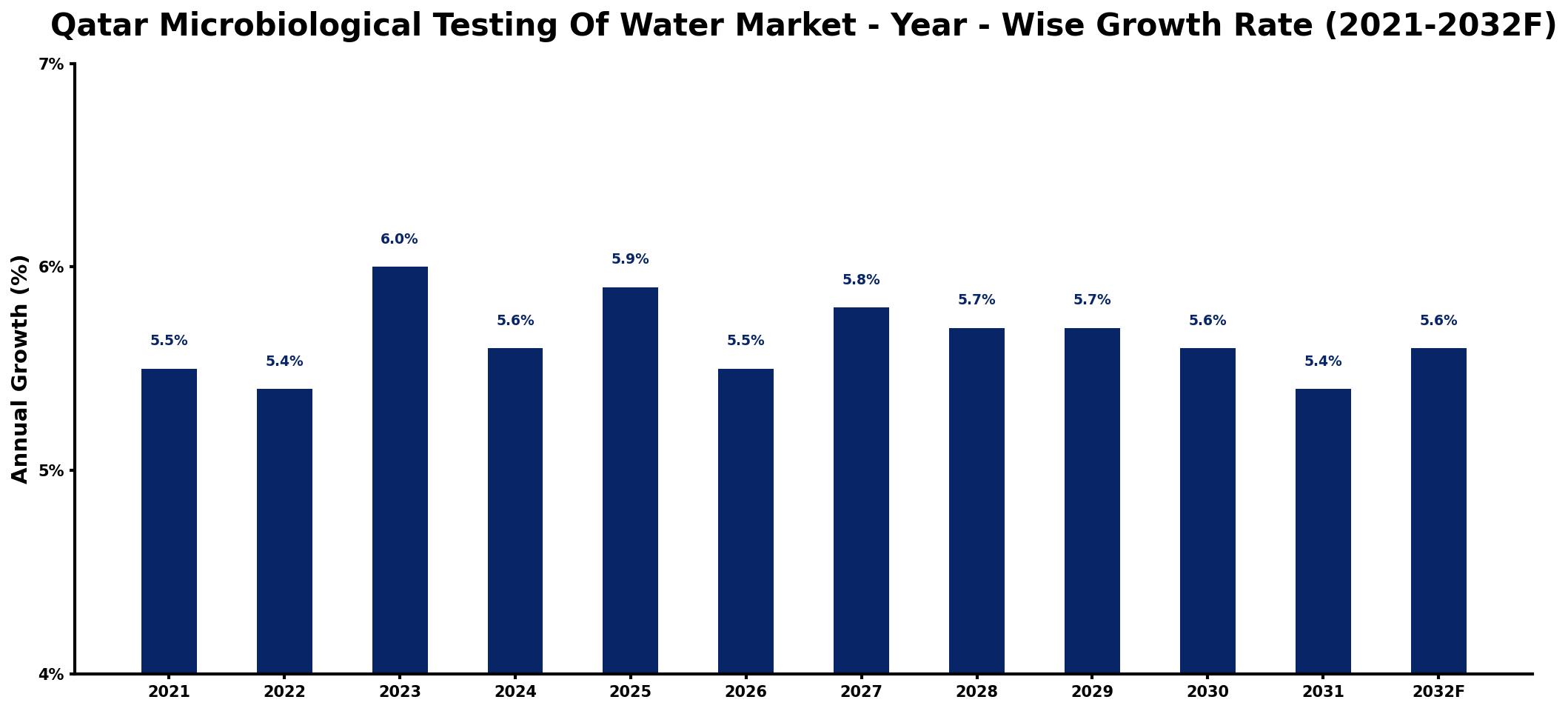
The table below presents the year‑wise growth rates along with the key drivers influencing the market
| Year | Growth Rate | Major Drivers |
| 2021 | 5.5% | Rising environmental safety standards |
| 2022 | 5.4% | Increased regulatory compliance requirements |
| 2023 | 6.0% | Growing public health awareness |
| 2024 | 5.6% | Expansion of industrial applications |
| 2025 | 5.9% | Investment in infrastructure development |
| 2026 | 5.5% | Enhanced quality assurance practices |
| 2027 | 5.8% | Technological advancements in analytics |
| 2028 | 5.7% | Demand for sustainable practices |
| 2029 | 5.7% | Focus on resource conservation efforts |
| 2030 | 5.6% | Strengthening of supply chain resilience |
| 2031 | 5.4% | Increased collaboration among stakeholders |
| 2032 | 5.6% | Emergence of new market opportunities |
Note: Market size estimations and growth projections presented in this report are based on 6Wresearch's proprietary forecasting methodology, utilizing the latest available industry data, government publications, and primary research inputs.
Qatar Microbiological Testing Of Water Market Synopsis
The strongest force currently shaping the Qatar Microbiological Testing of Water Market is the governments unwavering commitment to water safety and sanitation. This commitment is manifested through rigorous regulatory frameworks that mandate regular testing of water supplies to prevent contamination and safeguard public health.
Additionally, the rising concerns about waterborne diseases have catalyzed demand for microbiological testing services across various sectors, including residential, commercial, and industrial. Given Qatar's unique climate and limited freshwater resources, the continuous monitoring of water quality is not just a regulatory requirement; it's an essential service that underpins the nation's overall health and economic stability.
Qatar Microbiological Testing Of Water Market Key Takeaways
- The market is experiencing steady growth driven by stringent water quality regulations.
- Increased awareness about the health impacts of waterborne diseases significantly influences demand.
- Qatar's arid climate necessitates ongoing investment in water testing technologies.
- The COVID-19 pandemic has underscored the importance of microbiological testing for public health.
- Investment in skilled personnel and advanced methodologies is essential for meeting regulatory demands.
Evaluation of Restraints in Qatar Microbiological Testing Of Water Market
Despite its growth potential, the Qatar Microbiological Testing of Water Market faces several restraints. A primary concern is the scarcity of freshwater resources, which amplifies the urgency for reliable testing while concurrently limiting the availability of samples. Additionally, the market grapples with the need for advanced testing technologies and methodologies to ensure compliance with evolving standards. The shortage of skilled personnel in this specialized field also hampers operational efficiency, necessitating ongoing investment in training and development. Consequently, stakeholders must navigate these complexities while striving to deliver accurate and timely testing services.
Qatar Microbiological Testing Of Water Market Trends
Current trends in the Qatar Microbiological Testing of Water Market reflect an increasing reliance on technological advancements. Automation and real-time testing solutions are gaining traction, offering faster results and improved efficiency. Furthermore, the integration of digital platforms for data management and compliance reporting is reshaping how companies operate within this sector. Enhanced collaboration among public and private entities is also emerging as a vital trend, facilitating the sharing of best practices and resources to bolster water quality initiatives.
Qatar Microbiological Testing Of Water Market Opportunities
The future of the Qatar Microbiological Testing of Water Market is rich with opportunities, particularly in the realm of technological innovation. Companies can capitalize on the rising demand for rapid testing methods and enhanced monitoring solutions. Additionally, there exists significant potential for expanding testing services into rural and underserved areas, addressing gaps in water safety access. Partnerships with government bodies and NGOs can further enhance service outreach, leading to improvements in community health outcomes. As businesses align with national water quality initiatives, the synergy between regulatory requirements and market offerings will drive growth.
Government Initiatives in the Qatar Microbiological Testing Of Water Market
The Qatar government has launched several initiatives aimed at enhancing water quality and safety, which directly impact the microbiological testing sector. Significant public spending on water infrastructure and treatment facilities underscores its commitment to ensuring that all citizens have access to safe drinking water. Regulatory frameworks have been established to enforce compliance with testing standards, while public health campaigns increase awareness about the significance of water safety. These initiatives collectively create a favorable environment for the microbiological testing industry to flourish.
Future Insights of the Qatar Microbiological Testing Of Water Market
Looking ahead to 2026-2032, the Qatar Microbiological Testing of Water Market is set for continued expansion driven by ongoing regulatory compliance needs and public health priorities. As the government enhances its investment in water quality assurance, technological advancements will play a pivotal role in shaping the market's landscape. Moreover, the increasing integration of sustainability measures into water management will likely stimulate demand for innovative testing methodologies, creating an ecosystem that not only protects public health but also promotes environmental stewardship.
Qatar Microbiological Testing Of Water Market Latest Developments (2025 - 2026)
Recent developments in the Qatar Microbiological Testing of Water Market indicate a growing trend towards the adoption of automated testing solutions. Companies are investing in cutting-edge technology to enhance the accuracy and speed of water quality assessments. Additionally, there has been an increase in collaborative efforts among stakeholders aimed at setting more stringent testing protocols. These movements reflect a collective acknowledgment of the urgent need to safeguard water resources and improve public health outcomes across the nation.
Qatar Microbiological Testing Of Water Market - Key Attractiveness of the Report
- 10 Years of Market Numbers
- Historical Data Starting from 2022 to 2025
- Base Year: 2025
- Forecast Data until 2032
- Key Performance Indicators Impacting the Market
- Major Upcoming Developments and Projects
Key Highlights of the Report:
- Qatar Microbiological Testing Of Water Market Outlook
- Market Size of Qatar Microbiological Testing Of Water Market, 2025
- Forecast of Qatar Microbiological Testing Of Water Market, 2032
- Historical Data and Forecast of Qatar Microbiological Testing Of Water Revenues & Volume for the Period 2022-2032F
- Qatar Microbiological Testing Of Water Market Trend Evolution
- Qatar Microbiological Testing Of Water Market Drivers and Challenges
- Qatar Microbiological Testing Of Water Price Trends
- Qatar Microbiological Testing Of Water Porter's Five Forces
- Qatar Microbiological Testing Of Water Industry Life Cycle
- Historical Data and Forecast of Qatar Microbiological Testing Of Water Market Revenues & Volume By Pathogen Type for the Period 2022-2032F
- Historical Data and Forecast of Qatar Microbiological Testing Of Water Market Revenues & Volume By Legionella for the Period 2022-2032F
- Historical Data and Forecast of Qatar Microbiological Testing Of Water Market Revenues & Volume By Coliform for the Period 2022-2032F
- Historical Data and Forecast of Qatar Microbiological Testing Of Water Market Revenues & Volume By Salmonella for the Period 2022-2032F
- Historical Data and Forecast of Qatar Microbiological Testing Of Water Market Revenues & Volume By Vibrio for the Period 2022-2032F
- Historical Data and Forecast of Qatar Microbiological Testing Of Water Market Revenues & Volume By Clostridium for the Period 2022-2032F
- Historical Data and Forecast of Qatar Microbiological Testing Of Water Market Revenues & Volume By Others for the Period 2022-2032F
- Historical Data and Forecast of Qatar Microbiological Testing Of Water Market Revenues & Volume By Water Type for the Period 2022-2032F
- Historical Data and Forecast of Qatar Microbiological Testing Of Water Market Revenues & Volume By Drinking & bottled water for the Period 2022-2032F
- Historical Data and Forecast of Qatar Microbiological Testing Of Water Market Revenues & Volume By Industrial water for the Period 2022-2032F
- Historical Data and Forecast of Qatar Microbiological Testing Of Water Market Revenues & Volume By Type for the Period 2022-2032F
- Historical Data and Forecast of Qatar Microbiological Testing Of Water Market Revenues & Volume By Instruments for the Period 2022-2032F
- Historical Data and Forecast of Qatar Microbiological Testing Of Water Market Revenues & Volume By Test kits & reagents for the Period 2022-2032F
- Historical Data and Forecast of Qatar Microbiological Testing Of Water Market Revenues & Volume By Industry Type for the Period 2022-2032F
- Historical Data and Forecast of Qatar Microbiological Testing Of Water Market Revenues & Volume By Pharmaceutical for the Period 2022-2032F
- Historical Data and Forecast of Qatar Microbiological Testing Of Water Market Revenues & Volume By Clinical for the Period 2022-2032F
- Historical Data and Forecast of Qatar Microbiological Testing Of Water Market Revenues & Volume By Food for the Period 2022-2032F
- Historical Data and Forecast of Qatar Microbiological Testing Of Water Market Revenues & Volume By Energy for the Period 2022-2032F
- Historical Data and Forecast of Qatar Microbiological Testing Of Water Market Revenues & Volume By Chemicals & material for the Period 2022-2032F
- Historical Data and Forecast of Qatar Microbiological Testing Of Water Market Revenues & Volume By Environmental for the Period 2022-2032F
- Qatar Microbiological Testing Of Water Import Export Trade Statistics
- Market Opportunity Assessment By Pathogen Type
- Market Opportunity Assessment By Water Type
- Market Opportunity Assessment By Type
- Market Opportunity Assessment By Industry Type
- Qatar Microbiological Testing Of Water Top Companies Market Share
- Qatar Microbiological Testing Of Water Competitive Benchmarking By Technical and Operational Parameters
- Qatar Microbiological Testing Of Water Company Profiles
- Qatar Microbiological Testing Of Water Key Strategic Recommendations






































