Qatar Millets Market Size, Share & Growth Rate
The Qatar Millets Market was estimated at USD 1240 Million in 2025 and is projected to reach USD 1801 Million by 2032, growing at a CAGR of 5.5% from 2026 to 2032. This robust growth trajectory is fueled by the rising awareness of the nutritional benefits of millets, which are increasingly being recognized as vital components of a healthy diet. Furthermore, the shift towards gluten-free diets among health-conscious consumers is amplifying the demand for these versatile grains in Qatar.
Qatar Millets Market Growth Rate Analysis (2021-2032)
The Qatar millets market has exhibited stable growth, reflecting an annual increase of 6.4% in 2021, followed by 6.7% in 2022. This growth has been sustained despite a slight dip to 6.2% in 2023 and 2024, likely due to fluctuations in consumer demand as dietary preferences evolve. However, the market rebounded to 6.5% in 2028, fueled by rising health consciousness and investment in sustainable agricultural practices, aligning with Qatar's vision for food security. The forecast remains promising, with expected growth of 6.7% in 2030, driven by technological advancements in farming and infrastructure development that enhance millet production efficiency.
Qatar Millets Market Year-wise Growth Rate and Key Drivers
This graph highlights how the Qatar Millets Market has steadily grown over the past five years, supported by major growth factors.
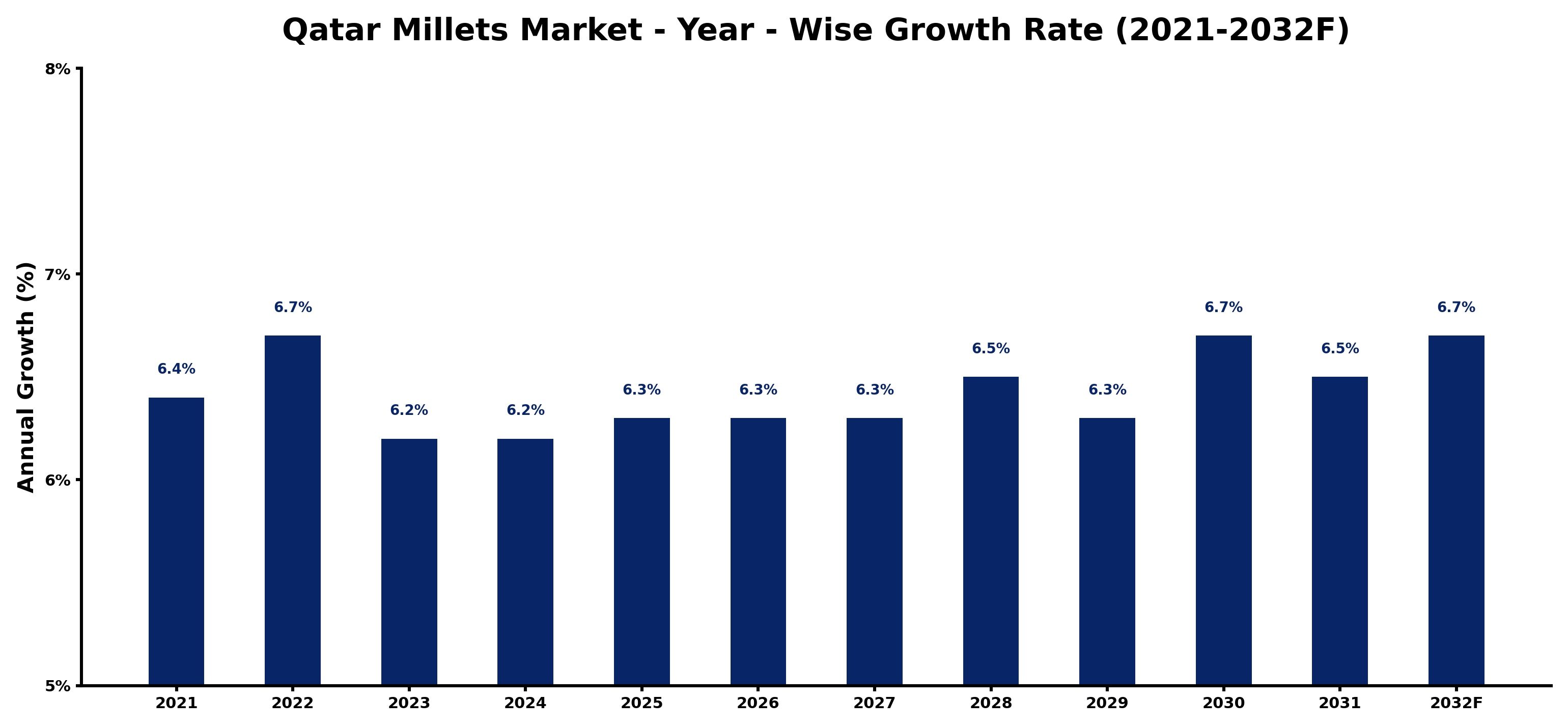
The table below presents the year‑wise growth rates along with the key drivers influencing the market
| Year | Growth Rate | Major Drivers |
| 2021 | 6.4% | Rising health consciousness drove demand |
| 2022 | 6.7% | Increased local production capabilities |
| 2023 | 6.2% | Growing popularity of gluten-free options |
| 2024 | 6.2% | Enhanced distribution networks expanded reach |
| 2025 | 6.3% | Innovative product launches attracted consumers |
| 2026 | 6.3% | Sustainable farming practices gained traction |
| 2027 | 6.3% | Culinary trends embraced ancient grains |
| 2028 | 6.5% | Nutritional awareness influenced purchasing decisions |
| 2029 | 6.3% | Export opportunities expanded market reach |
| 2030 | 6.7% | Consumer preference for organic products |
| 2031 | 6.5% | Increased investment in agricultural technology |
| 2032 | 6.7% | Industrial activity supported growth |
Note - Market size estimations and growth projections presented in this report are based on 6Wresearch’s advanced forecasting approach, validated with industry datasets as of June 2026.
Qatar Millets Market Synopsis
In recent years, Qatar has emerged as a significant player in the global millet import market, sourcing approximately 85% of its supply from India. This trend reflects a growing consumer preference for healthy food options that offer both nutrition and versatility in meal preparation. The increasing demand for millets is not just a passing trend; it's part of a broader shift towards healthier lifestyles among Qatari consumers.
Despite being a major importer, Qatar has seen a surge in local interest in millets, driven by their high protein and fiber content. From 2016 to 2018, millet consumption in Qatar grew by 4%, and this interest was further intensified by the COVID-19 pandemic, which highlighted the importance of nutritional foods.
Qatar Millets Market Key Takeaways
- Qatar is predominantly reliant on imports for millet supply, with a majority sourced from India.
- Health-conscious consumer trends are a primary driver of increased millet consumption.
- COVID-19 enhanced consumer awareness of the nutritional value of millets, boosting their popularity.
- The domestic market is witnessing efforts to cultivate millets locally to stabilize supply.
- The Qatar Millets Market is projected to reach USD 1801 Million by 2032, driven by a compound annual growth rate of 5.5%.
Evaluation of Restraints in Qatar Millets Market
While the Qatar millets market is on an upward trajectory, it faces certain challenges that could hinder its growth. A significant barrier lies in consumer awareness and market acceptance. Despite growing interest in millets, many consumers remain uninformed about their nutritional benefits and versatile culinary uses. Additionally, establishing a stable and efficient supply chain poses challenges, particularly given the country's reliance on imports. This could lead to fluctuations in availability and potentially affect market pricing.
Qatar Millets Market Trends
Currently, there is a marked trend towards the promotion of millets as a staple grain in health-focused diets. This trend aligns with the global emphasis on sustainable food practices, given that millets are considered environmentally friendly and require less water compared to traditional grains. Moreover, innovative product development, such as millet-based snacks and ready-to-eat meals, is emerging in response to consumer demand for convenience and health.
Qatar Millets Market Opportunities
The Qatar millets market presents lucrative opportunities for investors and businesses. Local cultivation initiatives, fueled by rising demand, can reduce dependency on imports and enhance food security. Furthermore, developing a broader range of millet-based products tailored to local tastes can attract diverse consumer segments. Collaborations between local producers and health-focused brands may also open new distribution channels, ensuring a wider reach for millet products.
Government Initiatives in the Qatar Millets Market
The Qatari government has been proactive in promoting food security and enhancing local agricultural production, which includes support for millet cultivation. Initiatives aimed at encouraging sustainable agricultural practices and providing resources for farmers can significantly impact the growth of the millets market. Additionally, public awareness campaigns about the nutritional benefits of millets align with government efforts to foster healthier food choices among the population.
Future Insights of the Qatar Millets Market
Looking ahead to 2026-2032, the Qatar millets market is poised for transformative growth, driven by an increasing shift towards health-focused diets. As consumers continue to seek gluten-free alternatives, millets will likely gain a more prominent position on grocery shelves. Enhanced agricultural practices and innovative product development will further bolster market expansion, making millets a staple in Qatar's evolving food landscape.
Qatar Millets Market Latest Developments (May 2025 - June 2026)
In the recent months leading up to mid-2026, the Qatar millets market has seen dynamic shifts as both local producers and international suppliers adapt to changing consumer preferences. There has been a noticeable increase in the availability of diverse millet-based products across retail outlets, catering to the health-conscious demographic. Additionally, collaborative efforts between government agencies and agricultural organizations have been focusing on enhancing local millet cultivation practices, aiming for self-sufficiency in the near future.
Qatar Millets Market - Key Attractiveness of the Report
- 10 Years of Market Numbers
- Historical Data Starting from 2022 to 2025
- Base Year: 2025
- Forecast Data until 2032
- Key Performance Indicators Impacting the Market
- Major Upcoming Developments and Projects
Key Highlights of the Report:
- Qatar Millets Market Outlook
- Market Size of Qatar Millets Market, 2025
- Forecast of Qatar Millets Market, 2032F
- Historical Data and Forecast of Qatar Millets Revenues & Volume for the Period 2022-2032F
- Qatar Millets Market Trend Evolution
- Qatar Millets Market Drivers and Challenges
- Qatar Millets Price Trends
- Qatar Millets Porter's Five Forces
- Qatar Millets Industry Life Cycle
- Historical Data and Forecast of Qatar Millets Market Revenues & Volume By Type for the Period 2022-2032F
- Historical Data and Forecast of Qatar Millets Market Revenues & Volume By Pearl Millet for the Period 2022-2032F
- Historical Data and Forecast of Qatar Millets Market Revenues & Volume By Finger Millet for the Period 2022-2032F
- Historical Data and Forecast of Qatar Millets Market Revenues & Volume By ProsoMillet for the Period 2022-2032F
- Historical Data and Forecast of Qatar Millets Market Revenues & Volume By Others for the Period 2022-2032F
- Historical Data and Forecast of Qatar Millets Market Revenues & Volume By Distribution Channel for the Period 2022-2032F
- Historical Data and Forecast of Qatar Millets Market Revenues & Volume By Trade Association& Organization for the Period 2022-2032F
- Historical Data and Forecast of Qatar Millets Market Revenues & Volume By Traditional Grocery Stores for the Period 2022-2032F
- Historical Data and Forecast of Qatar Millets Market Revenues & Volume By Supermarket for the Period 2022-2032F
- Historical Data and Forecast of Qatar Millets Market Revenues & Volume By Online Stores for the Period 2022-2032F
- Historical Data and Forecast of Qatar Millets Market Revenues & Volume By Others for the Period 2022-2032F
- Historical Data and Forecast of Qatar Millets Market Revenues & Volume By Application for the Period 2022-2032F
- Historical Data and Forecast of Qatar Millets Market Revenues & Volume By Infant Food for the Period 2022-2032F
- Historical Data and Forecast of Qatar Millets Market Revenues & Volume By Bakery Products for the Period 2022-2032F
- Historical Data and Forecast of Qatar Millets Market Revenues & Volume By Beverages for the Period 2022-2032F
- Qatar Millets Import Export Trade Statistics
- Market Opportunity Assessment By Type
- Market Opportunity Assessment By Distribution Channel
- Market Opportunity Assessment By Application
- Qatar Millets Top Companies Market Share
- Qatar Millets Competitive Benchmarking By Technical and Operational Parameters
- Qatar Millets Company Profiles
- Qatar Millets Key Strategic Recommendations






































