Qatar Narrow Woven Fabrics Market Summary
The qatar narrow woven fabrics market was estimated at USD 1424 Million in 2025 and is projected to reach USD 2044 Million by 2032, growing at a CAGR of 6.1% from 2026 to 2032.
Qatar Narrow Woven Fabrics Market Year-wise Growth Rate and Key Drivers
This graph highlights how the Qatar Narrow Woven Fabrics Market has steadily grown over the past five years, supported by major growth factors.
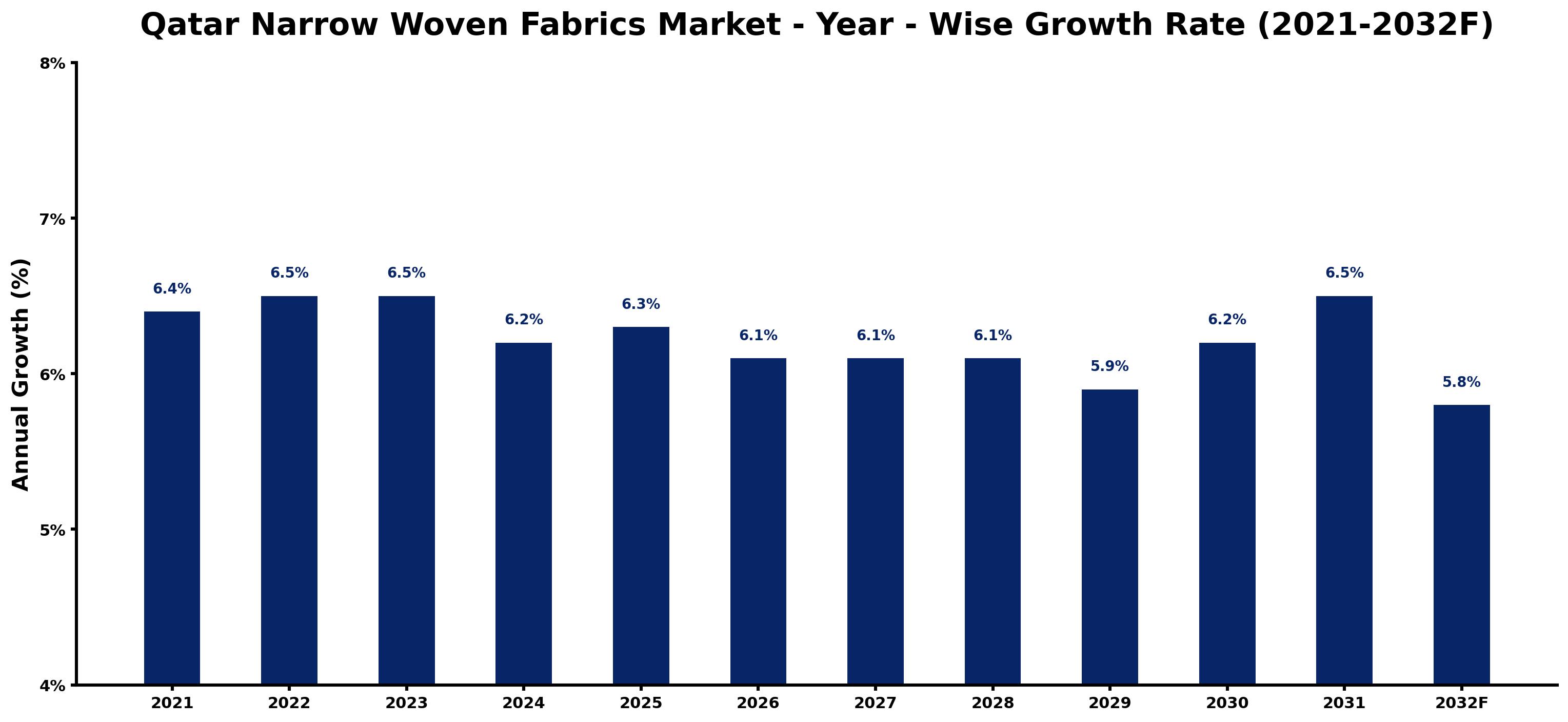
The table below presents the year wise growth rates along with the key drivers influencing the market
| Year | Growth Rate | Major Drivers |
| 2021 | 6.4% | Economic diversification policies focus on developing non-oil sectors like textiles. |
| 2022 | 6.5% | Upsurge in construction projects influences demand for specialized narrow woven fabrics. |
| 2023 | 6.5% | Investment in local manufacturing capabilities enhances supply chain efficiency in the region. |
| 2024 | 6.2% | Sustainability trends encourage the use of eco-friendly materials in fabric production. |
| 2025 | 6.3% | Increased participation in global trade agreements facilitates export opportunities for local manufacturers. |
| 2026 | 6.1% | Technological innovations in weaving techniques improve fabric quality and reduce production costs. |
| 2027 | 6.1% | Cultural events and festivals highlight traditional fabrics, boosting local artisan markets. |
| 2028 | 6.1% | Expansion of retail outlets increases consumer access to a variety of fabric options. |
| 2029 | 5.9% | Collaboration between designers and fabric manufacturers enhances product differentiation in the market. |
| 2030 | 6.2% | Growing preference for bespoke textiles among affluent consumers drives custom fabric demand. |
| 2031 | 6.5% | Emergence of smart fabrics integrated with technology appeals to new consumer segments. |
| 2032 | 5.8% | Urbanization trends lead to increased residential and commercial projects requiring high-quality fabrics. |
Note - Market size estimations and growth projections presented in this report are based on 6Wresearch's advanced forecasting approach, validated with industry datasets as of June 2026.
Qatar Narrow Woven Fabrics Market Synopsis
The Qatar Narrow Woven Fabrics Market is projected to reach 6.1% and witness significant growth during the forecast period (2026-2032). This growth is driven by the increasing demand across various sectors, including apparel, home textiles, and industrial applications. The unique characteristics of narrow woven fabrics, such as ribbons, tapes, and trimmings, make them suitable for a wide range of uses, leading to their growing acceptance in both consumer and industrial markets.
Qatar Narrow Woven Fabrics Market Growth Drivers
Economic advancements in Qatar have fueled the expansion of the narrow woven fabrics market. A few key drivers include:
- The significant infrastructure development and ongoing construction projects across Qatar have increased the demand for narrow woven fabrics in applications such as construction materials, safety harnesses, and industrial components.
- Urbanization trends have led to a more diverse consumer base that seeks fashionable and functional products, thereby boosting the demand for narrow woven fabrics in the fashion and home textiles sectors.
- Increased consumer spending on home decor and personal accessories has created a favorable environment for narrow woven fabrics, particularly in the development of stylish clothing and interior design products.
- The influence of global fashion trends and local design initiatives continues to inspire both manufacturers and consumers to explore innovative uses of narrow woven fabrics.
- Growing e-commerce platforms have made narrow woven fabric products more accessible to consumers, further driving market demand.
Qatar Narrow Woven Fabrics Market Trends and Opportunities
The Qatar Narrow Woven Fabrics Market is witnessing several trends that create opportunities for growth and innovation:
- The increasing integration of sustainable and eco-friendly materials into the fabric production process is gaining traction, responding to the rising consumer demand for environmentally responsible products.
- There is a noticeable trend toward customization, allowing consumers to personalize their fabric choices, which enhances product appeal and drives sales.
- Technological advancements in manufacturing processes are enabling better quality control and innovative fabric designs, increasing the competitive edge of narrow woven fabrics in the market.
- Collaboration between fashion designers and fabric manufacturers is fostering inventive applications of narrow woven fabrics, leading to unique product offerings.
- The expansion of local artisan communities focusing on traditional techniques is revitalizing interest in narrow woven fabrics, promoting cultural heritage while meeting modern consumer needs.
Qatar Narrow Woven Fabrics Market Challenges and Restraints
Despite the promising growth prospects, certain challenges may impede the Qatar Narrow Woven Fabrics Market:
- The highly competitive market landscape, characterized by both local and international suppliers, presents challenges for new entrants trying to capture market share.
- Price volatility of raw materials can lead to fluctuating production costs, affecting the overall pricing strategies for narrow woven fabric products.
- Economic uncertainties on a global scale can impact consumer spending and investment in the textiles industry, leading to potential market slowdowns.
- Regulatory challenges including compliance with quality standards and environmental regulations may increase operational costs for manufacturers.
- The need for continuous innovation in product offerings requires substantial investment, which can be a barrier for smaller manufacturers in the market.
Qatar Narrow Woven Fabrics Market Government Investment and Initiatives
The government of Qatar plays an essential role in fostering the growth of the narrow woven fabrics market through various investments and initiatives:
- Public spending on infrastructure and urban development projects enhances the construction sector's demand for narrow woven fabric applications, such as safety gear and materials.
- Government-backed development plans aimed at diversifying the economy support the textiles industry, promoting innovation and local manufacturing capabilities.
- Investment incentives for small and medium-sized enterprises (SMEs) encourage innovation in the textiles sector, allowing local manufacturers to thrive in a competitive landscape.
- Policies aimed at enhancing research and development within the textile industry help local businesses adapt to changing consumer preferences and market trends.
- The establishment of trade fairs and exhibitions provides a platform for local manufacturers to showcase their narrow woven fabric products, helping to strengthen market presence.
Qatar Narrow Woven Fabrics Market Latest Developments (May 2025 - June 2026)
Recent developments in the Qatar Narrow Woven Fabrics Market have highlighted shifts in both consumer behavior and industry focus:
- Increased attention on sustainable practices has led to manufacturers exploring eco-friendly raw materials and production methods, aligning with consumer preferences for environmentally responsible products.
- Several collaborative initiatives between local designers and fabric manufacturers have emerged, resulting in innovative designs that cater to contemporary tastes and preferences.
- Trade exhibitions and showcases have seen a rise in participation from local and international suppliers, reflecting heightened interest in narrowing the gap between production and retail.
- Technological advancements in production processes have gained traction, enabling faster turnaround times and greater customization options for consumers.
- Economic recovery from the COVID-19 pandemic has prompted a gradual resurgence in demand for narrow woven fabrics across various sectors, particularly in fashion and home decor.
Qatar Narrow Woven Fabrics Market - Key Attractiveness of the Report
- 10 Years of Market Numbers
- Historical Data Starting from 2022 to 2025
- Base Year: 2025
- Forecast Data until 2032
- Key Performance Indicators Impacting the Market
- Major Upcoming Developments and Projects
Key Highlights of the Report:
- Qatar Narrow Woven Fabrics Market Outlook
- Market Size of Qatar Narrow Woven Fabrics Market, 2025
- Forecast of Qatar Narrow Woven Fabrics Market, 2032
- Historical Data and Forecast of Qatar Narrow Woven Fabrics Revenues & Volume for the Period 2022-2032F
- Qatar Narrow Woven Fabrics Market Trend Evolution
- Qatar Narrow Woven Fabrics Market Drivers and Challenges
- Qatar Narrow Woven Fabrics Price Trends
- Qatar Narrow Woven Fabrics Porter's Five Forces
- Qatar Narrow Woven Fabrics Industry Life Cycle
- Historical Data and Forecast of Qatar Narrow Woven Fabrics Market Revenues & Volume By Type for the Period 2022-2032F
- Historical Data and Forecast of Qatar Narrow Woven Fabrics Market Revenues & Volume By Polyester for the Period 2022-2032F
- Historical Data and Forecast of Qatar Narrow Woven Fabrics Market Revenues & Volume By Nylon for the Period 2022-2032F
- Historical Data and Forecast of Qatar Narrow Woven Fabrics Market Revenues & Volume By PP for the Period 2022-2032F
- Historical Data and Forecast of Qatar Narrow Woven Fabrics Market Revenues & Volume By Applications for the Period 2022-2032F
- Historical Data and Forecast of Qatar Narrow Woven Fabrics Market Revenues & Volume By Garments for the Period 2022-2032F
- Historical Data and Forecast of Qatar Narrow Woven Fabrics Market Revenues & Volume By Home Furnishing for the Period 2022-2032F
- Historical Data and Forecast of Qatar Narrow Woven Fabrics Market Revenues & Volume By Other for the Period 2022-2032F
- Qatar Narrow Woven Fabrics Import Export Trade Statistics
- Market Opportunity Assessment By Type
- Market Opportunity Assessment By Applications
- Qatar Narrow Woven Fabrics Top Companies Market Share
- Qatar Narrow Woven Fabrics Competitive Benchmarking By Technical and Operational Parameters
- Qatar Narrow Woven Fabrics Company Profiles
- Qatar Narrow Woven Fabrics Key Strategic Recommendations






































