Qatar Oil Country Tubular Goods Market Size, Share & Growth Rate
The Qatar Oil Country Tubular Goods Market was estimated at USD 641 Million in 2025 and is projected to reach USD 929 Million by 2032, growing at a CAGR of 5.4% from 2026 to 2032. This growth trajectory is fueled by Qatar's substantial investments in oil and gas exploration, coupled with its strategic initiatives to maintain high production levels. The ongoing demand for high-quality OCTG products, driven by the expansion of both onshore and offshore infrastructure, reinforces the optimistic outlook for the market.
Qatar Oil Country Tubular Goods Market Year-wise Growth Rate and Key Drivers
This graph highlights how the Qatar Oil Country Tubular Goods Market has steadily grown over the years, supported by major growth factors.
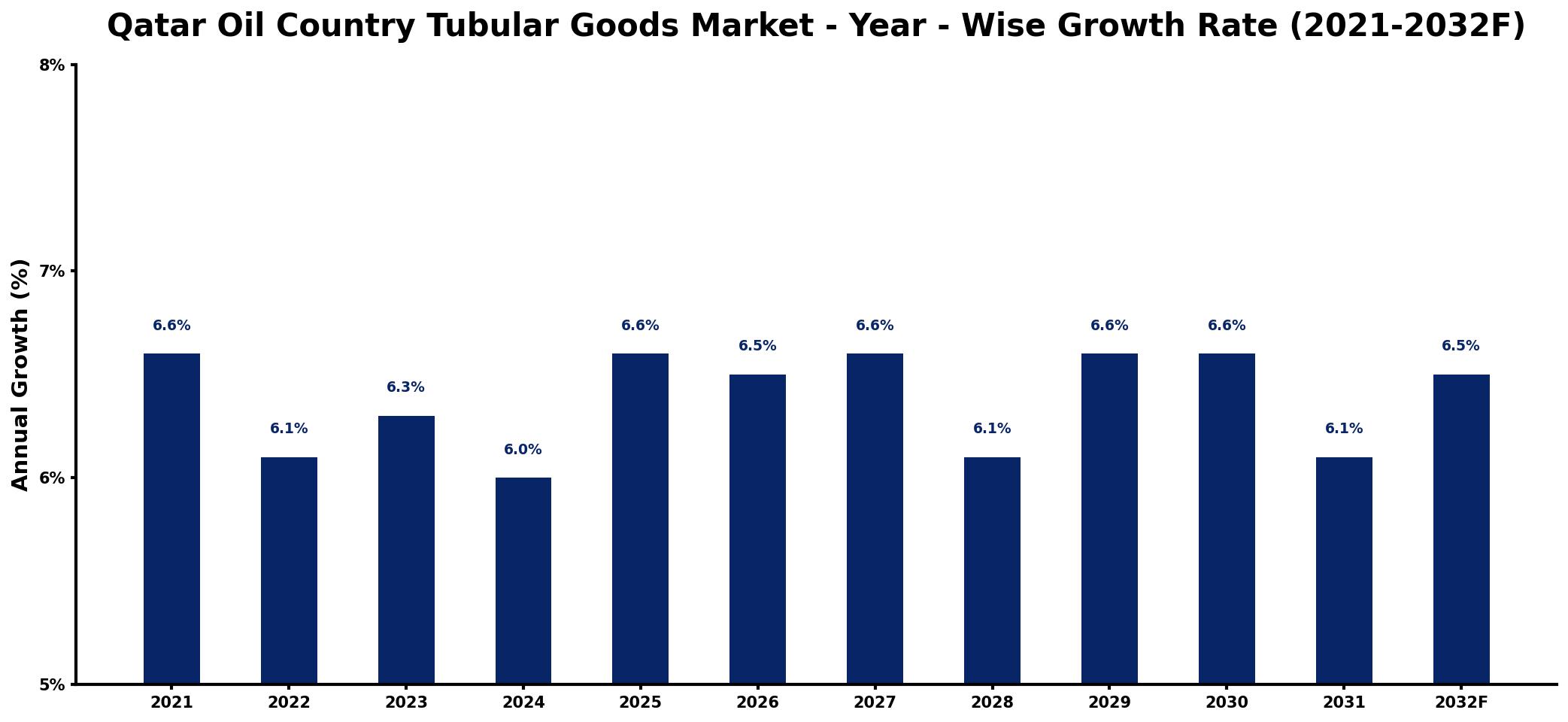
The table below presents the year‑wise growth rates along with the key drivers influencing the market
| Year | Growth Rate | Major Drivers |
| 2021 | 6.6% | Rising energy sector investments |
| 2022 | 6.1% | Increased infrastructure development projects |
| 2023 | 6.3% | Growing demand for energy resources |
| 2024 | 6.0% | Expansion of renewable energy initiatives |
| 2025 | 6.6% | Boost in regional exploration activities |
| 2026 | 6.5% | Strengthened international trade agreements |
| 2027 | 6.6% | Enhanced technological advancements adoption |
| 2028 | 6.1% | Increased domestic production capacities |
| 2029 | 6.6% | Surge in global energy consumption |
| 2030 | 6.6% | Growing focus on sustainability practices |
| 2031 | 6.1% | Heightened geopolitical stability effects |
| 2032 | 6.5% | Rise in strategic partnerships formation |
Note: Market size estimations and growth projections presented in this report are based on 6Wresearch's proprietary forecasting methodology, utilizing the latest available industry data, government publications, and primary research inputs.
Qatar Oil Country Tubular Goods Market Synopsis
Recent trends in the Qatar Oil Country Tubular Goods market indicate a stable demand, bolstered by the nations robust oil and gas industry. As Qatar continues to enhance its energy sector's capabilities, future prospects look promising with continuous infrastructural developments.
In light of global energy market fluctuations, Qatar's commitment to sustaining its oil and gas production levels positions its OCTG sector for resilience. Notably, the strategic expansion into liquefied natural gas (LNG) production further aligns with the rising necessity for OCTG products.
Qatar Oil Country Tubular Goods Market Key Takeaways
- Significant oil and gas reserves propel sustained demand for OCTG products.
- Qatar's strategic location enhances its status as a key player in the global energy market.
- Investment in high-quality OCTG products is critical for ongoing exploration and drilling projects.
- Quality standards and corrosion-resistant materials are increasingly prioritized in OCTG applications.
- Market growth is anticipated amid recovering global energy demands post-COVID-19.
Evaluation of Restraints in Qatar Oil Country Tubular Goods Market
The Qatar Oil Country Tubular Goods market encounters notable restraints primarily linked to the volatility of global oil prices. Qatar's heavy dependence on oil and gas exports means shifts in international energy trends can significantly affect its OCTG sector. Moreover, competition from regional oil-producing nations intensifies pressure on market share. Additionally, maintaining compliance with rigorous international standards for OCTG products poses ongoing challenges, requiring continuous investment in quality assurance and technology.
Qatar Oil Country Tubular Goods Market Trends
Current trends shaping the Qatar Oil Country Tubular Goods market include an increasing focus on innovative materials that enhance durability and performance in harsh environmental conditions. Additionally, the integration of advanced technologies, such as smart drilling and predictive maintenance, is gaining traction. These trends indicate a clear shift towards efficiency and sustainability in OCTG applications, which aligns with global demands for more environmentally responsible oil and gas operations.
Qatar Oil Country Tubular Goods Market Opportunities
Significant opportunities for growth in the Qatar OCTG market lie in the countrys ambitious plans to expand its LNG production capacity. Investment in new drilling technologies and advanced OCTG materials can open pathways for increased operational efficiency and reduced costs. Moreover, as Qatar continues to attract foreign investments in its energy sector, partnerships with leading OCTG suppliers can further capitalize on the burgeoning demand for high-quality products.
Government Initiatives in the Qatar Oil Country Tubular Goods Market
The Qatari government has initiated various policies aimed at bolstering its oil and gas sector, including incentives for exploration and production. Public investment in infrastructure projects and a strategic focus on sustainability align with international energy standards. These initiatives create a favorable environment for OCTG manufacturers and suppliers, ensuring a steady demand for quality tubular goods necessary for ongoing projects in the sector.
Future Insights of the Qatar Oil Country Tubular Goods Market
Looking ahead to the period between 2026 and 2032, the Qatar Oil Country Tubular Goods market is expected to flourish due to the sustained expansion of the oil and gas sector. Strategic investments in both onshore and offshore projects will elevate the demand for robust OCTG solutions. Furthermore, technological advancements will likely enhance the quality and performance of OCTG products, solidifying Qatar's role as a pivotal player in the global energy landscape.
Qatar Oil Country Tubular Goods Market Latest Developments (2025 - 2026)
Recent developments within the Qatar Oil Country Tubular Goods market point to a resurgence in production activity as the global energy sector stabilizes post-pandemic. Companies are increasingly investing in enhancing their supply chain efficiencies and exploring innovative OCTG materials. Additionally, ongoing government support for infrastructure projects continues to fuel the demand for high-quality tubular products, signaling a promising outlook for the market.
Qatar Oil Country Tubular Goods Market - Key Attractiveness of the Report
- 10 Years of Market Numbers
- Historical Data Starting from 2022 to 2025
- Base Year: 2025
- Forecast Data until 2032
- Key Performance Indicators Impacting the Market
- Major Upcoming Developments and Projects
Key Highlights of the Report:
- Qatar Oil Country Tubular Goods Market Outlook
- Market Size of Qatar Oil Country Tubular Goods Market, 2025
- Forecast of Qatar Oil Country Tubular Goods Market, 2032
- Historical Data and Forecast of Qatar Oil Country Tubular Goods Revenues & Volume for the Period 2022-2032F
- Qatar Oil Country Tubular Goods Market Trend Evolution
- Qatar Oil Country Tubular Goods Market Drivers and Challenges
- Qatar Oil Country Tubular Goods Price Trends
- Qatar Oil Country Tubular Goods Porter's Five Forces
- Qatar Oil Country Tubular Goods Industry Life Cycle
- Historical Data and Forecast of Qatar Oil Country Tubular Goods Market Revenues & Volume By Manufacturing Process for the Period 2022-2032F
- Historical Data and Forecast of Qatar Oil Country Tubular Goods Market Revenues & Volume By Seamless for the Period 2022-2032F
- Historical Data and Forecast of Qatar Oil Country Tubular Goods Market Revenues & Volume By Electric Resistance Welded for the Period 2022-2032F
- Historical Data and Forecast of Qatar Oil Country Tubular Goods Market Revenues & Volume By Grade for the Period 2022-2032F
- Historical Data and Forecast of Qatar Oil Country Tubular Goods Market Revenues & Volume By Premium Grade for the Period 2022-2032F
- Historical Data and Forecast of Qatar Oil Country Tubular Goods Market Revenues & Volume By API Grade for the Period 2022-2032F
- Qatar Oil Country Tubular Goods Import Export Trade Statistics
- Market Opportunity Assessment By Manufacturing Process
- Market Opportunity Assessment By Grade
- Qatar Oil Country Tubular Goods Top Companies Market Share
- Qatar Oil Country Tubular Goods Competitive Benchmarking By Technical and Operational Parameters
- Qatar Oil Country Tubular Goods Company Profiles
- Qatar Oil Country Tubular Goods Key Strategic Recommendations






































