Qatar Optical Microscopes Market Size Growth Rate
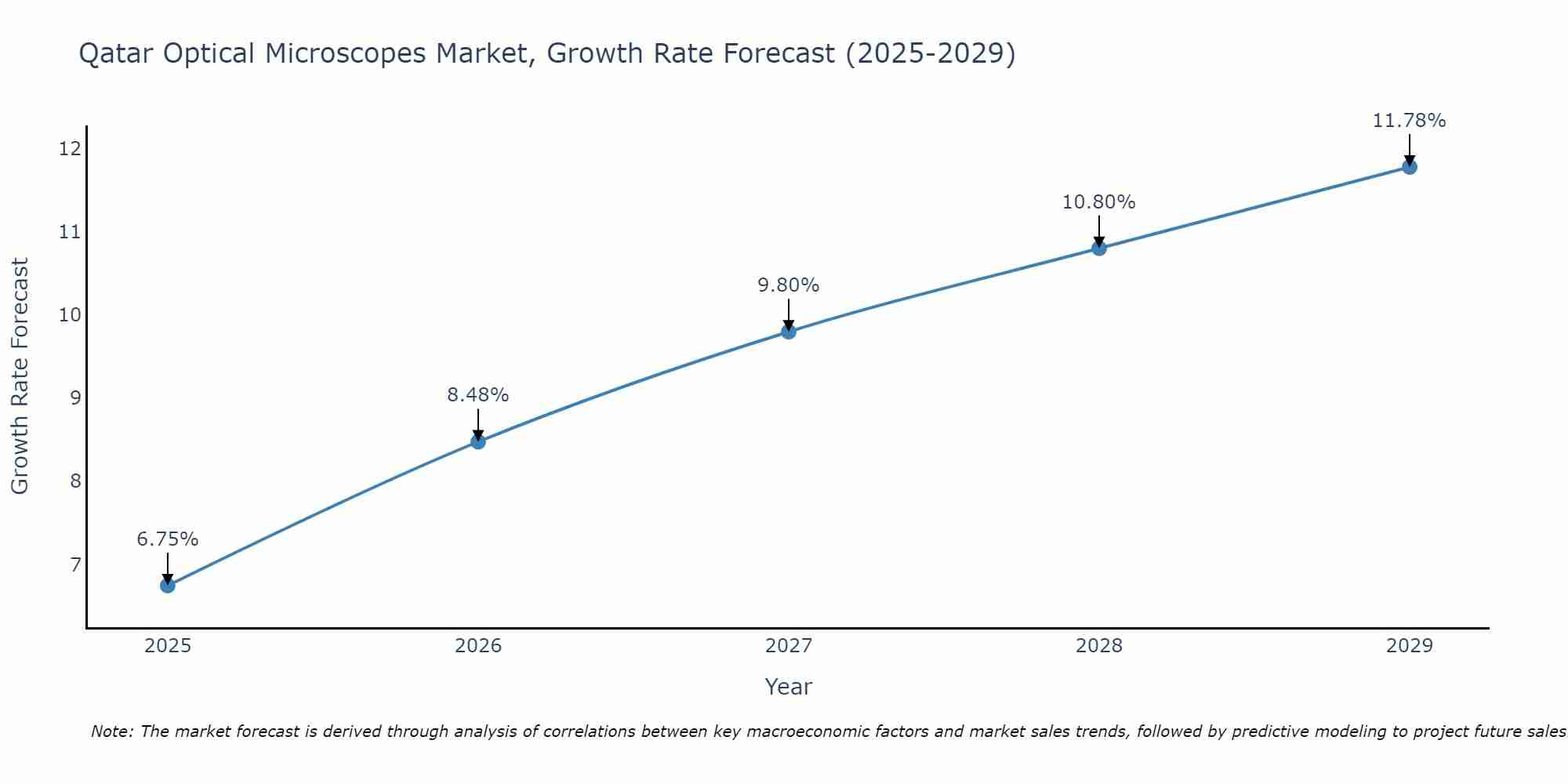
The Qatar Optical Microscopes Market is likely to experience consistent growth rate gains over the period 2025 to 2029. From 6.75% in 2025, the growth rate steadily ascends to 11.78% in 2029.
Qatar Optical Microscopes Market Synopsis
The optical microscopes market in Qatar has witnessed notable expansion in recent years, driven by a surge in research and development activities across various scientific disciplines. The demand for high-quality optical microscopes has been propelled by advancements in life sciences, material science, and nanotechnology. Moreover, Qatar`s investment in education and research infrastructure has created a conducive environment for the growth of the optical microscopes market. The presence of reputable manufacturers and distributors in the region has further bolstered the market`s development. With an increasing focus on scientific advancement and a commitment to fostering a knowledge-driven economy, the optical microscopes market in Qatar is poised for sustained growth.
Drivers of the Market
The Qatar optical microscopes market is poised for substantial growth, owing to several pivotal drivers. The burgeoning demand for high-resolution imaging solutions across various scientific and industrial applications is a primary factor propelling market expansion. Researchers, scientists, and professionals across fields such as life sciences, material sciences, and electronics rely heavily on optical microscopes for detailed analysis and diagnostics. Additionally, the continual advancements in microscopy technology, including confocal and super-resolution microscopy, are driving adoption rates. The increasing investment in research and development activities in Qatar further augments the demand for cutting-edge optical microscopes.
Challenges of the Market
The optical microscopes market in Qatar encounters challenges related to research and education funding. While there is a demand for high-quality optical microscopes in research institutions and educational settings, securing funding for these expensive devices can be difficult. Budget constraints may limit the adoption of advanced microscopy technologies, hindering scientific progress and educational opportunities.
COVID-19 Impact on the Market
The Qatar optical microscopes market faced challenges during the COVID-19 pandemic, as research institutions and laboratories scaled back operations or shifted their focus to pandemic-related research. This led to a temporary reduction in the demand for optical microscopes. However, as research activities resumed and the need for high-quality microscopy solutions persisted, the market began to recover. Qatar`s commitment to advancing its research and development capabilities, particularly in the fields of healthcare and materials science, is expected to drive the long-term demand for optical microscopes. Additionally, technological advancements in microscopy, such as digital imaging and remote collaboration capabilities, are likely to shape the market`s future outlook.
Key Players in the Market
The optical microscopes market in Qatar has evolved with the advancement of scientific research and education in the country. Key players in this market, including Leica Microsystems, Nikon Corporation, and Olympus Corporation, have been at the forefront of delivering high-quality optical microscopes for various applications, including life sciences, materials science, and education. These key players have established themselves as trusted providers of advanced microscopy solutions to research institutions and educational facilities in Qatar. As Qatar continues to promote scientific research and education, the optical microscopes market is expected to thrive, with these key players driving innovation and excellence in microscopy technology.
Key Highlights of the Report:
- Qatar Optical Microscopes Market Outlook
- Market Size of Qatar Optical Microscopes Market, 2024
- Forecast of Qatar Optical Microscopes Market, 2031
- Historical Data and Forecast of Qatar Optical Microscopes Revenues & Volume for the Period 2021-2031
- Qatar Optical Microscopes Market Trend Evolution
- Qatar Optical Microscopes Market Drivers and Challenges
- Qatar Optical Microscopes Price Trends
- Qatar Optical Microscopes Porter's Five Forces
- Qatar Optical Microscopes Industry Life Cycle
- Historical Data and Forecast of Qatar Optical Microscopes Market Revenues & Volume By Product for the Period 2021-2031
- Historical Data and Forecast of Qatar Optical Microscopes Market Revenues & Volume By Digital Microscopes for the Period 2021-2031
- Historical Data and Forecast of Qatar Optical Microscopes Market Revenues & Volume By Stereo Microscope for the Period 2021-2031
- Historical Data and Forecast of Qatar Optical Microscopes Market Revenues & Volume By Inverted Microscopes for the Period 2021-2031
- Historical Data and Forecast of Qatar Optical Microscopes Market Revenues & Volume By Other Products (Accessories, Software) for the Period 2021-2031
- Historical Data and Forecast of Qatar Optical Microscopes Market Revenues & Volume By End User for the Period 2021-2031
- Historical Data and Forecast of Qatar Optical Microscopes Market Revenues & Volume By Hospitals and Clinics for the Period 2021-2031
- Historical Data and Forecast of Qatar Optical Microscopes Market Revenues & Volume By Academic and Research Institutes for the Period 2021-2031
- Historical Data and Forecast of Qatar Optical Microscopes Market Revenues & Volume By Diagnostics Laboratories for the Period 2021-2031
- Historical Data and Forecast of Qatar Optical Microscopes Market Revenues & Volume By Other End Users for the Period 2021-2031
- Qatar Optical Microscopes Import Export Trade Statistics
- Market Opportunity Assessment By Product
- Market Opportunity Assessment By End User
- Qatar Optical Microscopes Top Companies Market Share
- Qatar Optical Microscopes Competitive Benchmarking By Technical and Operational Parameters
- Qatar Optical Microscopes Company Profiles
- Qatar Optical Microscopes Key Strategic Recommendations






































