Qatar Oyster Market Size, Share & Growth Rate
The Qatar Oyster Market was estimated at USD 156 Million in 2025 and is projected to reach USD 218 Million by 2032, growing at a CAGR of 4.9% from 2026 to 2032. This upward trend is driven primarily by the increasing consumer awareness of the health benefits associated with oysters, along with a growing culinary interest. Furthermore, the strategic geographical position of Qatar coupled with its efficient seafood distribution infrastructure fuels the markets expansion.
Qatar Oyster Market Year-wise Growth Rate and Key Drivers
This graph highlights how the Qatar Oyster Market has steadily grown over the years, supported by major growth factors.
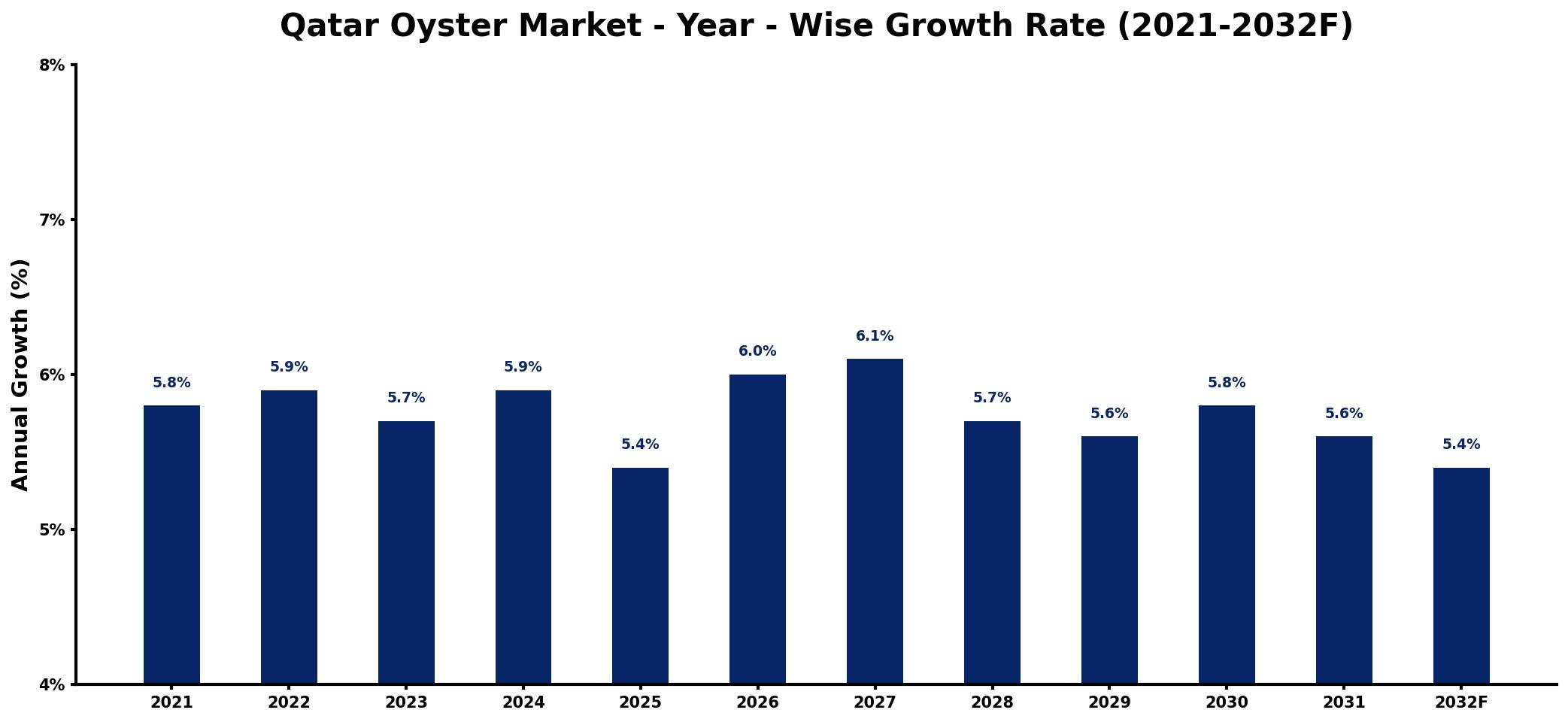
The table below presents the year‑wise growth rates along with the key drivers influencing the market
| Year | Growth Rate | Major Drivers |
| 2021 | 5.8% | Rising culinary tourism interest |
| 2022 | 5.9% | Growing seafood consumption trends |
| 2023 | 5.7% | Increased restaurant openings nationwide |
| 2024 | 5.9% | Expansion of aquaculture facilities |
| 2025 | 5.4% | Enhanced distribution network efficiency |
| 2026 | 6.0% | New export market opportunities |
| 2027 | 6.1% | Strengthened local farming practices |
| 2028 | 5.7% | Popularity of sustainability initiatives |
| 2029 | 5.6% | Investment in food technology |
| 2030 | 5.8% | Boost in health awareness campaigns |
| 2031 | 5.6% | Emergence of gourmet dining experiences |
| 2032 | 5.4% | Growth in luxury food segments |
Note: Market size estimations and growth projections presented in this report are based on 6Wresearch's proprietary forecasting methodology, utilizing the latest available industry data, government publications, and primary research inputs.
Qatar Oyster Market Synopsis
The Qatar oyster market is currently witnessing a notable surge, fueled by a consumer shift toward premium seafood options. Oysters, revered for their nutrient density, are becoming increasingly sought-after, especially among health-conscious diners and culinary enthusiasts who appreciate their unique flavor profile.
Local producers are rising to the occasion, emphasizing quality and freshness to meet this growing demand. The potential for exports further enhances the market's outlook, as Qatari oysters gain recognition in international markets for their quality.
Qatar Oyster Market Key Takeaways
- The market is experiencing robust growth due to rising demand for healthy and premium seafood options.
- Local producers are committed to maintaining high standards of quality and freshness.
- Qatar's geographical advantage enhances seafood distribution efficiency.
- Export opportunities are expanding as awareness of Qatari oysters increases globally.
- Sustainable practices and innovation are expected to shape the future of the market.
Evaluation of Restraints in Qatar Oyster Market
Despite the positive momentum, the Qatar oyster market grapples with significant restraints that may hinder its growth trajectory. A primary concern is the limited domestic production capacity, which leads to a heavy reliance on imports to satisfy burgeoning consumer demand. This reliance on foreign suppliers not only raises concerns about price volatility but also exposes the market to supply chain challenges, including potential geopolitical tensions. Ensuring the quality and safety of imported oysters is paramount; lapses in this area could undermine consumer confidence and stall market growth.
Qatar Oyster Market Trends
Several trends are emerging that are reshaping the Qatar oyster market landscape. Firstly, the rise of sustainable seafood sourcing is gaining traction, with consumers increasingly preferring oysters harvested through environmentally responsible methods. Additionally, the culinary versatility of oysters is being spotlighted, as chefs and home cooks alike experiment with innovative recipes. The digital age has also prompted a surge in e-commerce platforms focusing on seafood, making it easier for consumers to access high-quality oysters.
Qatar Oyster Market Opportunities
Opportunities abound in the Qatar oyster market, particularly in the realms of sustainable aquaculture and export growth. Investments in local oyster farming can help mitigate import dependence while also enhancing the quality of domestic offerings. The growing trend of experiential dining presents another avenue; restaurants focusing on oyster tastings and pairings can draw in gastronomes eager for unique culinary experiences. Moreover, the health and wellness movement positions oysters as an ideal option for restaurants aiming to appeal to health-focused consumers.
Government Initiatives in the Qatar Oyster Market
The Qatari government has been proactive in supporting the seafood industry through various initiatives and policies aimed at enhancing aquaculture. Public spending on sustainable seafood practices and quality control measures demonstrates a commitment to elevating the industry standards. Programs encouraging local production and research into innovative farming techniques are being prioritized, which will help bolster the oyster market's overall competitiveness in both domestic and export arenas.
Future Insights of the Qatar Oyster Market
Looking ahead to 2026-2032, the Qatar oyster market is poised for significant transformation. The convergence of consumer trends toward health, sustainability, and culinary exploration will likely drive demand higher. Additionally, advancements in aquaculture technology could lead to increased local production, reducing import reliance and elevating market resilience. As Qatar positions itself as a leading seafood hub in the region, the landscape for oysters will become increasingly competitive, with opportunities for innovative approaches in farming, distribution, and culinary presentation.
Qatar Oyster Market Latest Developments (2025 - 2026)
In recent months, the Qatar oyster market has seen a dynamic shift with increased collaborations between local producers and international distributors, facilitating a more diverse product range for consumers. Initiatives focusing on sustainable aquaculture practices are gaining traction, aiming to enhance the local production capabilities. Additionally, the culinary scene is witnessing a resurgence, with restaurants emphasizing gourmet oyster dishes as part of their offerings, reflecting a broader trend toward experiential dining.
Qatar Oyster Market - Key Attractiveness of the Report
- 10 Years of Market Numbers
- Historical Data Starting from 2022 to 2025
- Base Year: 2025
- Forecast Data until 2032
- Key Performance Indicators Impacting the Market
- Major Upcoming Developments and Projects
Key Highlights of the Report:
- Qatar Oyster Market Outlook
- Market Size of Qatar Oyster Market, 2025
- Forecast of Qatar Oyster Market, 2032
- Historical Data and Forecast of Qatar Oyster Revenues & Volume for the Period 2022-2032F
- Qatar Oyster Market Trend Evolution
- Qatar Oyster Market Drivers and Challenges
- Qatar Oyster Price Trends
- Qatar Oyster Porter's Five Forces
- Qatar Oyster Industry Life Cycle
- Historical Data and Forecast of Qatar Oyster Market Revenues & Volume By Oyster Type for the Period 2022-2032F
- Historical Data and Forecast of Qatar Oyster Market Revenues & Volume By Cupped Oyster for the Period 2022-2032F
- Historical Data and Forecast of Qatar Oyster Market Revenues & Volume By Pacific Cupped Oyster for the Period 2022-2032F
- Historical Data and Forecast of Qatar Oyster Market Revenues & Volume By American Cupped Oyster for the Period 2022-2032F
- Historical Data and Forecast of Qatar Oyster Market Revenues & Volume By Penguin Wing Oyster for the Period 2022-2032F
- Historical Data and Forecast of Qatar Oyster Market Revenues & Volume By Others for the Period 2022-2032F
- Historical Data and Forecast of Qatar Oyster Market Revenues & Volume By End User for the Period 2022-2032F
- Historical Data and Forecast of Qatar Oyster Market Revenues & Volume By Foodservice for the Period 2022-2032F
- Historical Data and Forecast of Qatar Oyster Market Revenues & Volume By Retail for the Period 2022-2032F
- Historical Data and Forecast of Qatar Oyster Market Revenues & Volume By Packaging Form for the Period 2022-2032F
- Historical Data and Forecast of Qatar Oyster Market Revenues & Volume By Fresh for the Period 2022-2032F
- Historical Data and Forecast of Qatar Oyster Market Revenues & Volume By Frozen for the Period 2022-2032F
- Historical Data and Forecast of Qatar Oyster Market Revenues & Volume By Canned for the Period 2022-2032F
- Historical Data and Forecast of Qatar Oyster Market Revenues & Volume By Others for the Period 2022-2032F
- Qatar Oyster Import Export Trade Statistics
- Market Opportunity Assessment By Oyster Type
- Market Opportunity Assessment By End User
- Market Opportunity Assessment By Packaging Form
- Qatar Oyster Top Companies Market Share
- Qatar Oyster Competitive Benchmarking By Technical and Operational Parameters
- Qatar Oyster Company Profiles
- Qatar Oyster Key Strategic Recommendations






































