Qatar Perfume Ingredients Chemicals Market Size, Share & Growth Rate
The Qatar Perfume Ingredients Chemicals Market was estimated at USD 270 Million in 2025 and is projected to reach USD 371 Million by 2032, growing at a CAGR of 4.6% from 2026 to 2032. This growth trajectory is fueled by the rising demand for luxury fragrances among Qatars affluent consumer base, driven by an increase in disposable income and a culture that values personal grooming and distinctiveness in scent. Moreover, as the country enhances its reputation as a luxury shopping destination, manufacturers are urged to innovate and supply high-quality, unique fragrance ingredients to meet evolving consumer tastes.
Qatar Perfume Ingredients Chemicals Market Year-wise Growth Rate and Key Drivers
This graph highlights how the Qatar Perfume Ingredients Chemicals Market has steadily grown over the years, supported by major growth factors.
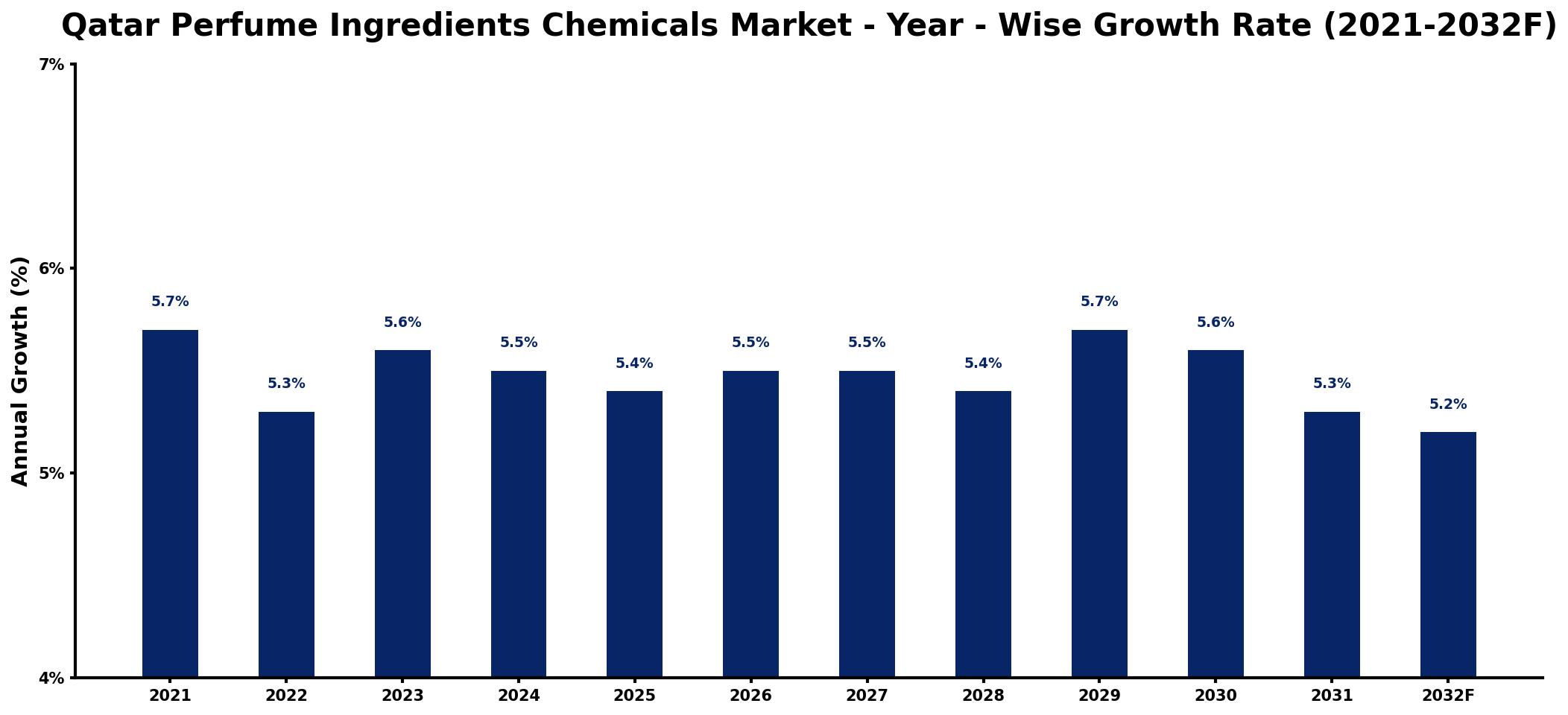
The table below presents the year‑wise growth rates along with the key drivers influencing the market
| Year | Growth Rate | Major Drivers |
| 2021 | 5.7% | Rising consumer fragrance preferences |
| 2022 | 5.3% | Increased luxury market investments |
| 2023 | 5.6% | Growing online retail platforms |
| 2024 | 5.5% | Expansion of artisanal brands |
| 2025 | 5.4% | Emerging markets demand surge |
| 2026 | 5.5% | Sustainable sourcing initiatives growth |
| 2027 | 5.5% | Innovations in scent technologies |
| 2028 | 5.4% | Regional trade agreements enhancement |
| 2029 | 5.7% | Collaborations with fashion industries |
| 2030 | 5.6% | Growing wellness lifestyle trends |
| 2031 | 5.3% | Increased global travel resumption |
| 2032 | 5.2% | Rise of personalized fragrances |
Note: Market size estimations and growth projections presented in this report are based on 6Wresearch's proprietary forecasting methodology, utilizing the latest available industry data, government publications, and primary research inputs.
Qatar Perfume Ingredients Chemicals Market Synopsis
The perfume ingredients chemicals market in Qatar is currently experiencing a transformation, marked by a growing preference for quality and originality in fragrance offerings. As local consumers become increasingly discerning, there is a notable shift towards sourcing premium and exotic ingredients that can create unique scent profiles, aligning with personal identity and luxury lifestyle aspirations.
This evolving landscape is supported by Qatar's dynamic retail sector, which is expanding rapidly to accommodate luxury brands. The ongoing development of retail spaces and boutiques dedicated to high-end fragrances highlights the significant role that perfume ingredients chemicals play in enhancing consumer experiences within this burgeoning market.
Qatar Perfume Ingredients Chemicals Market Key Takeaways
- The market is closely linked to the luxury retail sector, which is thriving in Qatar.
- Consumer awareness surrounding personal grooming is driving demand for unique and high-quality fragrances.
- Local businesses can gain a competitive edge by focusing on sustainable sourcing and unique blends.
- Fluctuations from the COVID-19 pandemic have led to a resilient rebound in consumer spending on fragrances.
- Strategic positioning and innovation are critical for manufacturers in this competitive landscape.
Evaluation of Restraints in Qatar Perfume Ingredients Chemicals Market
Despite its promising growth, the Qatar perfume ingredients chemicals market faces significant challenges. One of the key restraints is the sourcing of rare or exotic materials, which can often be inconsistent and costly, impacting the ability of local manufacturers to produce unique fragrances. Furthermore, competition from established global suppliers poses a threat, as these players typically have more extensive resources for ingredient procurement and research and development. To mitigate these issues, local businesses must emphasize the importance of cultural preferences and sustainable practices, offering products that resonate with consumers' values.
Qatar Perfume Ingredients Chemicals Market Trends
A noticeable trend in the Qatar perfume ingredients chemicals market is the increasing integration of technology in fragrance formulation. Manufacturers are utilizing advanced techniques, such as artificial intelligence and data analytics, to predict consumer preferences and create tailored fragrances. Additionally, there is a growing shift towards natural and organic ingredients, reflecting global sustainability trends. As consumers prioritize eco-friendly products, businesses that focus on ethically sourced materials are likely to appeal to the conscious buyer segment.
Qatar Perfume Ingredients Chemicals Market Opportunities
The future of the Qatar perfume ingredients chemicals market is rich with opportunities for growth and innovation. As the luxury retail sector expands, there is an increasing demand for unique fragrance offerings, paving the way for local businesses to explore bespoke blends and artisanal products. Additionally, collaborations with international fragrance houses can elevate local brands and broaden their appeal. Investment in research and development will be essential to capitalize on emerging trends, particularly in natural and sustainable ingredients.
Government Initiatives in the Qatar Perfume Ingredients Chemicals Market
The Qatari government is actively supporting the fragrance industry through various initiatives aimed at bolstering local production and innovation. Policies promoting entrepreneurship and investment in luxury goods contribute to the growth of the perfume ingredients chemicals market. Additionally, public spending on infrastructure development enhances retail opportunities, providing a conducive environment for both domestic and international players in the fragrance sector.
Future Insights of the Qatar Perfume Ingredients Chemicals Market
Looking ahead to 2026-2032, the Qatar perfume ingredients chemicals market is poised for robust growth, fueled by a confluence of factors including rising disposable income, a burgeoning luxury retail scene, and an increasingly discerning consumer base. The integration of innovative technologies in product development will also shape the future landscape, enabling manufacturers to create personalized fragrance experiences that resonate with consumers. Overall, the market is on track to thrive, driven by evolving consumer preferences and a commitment to quality and sustainability.
Qatar Perfume Ingredients Chemicals Market Latest Developments (2025 - 2026)
In recent months, the Qatar perfume ingredients chemicals market has seen an uptick in activity, with several local firms exploring partnerships with international suppliers to enhance their ingredient portfolios. These collaborations focus on sourcing unique and sustainable raw materials. Additionally, the trend towards personalization has led to innovative product launches, as companies strive to meet the evolving tastes of their affluent customer base. As the market adapts to these dynamics, stakeholders are increasingly attentive to consumer feedback, shaping future offerings.
Qatar Perfume Ingredients Chemicals Market - Key Attractiveness of the Report
- 10 Years of Market Numbers
- Historical Data Starting from 2022 to 2025
- Base Year: 2025
- Forecast Data until 2032
- Key Performance Indicators Impacting the Market
- Major Upcoming Developments and Projects
Key Highlights of the Report:
- Qatar Perfume Ingredients Chemicals Market Outlook
- Market Size of Qatar Perfume Ingredients Chemicals Market, 2025
- Forecast of Qatar Perfume Ingredients Chemicals Market, 2032
- Historical Data and Forecast of Qatar Perfume Ingredients Chemicals Revenues & Volume for the Period 2022-2032F
- Qatar Perfume Ingredients Chemicals Market Trend Evolution
- Qatar Perfume Ingredients Chemicals Market Drivers and Challenges
- Qatar Perfume Ingredients Chemicals Price Trends
- Qatar Perfume Ingredients Chemicals Porter's Five Forces
- Qatar Perfume Ingredients Chemicals Industry Life Cycle
- Historical Data and Forecast of Qatar Perfume Ingredients Chemicals Market Revenues & Volume By Type for the Period 2022-2032F
- Historical Data and Forecast of Qatar Perfume Ingredients Chemicals Market Revenues & Volume By Aromatic chemicals for the Period 2022-2032F
- Historical Data and Forecast of Qatar Perfume Ingredients Chemicals Market Revenues & Volume By Essential oils for the Period 2022-2032F
- Historical Data and Forecast of Qatar Perfume Ingredients Chemicals Market Revenues & Volume By Application for the Period 2022-2032F
- Historical Data and Forecast of Qatar Perfume Ingredients Chemicals Market Revenues & Volume By Soaps and detergents for the Period 2022-2032F
- Historical Data and Forecast of Qatar Perfume Ingredients Chemicals Market Revenues & Volume By Cosmetics and toiletries for the Period 2022-2032F
- Historical Data and Forecast of Qatar Perfume Ingredients Chemicals Market Revenues & Volume By Fine fragrances for the Period 2022-2032F
- Historical Data and Forecast of Qatar Perfume Ingredients Chemicals Market Revenues & Volume By Others for the Period 2022-2032F
- Qatar Perfume Ingredients Chemicals Import Export Trade Statistics
- Market Opportunity Assessment By Type
- Market Opportunity Assessment By Application
- Qatar Perfume Ingredients Chemicals Top Companies Market Share
- Qatar Perfume Ingredients Chemicals Competitive Benchmarking By Technical and Operational Parameters
- Qatar Perfume Ingredients Chemicals Company Profiles
- Qatar Perfume Ingredients Chemicals Key Strategic Recommendations






































