Qatar Perfumes and Perfumery Products Market Summary
The qatar perfumes and perfumery products market was estimated at USD 367 Million in 2025 and is projected to reach USD 492 Million by 2032, growing at a CAGR of 4.9% from 2026 to 2032.
Qatar Perfumes and Perfumery Products Market Year-wise Growth Rate and Key Drivers
This graph highlights how the Qatar Perfumes and Perfumery Products Market has steadily grown over the past five years, supported by major growth factors.
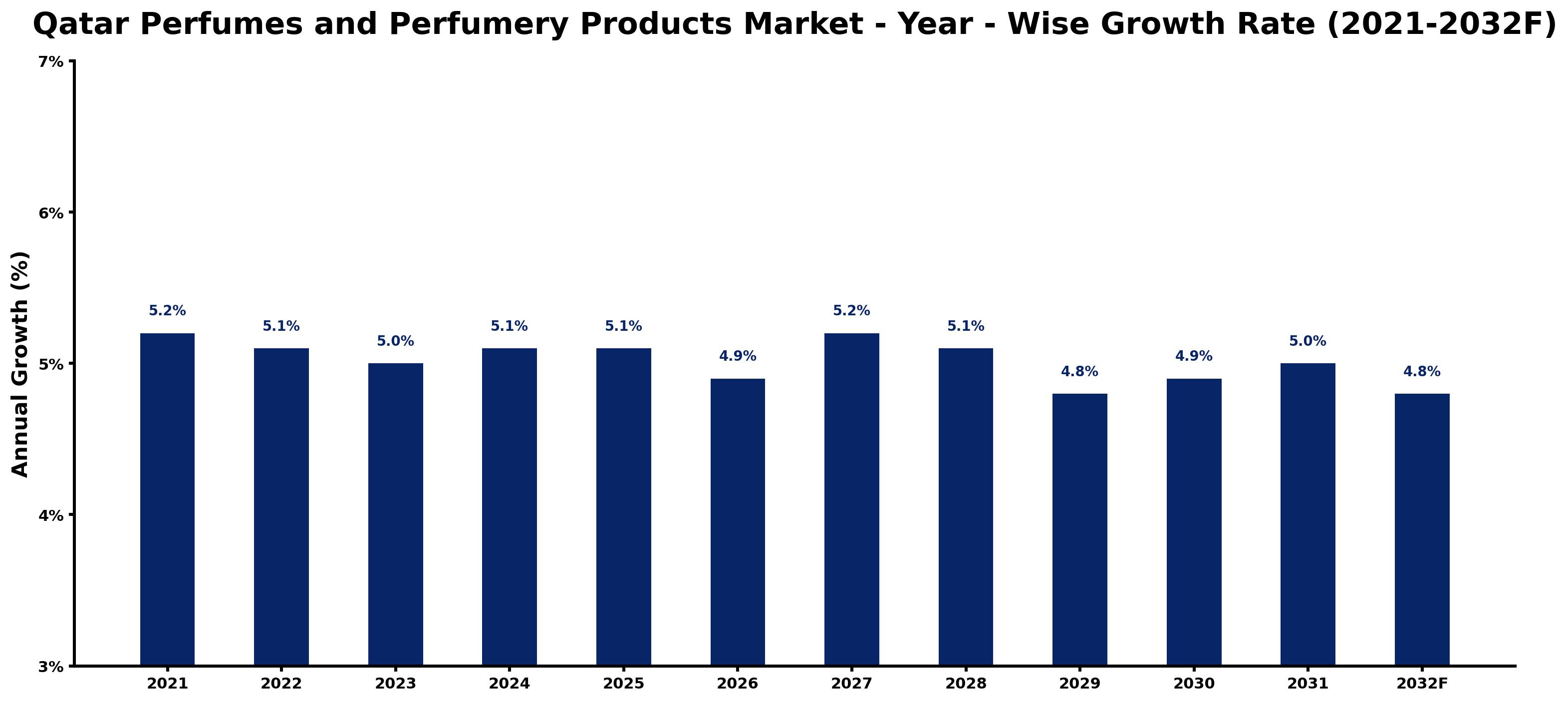
The table below presents the year wise growth rates along with the key drivers influencing the market
| Year | Growth Rate | Major Drivers |
| 2021 | 5.2% | Post-pandemic consumer interest in luxury goods revived spending in perfume sectors. |
| 2022 | 5.1% | Local artisans introduced unique scent blends, enhancing market appeal for niche products. |
| 2023 | 5.0% | E-commerce platforms expanded, facilitating broader access to international fragrance brands. |
| 2024 | 5.1% | Cultural events emphasized traditional scents, boosting local perfumery brand visibility. |
| 2025 | 5.1% | Tourism recovery led to heightened demand for souvenirs, including locally crafted perfumes. |
| 2026 | 4.9% | Sustainability trends prompted brands to explore eco-friendly ingredients and packaging options. |
| 2027 | 5.2% | Increased disposable incomes allowed consumers to invest in premium fragrance experiences. |
| 2028 | 5.1% | Brand collaborations with local artists created exclusive editions, enhancing consumer engagement. |
| 2029 | 4.8% | Market research indicated rising interest in personalized fragrance services among consumers. |
| 2030 | 4.9% | Digital marketing innovations enabled brands to effectively reach tech-savvy younger audiences. |
| 2031 | 5.0% | Luxury hotels and resorts began offering signature scents, increasing brand exposure. |
| 2032 | 4.8% | Local workshops and experiences attracted tourists, further embedding perfumes in cultural identity. |
Note - Market size estimations and growth projections presented in this report are based on 6Wresearch's advanced forecasting approach, validated with industry datasets as of June 2026.
Qatar Perfumes and Perfumery Products Market Synopsis
The Qatar Perfumes and Perfumery Products Market is projected to reach 4.9% and witness significant growth during the forecast period (2026-2032). This evolving market is characterized by the rising spending power of consumers, who increasingly view personal care products, including fragrances, as essential status symbols. Coupled with rapid urbanization, this consumer trend has led to a proliferation of shopping malls offering premium international brands at competitive prices, thus enhancing sales volumes across the sector. Furthermore, the surge in e-commerce accessibility has expanded the reach of various perfume types, facilitating a broader consumer base eager to experiment with new scents.
Qatar Perfumes and Perfumery Products Market Growth Drivers
The growth of the Qatar Perfumes and Perfumery Products Market can be attributed to multiple factors that synergistically enhance demand:
- The increasing disposable income among consumers has prompted greater expenditure on luxury personal care items, notably fragrances, thus driving market growth.
- Urbanization in Qatar has resulted in an enhanced retail landscape, with modern shopping malls featuring dedicated perfume sections that cater to a diverse clientele.
- Heightened awareness of different perfume types and their distinct characteristics motivates consumers to explore various offerings, thereby boosting market demand.
- The flourishing e-commerce sector facilitates convenient shopping experiences, allowing consumers to access a wider range of products and brands than ever before.
- Product innovation through the introduction of new flavors and fragrances coupled with effective promotional strategies by manufacturers has further attracted a more substantial customer base.
Qatar Perfumes and Perfumery Products Market Challenges and Restraints
Despite the promising growth trajectory of the Qatar Perfumes and Perfumery Products Market, several challenges threaten to impede its progress:
- Intense competition from unorganized local players offering lower-priced alternatives is a significant challenge, as it exerts downward pressure on profit margins for established brands.
- Counterfeit products pose a considerable risk, as they are often sold at reduced prices, potentially undermining consumer trust in genuine products and brands.
- Economic fluctuations may impact consumer spending on luxury items like perfumes, creating uncertainty within the market.
- Regulatory hurdles related to product safety and labeling can complicate market entry and expansion for new brands.
- Shifts in consumer preferences towards more sustainable and ethical products are changing the landscape, requiring brands to adapt quickly.
Qatar Perfumes and Perfumery Products Market Government Investment and Initiatives
The Qatari government has implemented various initiatives aimed at enhancing the growth of the perfume and perfumery sector. Investments in infrastructure, including the development of commercial hubs and retail spaces, support the expansion of luxury goods markets. Public spending on cultural initiatives promotes the appreciation of local artistry in fragrance creation, fostering a unique identity for Qatari perfumes. Additionally, the government encourages foreign investment in the retail sector, providing incentives for international brands to establish a presence in the market. These initiatives are expected to create a conducive environment for both local and foreign players, fostering a dynamic and competitive atmosphere.
Qatar Perfumes and Perfumery Products Market Latest Developments (May 2025 - June 2026)
Recent developments in the Qatar Perfumes and Perfumery Products Market indicate a growing trend towards innovation and sustainability. Manufacturers are increasingly incorporating natural ingredients into their fragrances, catering to a rising consumer preference for eco-friendly products. Additionally, there has been a noticeable shift towards personalized fragrance experiences, with brands offering customization options to enhance customer engagement. The retail landscape has also evolved, with an uptick in offline experiences being complemented by robust online sales channels. This hybrid approach enables brands to reach broader audiences and adapt to changing consumer behaviors, ensuring resilience against market fluctuations.
Qatar Perfumes and Perfumery Products Market - Key Attractiveness of the Report
- 10 Years of Market Numbers
- Historical Data Starting from 2022 to 2025
- Base Year: 2025
- Forecast Data until 2032
- Key Performance Indicators Impacting the Market
- Major Upcoming Developments and Projects
Key Highlights of the Report:
- Qatar Perfumes and Perfumery Products Market Outlook
- Market Size of Qatar Perfumes and Perfumery Products Market, 2025
- Forecast of Qatar Perfumes and Perfumery Products Market, 2032
- Historical Data and Forecast of Qatar Perfumes and Perfumery Products Revenues & Volume for the Period 2022-2032F
- Qatar Perfumes and Perfumery Products Market Trend Evolution
- Qatar Perfumes and Perfumery Products Market Drivers and Challenges
- Qatar Perfumes and Perfumery Products Price Trends
- Qatar Perfumes and Perfumery Products Porter's Five Forces
- Qatar Perfumes and Perfumery Products Industry Life Cycle
- Historical Data and Forecast of Qatar Perfumes and Perfumery Products Market Revenues & Volume By Product for the Period 2022-2032F
- Historical Data and Forecast of Qatar Perfumes and Perfumery Products Market Revenues & Volume By Premium for the Period 2022-2032F
- Historical Data and Forecast of Qatar Perfumes and Perfumery Products Market Revenues & Volume By Mass for the Period 2022-2032F
- Historical Data and Forecast of Qatar Perfumes and Perfumery Products Market Revenues & Volume By End-User for the Period 2022-2032F
- Historical Data and Forecast of Qatar Perfumes and Perfumery Products Market Revenues & Volume By Men for the Period 2022-2032F
- Historical Data and Forecast of Qatar Perfumes and Perfumery Products Market Revenues & Volume By Women for the Period 2022-2032F
- Historical Data and Forecast of Qatar Perfumes and Perfumery Products Market Revenues & Volume By Unisex for the Period 2022-2032F
- Historical Data and Forecast of Qatar Perfumes and Perfumery Products Market Revenues & Volume By Distribution Channel for the Period 2022-2032F
- Historical Data and Forecast of Qatar Perfumes and Perfumery Products Market Revenues & Volume By Online for the Period 2022-2032F
- Historical Data and Forecast of Qatar Perfumes and Perfumery Products Market Revenues & Volume By Offline for the Period 2022-2032F
- Qatar Perfumes and Perfumery Products Import Export Trade Statistics
- Market Opportunity Assessment By Product
- Market Opportunity Assessment By End-User
- Market Opportunity Assessment By Distribution Channel
- Qatar Perfumes and Perfumery Products Top Companies Market Share
- Qatar Perfumes and Perfumery Products Competitive Benchmarking By Technical and Operational Parameters
- Qatar Perfumes and Perfumery Products Company Profiles
- Qatar Perfumes and Perfumery Products Key Strategic Recommendations






































