Qatar Pest Control Products Market Summary
The qatar pest control products market was estimated at USD 236 Million in 2025 and is projected to reach USD 333 Million by 2032, growing at a CAGR of 6.3% from 2026 to 2032.
Qatar Pest Control Products Market Year-wise Growth Rate and Key Drivers
This graph highlights how the Qatar Pest Control Products Market has steadily grown over the past five years, supported by major growth factors.
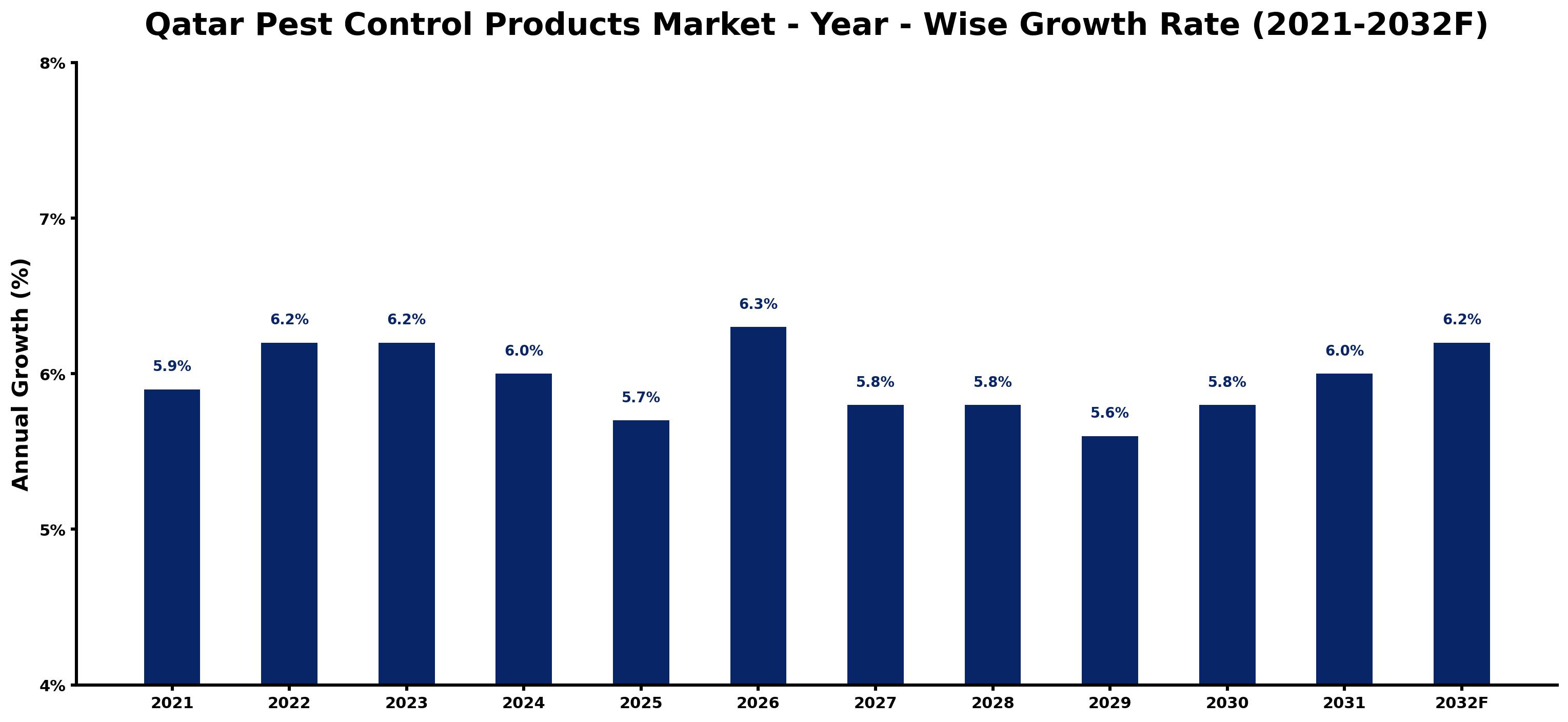
The table below presents the year wise growth rates along with the key drivers influencing the market
| Year | Growth Rate | Major Drivers |
| 2021 | 5.9% | Post-lockdown retail projects elevated pest issues in urban and suburban areas. |
| 2022 | 6.2% | Increased property developments created a higher demand for pest control solutions. |
| 2023 | 6.2% | Hot climate conditions in Qatar intensified the need for effective pest management products. |
| 2024 | 6.0% | Corporate budgets focused on facility maintenance boosted pest control product investments. |
| 2025 | 5.7% | Rising health awareness prompted consumers to prioritize pest-free living environments. |
| 2026 | 6.3% | Technological innovations in pest control enhanced product effectiveness and consumer trust. |
| 2027 | 5.8% | Expansion of e-commerce platforms simplified access to pest control solutions for consumers. |
| 2028 | 5.8% | International expertise in pest management attracted new companies to the regional market. |
| 2029 | 5.6% | Sustainability trends encouraged the development of eco-friendly pest control products. |
| 2030 | 5.8% | Local partnerships facilitated better distribution networks for pest control supplies nationally. |
| 2031 | 6.0% | Urbanization trends increased pest populations, necessitating consistent pest control measures. |
| 2032 | 6.2% | Cultural shifts towards health-oriented living further cemented pest control's market relevance. |
Note - Market size estimations and growth projections presented in this report are based on 6Wresearch's advanced forecasting approach, validated with industry datasets as of June 2026.
Qatar Pest Control Products Market Synopsis
The Qatar Pest Control Products Market is projected to reach 6.3% and witness significant growth during the forecast period (2026-2032). This growth is driven by the increasing prevalence of pests such as houseflies, mosquitoes, cockroaches, and rodents, which thrive in Qatar's tropical climate. As public awareness regarding hygiene and health escalates, the demand for effective pest control solutions is poised to surge. This report delves into the factors influencing the Qatar Pest Control Products Market, highlighting its potential for expansion and the challenges that may impede growth.
Qatar Pest Control Products Market Growth Drivers
The Qatar Pest Control Products Market is witnessing a range of growth drivers that are propelling its expansion:
- The tropical climate of Qatar creates an environment conducive to the proliferation of pests, necessitating effective pest control solutions in both residential and commercial spaces.
- Heightened awareness of public health concerns related to pest infestations has led individuals and businesses to prioritize pest control, driving demand for pest control products.
- Government initiatives aimed at promoting public health and safety have resulted in increased spending on pest management solutions, further fueling market growth.
- The introduction of innovative and eco-friendly pest control products has attracted a growing customer base, aligning with consumer preferences for safer alternatives.
- With an expanding urban population, the need for pest control services in densely populated areas is rising, adding to market demand.
Qatar Pest Control Products Market Challenges and Restraints
Despite the growth prospects, the Qatar Pest Control Products Market faces several challenges:
- Stringent government regulations on the use of chemical pesticides due to environmental concerns have pressured manufacturers to innovate and develop eco-friendly solutions.
- The impact of the COVID-19 pandemic led to temporary disruptions in supply chains, affecting product availability and market dynamics.
- Consumer preferences are shifting toward organic and less toxic pest control methods, which may limit the acceptance of traditional chemical products.
- Seasonal fluctuations in pest activity can lead to unpredictable demand for pest control products, complicating inventory management for suppliers.
- The market is characterized by a high level of competition, which can lead to price wars and reduced profit margins for manufacturers.
Qatar Pest Control Products Market Government Investment and Initiatives
The Qatari government has implemented various initiatives aimed at tackling public health challenges posed by pests, thereby impacting the Qatar Pest Control Products Market. These initiatives include:
- Investment in public health campaigns that educate citizens about the risks associated with pest infestations and the importance of effective pest management.
- Funding for research and development in pest control technologies that prioritize environmental sustainability, encouraging manufacturers to innovate.
- Regulatory frameworks that promote the use of integrated pest management practices, ensuring that pest control measures are both effective and ecologically responsible.
- Increased inspections and enforcement of hygiene standards in commercial establishments, leading to a rising demand for pest control products in the hospitality and food industries.
- Collaboration with international organizations to adopt best practices in pest control and public health management, enhancing the effectiveness of local pest control strategies.
Qatar Pest Control Products Market Latest Developments (May 2025 - June 2026)
The period from May 2025 to June 2026 has seen notable developments in the Qatar Pest Control Products Market. Key trends observed include:
- An increasing number of companies are focusing on the introduction of organic and biodegradable pest control options, catering to the growing demand for environmentally friendly solutions.
- Technological advancements, including the use of smart pest control systems and IoT-enabled devices, are becoming more prevalent, enhancing the effectiveness of pest management.
- Market players are increasingly adopting digital marketing strategies to reach consumers directly, capitalizing on the shift toward online purchasing in the wake of COVID-19.
- Collaborative efforts between pest control companies and local authorities are fostering more comprehensive pest management initiatives in urban areas.
- As travel restrictions are lifted, a resurgence in hospitality and tourism is expected to increase demand for pest control services, particularly in hotels and restaurants.
Qatar Pest Control Products Market - Key Attractiveness of the Report
- 10 Years of Market Numbers
- Historical Data Starting from 2022 to 2025
- Base Year: 2025
- Forecast Data until 2032
- Key Performance Indicators Impacting the Market
- Major Upcoming Developments and Projects
Key Highlights of the Report:
- Qatar Pest Control Products Market Outlook
- Market Size of Qatar Pest Control Products Market, 2025
- Forecast of Qatar Pest Control Products Market, 2032
- Historical Data and Forecast of Qatar Pest Control Products Revenues & Volume for the Period 2022-2032F
- Qatar Pest Control Products Market Trend Evolution
- Qatar Pest Control Products Market Drivers and Challenges
- Qatar Pest Control Products Price Trends
- Qatar Pest Control Products Porter's Five Forces
- Qatar Pest Control Products Industry Life Cycle
- Historical Data and Forecast of Qatar Pest Control Products Market Revenues & Volume By Type for the Period 2022-2032F
- Historical Data and Forecast of Qatar Pest Control Products Market Revenues & Volume By Chemical for the Period 2022-2032F
- Historical Data and Forecast of Qatar Pest Control Products Market Revenues & Volume By Mechanical for the Period 2022-2032F
- Historical Data and Forecast of Qatar Pest Control Products Market Revenues & Volume By Biological for the Period 2022-2032F
- Historical Data and Forecast of Qatar Pest Control Products Market Revenues & Volume By Others for the Period 2022-2032F
- Historical Data and Forecast of Qatar Pest Control Products Market Revenues & Volume By Pest type for the Period 2022-2032F
- Historical Data and Forecast of Qatar Pest Control Products Market Revenues & Volume By Insects for the Period 2022-2032F
- Historical Data and Forecast of Qatar Pest Control Products Market Revenues & Volume By Termites for the Period 2022-2032F
- Historical Data and Forecast of Qatar Pest Control Products Market Revenues & Volume By Rodents for the Period 2022-2032F
- Historical Data and Forecast of Qatar Pest Control Products Market Revenues & Volume By Others for the Period 2022-2032F
- Historical Data and Forecast of Qatar Pest Control Products Market Revenues & Volume By Application for the Period 2022-2032F
- Historical Data and Forecast of Qatar Pest Control Products Market Revenues & Volume By Commercial for the Period 2022-2032F
- Historical Data and Forecast of Qatar Pest Control Products Market Revenues & Volume By Residential for the Period 2022-2032F
- Historical Data and Forecast of Qatar Pest Control Products Market Revenues & Volume By Agriculture for the Period 2022-2032F
- Historical Data and Forecast of Qatar Pest Control Products Market Revenues & Volume By Industrial for the Period 2022-2032F
- Historical Data and Forecast of Qatar Pest Control Products Market Revenues & Volume By Others for the Period 2022-2032F
- Qatar Pest Control Products Import Export Trade Statistics
- Market Opportunity Assessment By Type
- Market Opportunity Assessment By Pest type
- Market Opportunity Assessment By Application
- Qatar Pest Control Products Top Companies Market Share
- Qatar Pest Control Products Competitive Benchmarking By Technical and Operational Parameters
- Qatar Pest Control Products Company Profiles
- Qatar Pest Control Products Key Strategic Recommendations






































