Qatar Plastic Film Market Summary
The qatar plastic film market was estimated at USD 443 Million in 2025 and is projected to reach USD 622 Million by 2032, growing at a CAGR of 6.0% from 2026 to 2032.
Qatar Plastic Film Market Year-wise Growth Rate and Key Drivers
This graph highlights how the Qatar Plastic Film Market has steadily grown over the past five years, supported by major growth factors.
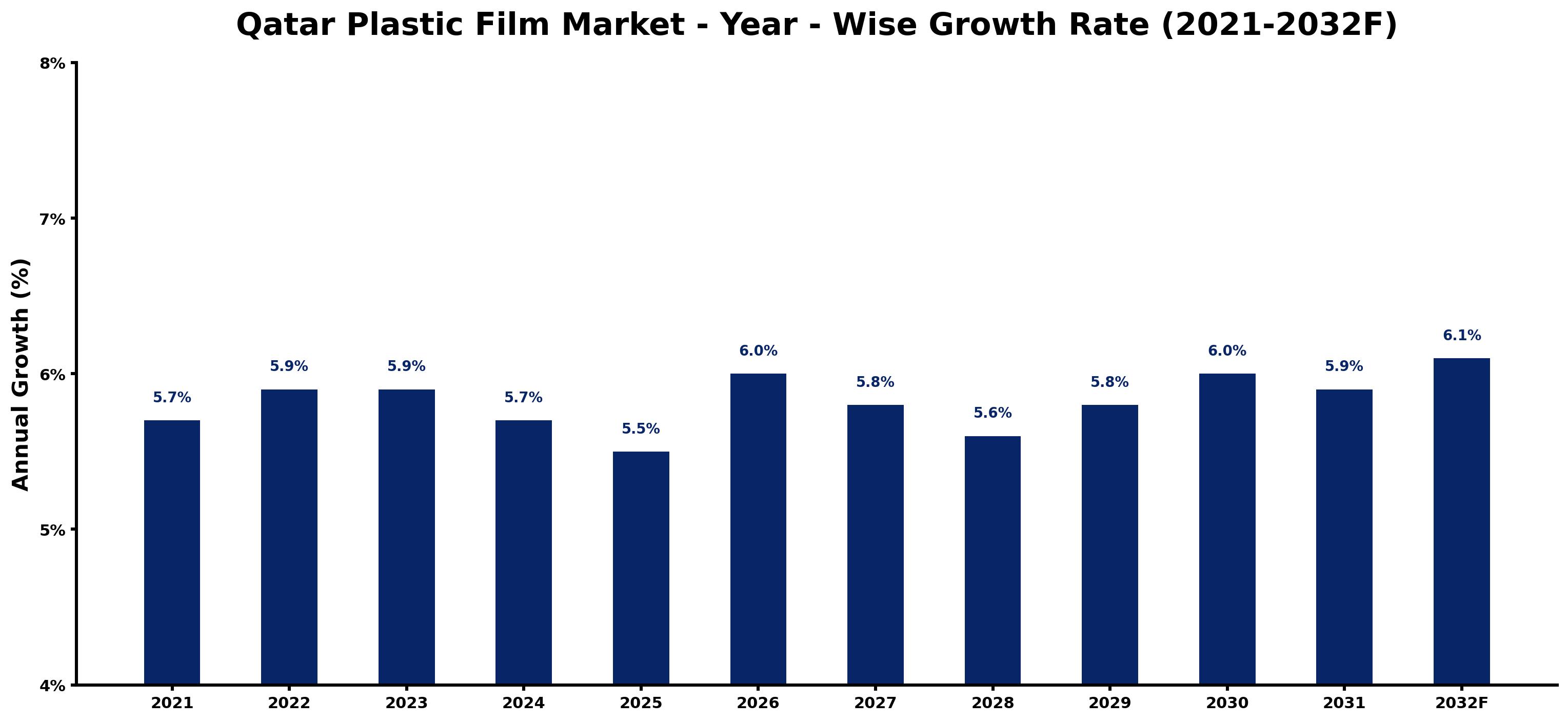
The table below presents the year wise growth rates along with the key drivers influencing the market
| Year | Growth Rate | Major Drivers |
| 2021 | 5.7% | Plastic film applications continue to expand in packaging and construction sectors. |
| 2022 | 5.9% | Local manufacturing initiatives reduce reliance on imports for plastic film materials. |
| 2023 | 5.9% | Major construction projects in Qatar stimulate significant demand for protective films. |
| 2024 | 5.7% | Environmental concerns prompt investments in biodegradable plastic film technologies. |
| 2025 | 5.5% | Technological advancements enhance the quality and functionality of plastic films. |
| 2026 | 6.0% | Increased scrutiny on waste management leads to innovations in recycling methods. |
| 2027 | 5.8% | E-commerce growth necessitates improved packaging solutions, boosting plastic film usage. |
| 2028 | 5.6% | Regional trade agreements facilitate easier market access for plastic film suppliers. |
| 2029 | 5.8% | Energy-efficient solutions become a priority, influencing material choice in manufacturing. |
| 2030 | 6.0% | Consumer preferences shift towards sustainable products, impacting plastic film production. |
| 2031 | 5.9% | Corporate responsibility initiatives lead to heightened transparency in supply chains. |
| 2032 | 6.1% | Digital transformation in manufacturing reduces costs and enhances production efficiency. |
Note - Market size estimations and growth projections presented in this report are based on 6Wresearch's advanced forecasting approach, validated with industry datasets as of June 2026.
Qatar Plastic Film Market Synopsis
The Qatar Plastic Film Market is projected to reach 6.0% and witness significant growth during the forecast period (2026-2032). This market is primarily driven by the rapid demographic shifts in Qatar, characterized by a burgeoning population, which has been fueled by the nation's economic advancement and enhanced infrastructure development. As these factors converge, there is an escalating demand for plastic packaging solutions, particularly plastic films, which are integral for protection and convenience in various applications.
Qatar Plastic Film Market Growth Drivers
Several key drivers are influencing the growth trajectory of the Qatar Plastic Film Market. The first is the remarkable expansion of the e-commerce sector within the nation. As consumers increasingly prefer online shopping, the necessity for reliable packaging solutions that safeguard products during transit has dramatically increased.
- Rising disposable incomes have empowered consumers to spend more on packaged goods, further propelling the demand for plastic films that offer an appealing balance of convenience and safety.
- The versatility of plastic films, particularly Low Density Polyethylene (LDPE), which offers excellent barrier properties, makes them suitable for various applications, including food and pharmaceutical packaging.
- Government initiatives aimed at boosting foreign direct investment are also playing a crucial role in the market's growth by enhancing manufacturing capacities, thereby increasing the local supply of plastic packaging products.
- The increasing focus on sustainability is prompting manufacturers to develop eco-friendly plastic films, which are gaining traction in various sectors.
- Finally, the integration of advanced technologies in the production processes is leading to higher efficiency and quality of plastic films, making them more attractive to end-users.
Qatar Plastic Film Market Trends and Opportunities
The Qatar Plastic Film Market is experiencing notable trends that present opportunities for growth and innovation. A significant trend is the shift towards flexible packaging solutions. Flexibility in packaging not only enhances convenience but also reduces waste, aligning with the global push towards sustainability.
- There is a growing inclination among consumers and businesses alike to adopt eco-friendly alternatives. This shift is encouraging manufacturers to invest in biodegradable films and recyclable materials, thus broadening their product portfolios.
- Advanced printing technologies are now being utilized on plastic films, allowing for high-quality graphics and branding opportunities, which are invaluable in competitive markets.
- The demand for customized film solutions is on the rise, as companies strive to meet specific product needs and improve functionalities such as moisture retention and UV resistance.
- Concurrently, the market is witnessing increased focus on automation and smart packaging, aimed at enhancing supply chain efficiency and product traceability.
- Expansion into neighboring markets presents further opportunities for growth, as regional demand for plastic films increases in accordance with broader economic trends.
Qatar Plastic Film Market Challenges and Restraints
Despite its promising outlook, the Qatar Plastic Film Market faces several challenges that could hinder its growth. One of the predominant concerns is the increasing regulatory pressure regarding plastic use and waste management. Stricter laws are being implemented to reduce plastic pollution, which may restrict the market.
- The volatility in raw material prices is another significant challenge, as fluctuations can directly impact production costs and pricing strategies for plastic films.
- Competition from alternative packaging materials, such as glass or metal, is intensifying, as these materials are often perceived as more sustainable.
- Technological advancements are required to improve the recyclability and sustainability of plastic films, which necessitates ongoing investment and innovation.
- In addition, there is a growing public sentiment against single-use plastics, which may challenge the growth of traditional plastic film applications.
Qatar Plastic Film Market Government Investment and Initiatives
The Qatari government plays a pivotal role in shaping the landscape of the plastic film market through several strategic investments and initiatives. The government has laid out comprehensive development plans that focus on enhancing industrial capabilities within the country, which inherently boosts demand for packaging solutions.
- Key initiatives include the provision of subsidies and tax incentives aimed at attracting foreign investment into the manufacturing sector, creating a conducive environment for plastic film production.
- The National Development Strategy emphasizes sustainability, pushing for research and development in eco-friendly packaging alternatives, which aligns with global best practices.
- Public spending on infrastructure developments is also significant, indirectly fueling the plastic packaging sector by enhancing logistics and distribution networks.
- Furthermore, partnerships between government entities and private organizations are promoting advancements in manufacturing technologies, which are crucial for enhancing the quality and efficiency of plastic films.
- Overall, these government initiatives are essential not only for domestic manufacturers but also for creating a sustainable future for the plastic film industry in Qatar.
Qatar Plastic Film Market Latest Developments (May 2025 - June 2026)
Recent developments within the Qatar Plastic Film Market indicate a shift towards innovation and sustainability. Key trends observed during this period encompass an increased emphasis on biodegradable and recyclable materials, reflecting a growing awareness of environmental implications. Meanwhile, ongoing efforts to enhance production technologies have resulted in improved efficiency and quality in the manufacturing of plastic films.
- The market has seen a surge in investments directed towards research and development initiatives aimed at creating smarter and more sustainable packaging solutions.
- Emerging packaging formats have gained traction, as companies explore flexible options that cater to evolving consumer preferences for convenience and sustainability.
- Regulatory changes have prompted manufacturers to adapt their product lines to comply with new environmental standards, promoting a shift towards sustainable packaging solutions.
- Increased collaboration between public and private sectors has fostered innovation, enhancing the overall growth potential of the market.
- The overall trajectory of the market suggests a continued focus on sustainable practices, positioning Qatar as a responsible player in the global plastic film industry.
Qatar Plastic Film Market - Key Attractiveness of the Report
- 10 Years of Market Numbers
- Historical Data Starting from 2022 to 2025
- Base Year: 2025
- Forecast Data until 2032
- Key Performance Indicators Impacting the Market
- Major Upcoming Developments and Projects
Key Highlights of the Report:
- Qatar Plastic Film Market Outlook
- Market Size of Qatar Plastic Film Market, 2025
- Forecast of Qatar Plastic Film Market, 2032F
- Historical Data and Forecast of Qatar Plastic Film Revenues & Volume for the Period 2022-2032F
- Qatar Plastic Film Market Trend Evolution
- Qatar Plastic Film Market Drivers and Challenges
- Qatar Plastic Film Price Trends
- Qatar Plastic Film Porter's Five Forces
- Qatar Plastic Film Industry Life Cycle
- Historical Data and Forecast of Qatar Plastic Film Market Revenues & Volume By Product Types for the Period 2022-2032F
- Historical Data and Forecast of Qatar Plastic Film Market Revenues & Volume By Polyethylene (PE) for the Period 2022-2032F
- Historical Data and Forecast of Qatar Plastic Film Market Revenues & Volume By Polypropylene (PP) for the Period 2022-2032F
- Historical Data and Forecast of Qatar Plastic Film Market Revenues & Volume By Polyvinyl chloride (PVC) for the Period 2022-2032F
- Historical Data and Forecast of Qatar Plastic Film Market Revenues & Volume By Polyethylene terephthalate (PET) for the Period 2022-2032F
- Historical Data and Forecast of Qatar Plastic Film Market Revenues & Volume By Others for the Period 2022-2032F
- Historical Data and Forecast of Qatar Plastic Film Market Revenues & Volume By Applications for the Period 2022-2032F
- Historical Data and Forecast of Qatar Plastic Film Market Revenues & Volume By Packaging for the Period 2022-2032F
- Historical Data and Forecast of Qatar Plastic Film Market Revenues & Volume By Construction for the Period 2022-2032F
- Historical Data and Forecast of Qatar Plastic Film Market Revenues & Volume By Electricals & Electronics for the Period 2022-2032F
- Historical Data and Forecast of Qatar Plastic Film Market Revenues & Volume By Automotive for the Period 2022-2032F
- Historical Data and Forecast of Qatar Plastic Film Market Revenues & Volume By Pharmaceutical for the Period 2022-2032F
- Historical Data and Forecast of Qatar Plastic Film Market Revenues & Volume By Agriculture for the Period 2022-2032F
- Historical Data and Forecast of Qatar Plastic Film Market Revenues & Volume By Consumer Goods for the Period 2022-2032F
- Historical Data and Forecast of Qatar Plastic Film Market Revenues & Volume By Utility for the Period 2022-2032F
- Qatar Plastic Film Import Export Trade Statistics
- Market Opportunity Assessment By Product Types
- Market Opportunity Assessment By Applications
- Qatar Plastic Film Top Companies Market Share
- Qatar Plastic Film Competitive Benchmarking By Technical and Operational Parameters
- Qatar Plastic Film Company Profiles
- Qatar Plastic Film Key Strategic Recommendations






































