Qatar Pliers Market Summary
The qatar pliers market was estimated at USD 423 Million in 2025 and is projected to reach USD 571 Million by 2032, growing at a CAGR of 4.9% from 2026 to 2032.
Qatar Pliers Market Year-wise Growth Rate and Key Drivers
This graph highlights how the Qatar Pliers Market has steadily grown over the past five years, supported by major growth factors.
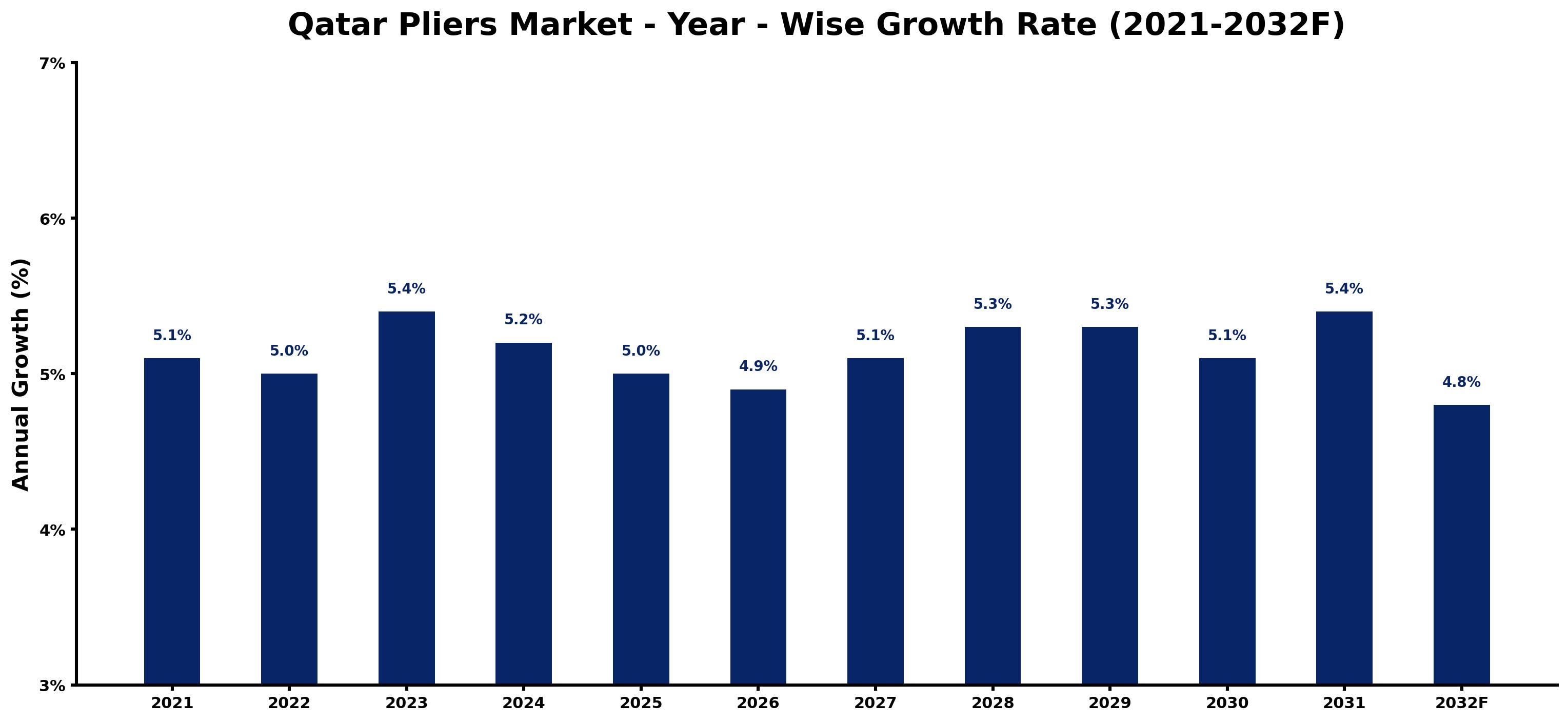
The table below presents the year wise growth rates along with the key drivers influencing the market
| Year | Growth Rate | Major Drivers |
| 2021 | 5.1% | Construction projects focused on infrastructure significantly boost the tool market's demand. |
| 2022 | 5.0% | Localization initiatives encourage domestic production, reducing reliance on imported tools. |
| 2023 | 5.4% | Expansion of the oil and gas sector creates additional tools and equipment needs. |
| 2024 | 5.2% | Increased investment in residential developments drives a need for quality hand tools. |
| 2025 | 5.0% | Regional trade agreements enhance market access, benefiting local tool manufacturers. |
| 2026 | 4.9% | Shift towards smart tools and technology integration attracts new market entrants. |
| 2027 | 5.1% | Engineering colleges produce skilled labor, improving craftsmanship in tool usage. |
| 2028 | 5.3% | E-commerce platforms expand distribution channels, reaching previously untapped customer segments. |
| 2029 | 5.3% | Emerging green buildings demand specialized tools for sustainable construction practices. |
| 2030 | 5.1% | Urbanization in Qatar necessitates continuous upgrading of infrastructure and facilities. |
| 2031 | 5.4% | Workforce training programs lead to increased proficiency in tool utilization and safety. |
| 2032 | 4.8% | Growing DIY culture encourages consumers to invest in high-quality hand tools. |
Note - Market size estimations and growth projections presented in this report are based on 6Wresearch's advanced forecasting approach, validated with industry datasets as of June 2026.
Qatar Pliers Market Synopsis
The Qatar Pliers Market is projected to reach 4.9% and witness significant growth during the forecast period (2026-2032). This market is an integral part of the hand tools sector, encompassing a variety of pliers employed for gripping, holding, bending, and cutting materials across multiple applications. Pliers play a vital role in sectors such as construction, automotive, electrical, and maintenance, highlighting their essential function in both professional and DIY environments.
Qatar Pliers Market Growth Drivers
The growth of the Qatar Pliers Market is predominantly influenced by several factors. Firstly, significant infrastructure development in the country, fueled by ambitious construction projects such as stadiums, roads, and public facilities, has heightened the demand for various hand tools including pliers. As construction activities increase, the need for reliable and efficient hand tools becomes paramount.
- Qatar's rapid urbanization is spurring higher demand for versatile tools, including pliers, essential for construction tasks.
- The expansion of the industrial and manufacturing sectors is leading to greater usage of hand tools in assembly and maintenance activities, thus driving market growth.
- There is an increasing trend among homeowners and hobbyists in Qatar towards do-it-yourself (DIY) projects, further boosting the demand for pliers.
- With the automotive industry experiencing growth, the need for pliers in vehicle repair and maintenance becomes increasingly significant.
- The government's supportive infrastructure initiatives are likely to create a favorable environment for the continued expansion of the pliers market.
Qatar Pliers Market Trends and Opportunities
The Qatar Pliers Market is witnessing trends that shape its future landscape. A notable trend is the growing popularity of ergonomically designed tools that enhance user comfort and efficiency. Manufacturers are increasingly focusing on this aspect to cater to both professional tradespeople and DIY enthusiasts. Additionally, the integration of advanced materials in pliers production is becoming commonplace, which contributes to durability and performance.
- The trend toward eco-friendly tools is influencing the production process, with an emphasis on sustainable materials and practices.
- Technological advancements are leading to the development of multi-functional pliers that meet various user needs, expanding market possibilities.
- Increased awareness and implementation of safety standards in construction and electrical sectors are bolstering the demand for high-quality pliers.
- The rise in online retailing is providing consumers with greater access to a broad range of pliers, encouraging competitive pricing and variety.
- Partnerships between local distributors and international manufacturers are becoming prevalent, enhancing the product availability in the Qatar market.
Qatar Pliers Market Challenges and Restraints
Despite the positive growth outlook, the Qatar Pliers Market must navigate several challenges. One of the primary concerns is the increasing prevalence of power tools, which can deter the use of traditional hand tools like pliers. The convenience of power tools often leads to preference shifts among users in various sectors.
- Fluctuations in raw material prices pose a significant challenge to manufacturers, potentially leading to increased production costs and affecting overall market pricing.
- The economic uncertainties resulting from global events can hinder market growth, particularly in non-essential segments, where demand for pliers may decline.
- Supply chain disruptions, which became evident during the Covid-19 pandemic, can impact the timely availability of pliers in the market.
- The competition from low-cost imports may challenge local manufacturers, affecting their market share and profitability.
- Consumer preferences are continuously evolving, necessitating constant innovation among manufacturers to stay relevant in the market.
Qatar Pliers Market Government Investment and Initiatives
The Qatari government plays a crucial role in shaping the landscape of the pliers market through various investment initiatives and public spending programs. The ongoing economic diversification strategy aims to reduce dependence on hydrocarbon industries and promote growth in non-oil sectors, including construction and manufacturing. Such initiatives are fostering an environment favorable for the development of the hand tools market.
- The government's commitment to ambitious infrastructure projects is generating significant demand for tools, including pliers, required for construction and maintenance.
- Public investments in vocational training programs are enhancing skilled labor availability, subsequently increasing the requirement for quality hand tools.
- Policies promoting local manufacturing aim to bolster the domestic production of pliers, reducing reliance on imports and improving supply chain resilience.
- The establishment of free trade zones encourages international partnerships in the tool manufacturing sector, potentially increasing market access for innovative products.
- Investment in research and development is being prioritized to bring advanced technology in tool manufacturing, thus encouraging better productivity and safety standards.
Qatar Pliers Market Latest Developments (May 2025 - June 2026)
The period from May 2025 to June 2026 is expected to witness several notable developments in the Qatar Pliers Market. Industry players are likely to adapt to the changing market dynamics influenced by both local and global trends. Innovations in tool designs, focusing on efficiency and ergonomics, will likely become a focal point as manufacturers strive to meet the evolving preferences of consumers.
- Recent initiatives aimed at enhancing local manufacturing capabilities may drive an increase in homegrown pliers production, improving market competitiveness.
- Increased collaborations between government agencies and private sector stakeholders are expected to foster technological advancements in hand tool manufacturing.
- The growing focus on sustainability in production practices is likely to shape product offerings, emphasizing eco-friendly material usage.
- A surge in DIY activity among the population may see an uptick in retail offerings of pliers, showcasing a diverse range of products.
- The period may also witness enhanced distribution channels, with an increasing number of suppliers adopting online platforms for broader market reach.
Qatar Pliers Market - Key Attractiveness of the Report
- 10 Years of Market Numbers
- Historical Data Starting from 2022 to 2025
- Base Year: 2025
- Forecast Data until 2032
- Key Performance Indicators Impacting the Market
- Major Upcoming Developments and Projects
Key Highlights of the Report:
- Qatar Pliers Market Outlook
- Market Size of Qatar Pliers Market, 2025
- Forecast of Qatar Pliers Market, 2032
- Historical Data and Forecast of Qatar Pliers Revenues & Volume for the Period 2022-2032F
- Qatar Pliers Market Trend Evolution
- Qatar Pliers Market Drivers and Challenges
- Qatar Pliers Price Trends
- Qatar Pliers Porter's Five Forces
- Qatar Pliers Industry Life Cycle
- Historical Data and Forecast of Qatar Pliers Market Revenues & Volume By Types for the Period 2022-2032F
- Historical Data and Forecast of Qatar Pliers Market Revenues & Volume By Cutting pliers for the Period 2022-2032F
- Historical Data and Forecast of Qatar Pliers Market Revenues & Volume By Crimping pliers for the Period 2022-2032F
- Historical Data and Forecast of Qatar Pliers Market Revenues & Volume By Linesman?s Pliers for the Period 2022-2032F
- Historical Data and Forecast of Qatar Pliers Market Revenues & Volume By Locking Pliers for the Period 2022-2032F
- Historical Data and Forecast of Qatar Pliers Market Revenues & Volume By Needle-Nose Pliers for the Period 2022-2032F
- Historical Data and Forecast of Qatar Pliers Market Revenues & Volume By Water-Pump Pliers for the Period 2022-2032F
- Historical Data and Forecast of Qatar Pliers Market Revenues & Volume By Diagonal Pliers for the Period 2022-2032F
- Historical Data and Forecast of Qatar Cutting pliers Pliers Market Revenues & Volume By Others for the Period 2022-2032F
- Historical Data and Forecast of Qatar Pliers Market Revenues & Volume By Applications for the Period 2022-2032F
- Historical Data and Forecast of Qatar Pliers Market Revenues & Volume By Industrial for the Period 2022-2032F
- Historical Data and Forecast of Qatar Pliers Market Revenues & Volume By Automotive professional mechanic for the Period 2022-2032F
- Historical Data and Forecast of Qatar Pliers Market Revenues & Volume By Electrician for the Period 2022-2032F
- Historical Data and Forecast of Qatar Pliers Market Revenues & Volume By General maintenance for the Period 2022-2032F
- Qatar Pliers Import Export Trade Statistics
- Market Opportunity Assessment By Types
- Market Opportunity Assessment By Applications
- Qatar Pliers Top Companies Market Share
- Qatar Pliers Competitive Benchmarking By Technical and Operational Parameters
- Qatar Pliers Company Profiles
- Qatar Pliers Key Strategic Recommendations






































