Qatar Polyethylene (PE) Pipes and Tubes Market Summary
The qatar polyethylene (pe) pipes and tubes market was estimated at USD 197 Million in 2025 and is projected to reach USD 269 Million by 2032, growing at a CAGR of 5.3% from 2026 to 2032.
Qatar Polyethylene (PE) Pipes and Tubes Market Year-wise Growth Rate and Key Drivers
This graph highlights how the Qatar Polyethylene (PE) Pipes and Tubes Market has steadily grown over the past five years, supported by major growth factors.
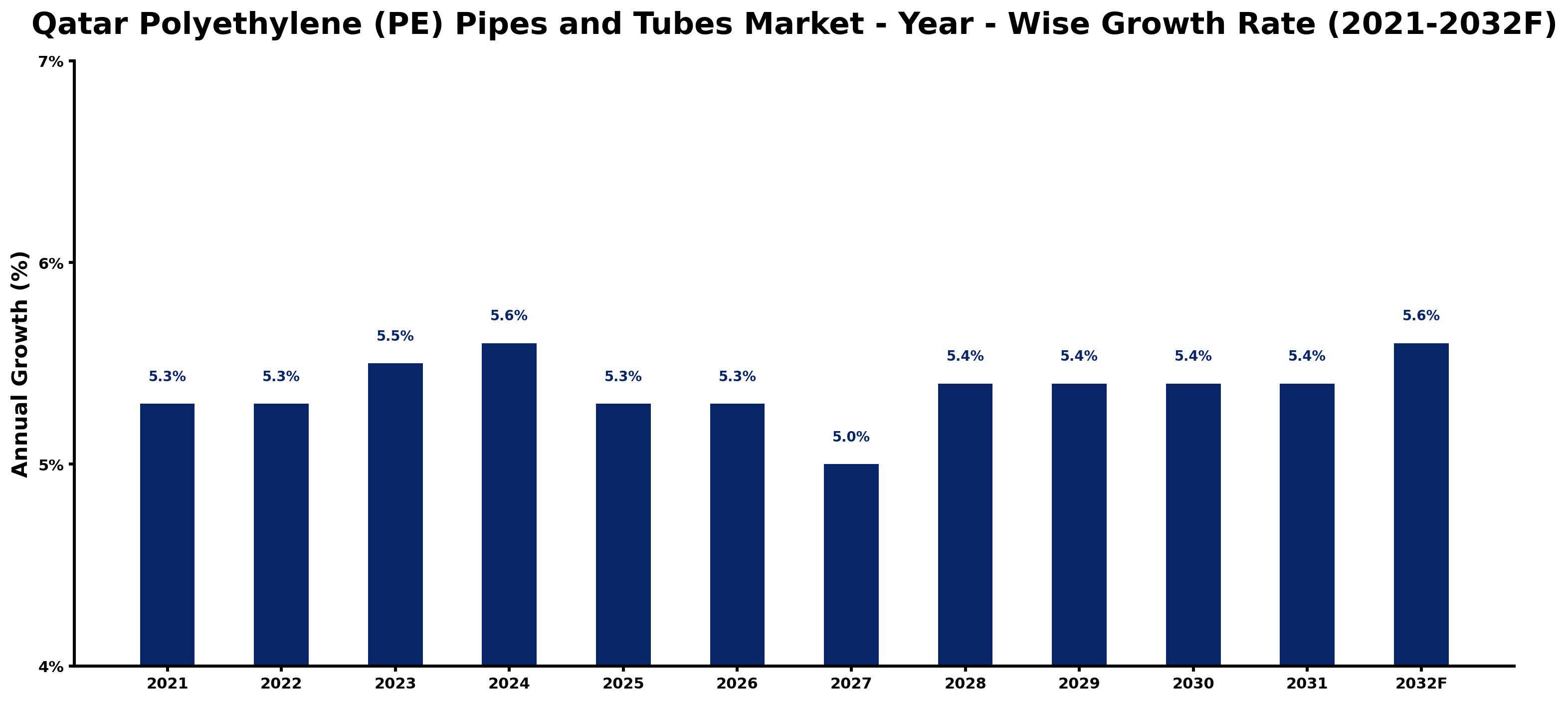
The table below presents the year wise growth rates along with the key drivers influencing the market
| Year | Growth Rate | Major Drivers |
| 2021 | 5.3% | The construction sector rebounds, leading to increased demand for durable piping solutions. |
| 2022 | 5.3% | Local manufacturers enhance production capabilities to meet rising infrastructure project needs. |
| 2023 | 5.5% | Increased investments in water management infrastructure drive interest in polyethylene solutions. |
| 2024 | 5.6% | Technological advancements in pipe manufacturing improve efficiency and reduce production costs. |
| 2025 | 5.3% | The regional shift towards sustainable building materials influences market growth patterns. |
| 2026 | 5.3% | Emerging construction projects align with Qatar's Vision 2030, boosting polyethylene usage. |
| 2027 | 5.0% | Market players focus on innovation, developing high-performance polyethylene pipe variants. |
| 2028 | 5.4% | A significant increase in urbanization elevates the necessity for modern piping systems. |
| 2029 | 5.4% | Environmental regulations encouraging the use of recyclable materials support polyethylene adoption. |
| 2030 | 5.4% | Expansion of smart city initiatives in Qatar further escalates demand for advanced piping solutions. |
| 2031 | 5.4% | Global supply chain improvements enhance accessibility to polyethylene pipe products. |
| 2032 | 5.6% | Market consolidation among key players leads to better competitive pricing and availability. |
Note - Market size estimations and growth projections presented in this report are based on 6Wresearch's advanced forecasting approach, validated with industry datasets as of June 2026.
Qatar Polyethylene (PE) Pipes and Tubes Market Synopsis
The Qatar Polyethylene (PE) Pipes and Tubes Market is projected to reach 5.3% and witness significant growth during the forecast period (2026-2032). The anticipated expansion of this market can be primarily attributed to the increasing demand for polyethylene pipes, known for their exceptional physical, mechanical, and chemical properties. These pipes are favored for their cost-effectiveness and versatile applications in vital sectors including water supply, drainage and sewage systems, and oil and gas transportation. Furthermore, heightened investments in infrastructure development by various industrial sectors in Qatar play a crucial role in driving the demand for polyethylene pipes in the upcoming years.
Qatar Polyethylene (PE) Pipes and Tubes Market Growth Drivers
The growth dynamics of the Qatar Polyethylene (PE) Pipes and Tubes Market are influenced by several key factors:
- The rapid economic development in Qatar, spurred by national and international investments across various industries, is creating substantial opportunities for market expansion.
- Increased construction activities, particularly in the infrastructure sector, necessitate the utilization of PE pipes due to their efficiency in transporting liquids and supporting large-scale projects.
- Government initiatives aimed at boosting infrastructural development have facilitated foreign direct investments (FDI), particularly in projects like the Doha Metro Rail Network, which requires extensive pipeline networks.
- The diverse applications of polyethylene pipes, including their use in agricultural systems and waste management, are contributing to their growing popularity in multiple sectors.
- Cost advantages associated with polyethylene materials, along with their longevity and resistance to corrosion, make them a preferred choice for developers and contractors in Qatar.
Qatar Polyethylene (PE) Pipes and Tubes Market Challenges and Restraints
Despite the optimistic outlook for the Qatar Polyethylene (PE) Pipes and Tubes Market, there are notable challenges that could hinder growth:
- The availability and accessibility of raw materials required for manufacturing PE pipes pose significant challenges, largely due to reliance on resin suppliers located outside of Qatar.
- Transportation issues stemming from inadequate connections with neighboring countries can delay supply chains, leading to increased production costs and decreased profitability.
- Market players face potential fluctuations in global oil prices, which can impact investment levels and overall market stability, creating uncertainty in demand.
- Compliance with stringent environmental regulations may necessitate additional investments and modifications in production processes, further straining manufacturers.
- The Covid-19 pandemic has introduced unprecedented disruptions in the supply chain, exacerbating existing challenges and causing a temporary decline in market demand.
Qatar Polyethylene (PE) Pipes and Tubes Market Government Investment and Initiatives
The Qatari government has demonstrated a strong commitment to investing in infrastructure development, which significantly influences the Qatar Polyethylene (PE) Pipes and Tubes Market. Key initiatives include:
- Strategic national plans aimed at boosting construction and infrastructure are anticipated to enhance the demand for polyethylene piping systems.
- The government's focus on environmental sustainability has led to the promotion of polyethylene pipes due to their recyclable nature and lower environmental impact compared to traditional materials.
- Public spending initiatives aimed at large-scale projects, including the upcoming 2022 FIFA World Cup-related infrastructure, are expected to result in increased procurement of PE pipes.
- Regulatory frameworks encouraging FDI into the construction sector reflect the government's push to foster market growth and attract foreign investments.
- Consideration of future urban expansion and population growth in national development plans reinforces the ongoing investment in pipeline infrastructure, further stimulating market demand.
Qatar Polyethylene (PE) Pipes and Tubes Market Latest Developments (May 2025 - June 2026)
Recent developments in the Qatar Polyethylene (PE) Pipes and Tubes Market underscore a shift towards innovation and resilience:
- There has been a notable increase in the adoption of advanced manufacturing technologies aimed at improving the efficiency and sustainability of polyethylene pipe production.
- Market participants are actively exploring strategic partnerships and collaborations to enhance supply chain strength and mitigate material shortages.
- Investment trends indicate a steady flow towards infrastructure projects, which are expected to resume following the recovery from the pandemic's impact on the economy.
- Increased focus on environmentally friendly practices is driving research and development for more sustainable polyethylene products, catering to growing market demands for eco-friendly alternatives.
- As international trade resumes and supply chains stabilize, the market is poised for a gradual recovery, with expectations of heightened activity in construction and infrastructure sectors.
Qatar Polyethylene (PE) Pipes and Tubes Market - Key Attractiveness of the Report
- 10 Years of Market Numbers
- Historical Data Starting from 2022 to 2025
- Base Year: 2025
- Forecast Data until 2032
- Key Performance Indicators Impacting the Market
- Major Upcoming Developments and Projects
Key Highlights of the Report:
- Qatar Polyethylene (PE) Pipes and Tubes Market Outlook
- Market Size of Qatar Polyethylene (PE) Pipes and Tubes Market, 2025
- Forecast of Qatar Polyethylene (PE) Pipes and Tubes Market, 2032
- Historical Data and Forecast of Qatar Polyethylene (PE) Pipes and Tubes Revenues & Volume for the Period 2022-2032F
- Qatar Polyethylene (PE) Pipes and Tubes Market Trend Evolution
- Qatar Polyethylene (PE) Pipes and Tubes Market Drivers and Challenges
- Qatar Polyethylene (PE) Pipes and Tubes Price Trends
- Qatar Polyethylene (PE) Pipes and Tubes Porter's Five Forces
- Qatar Polyethylene (PE) Pipes and Tubes Industry Life Cycle
- Historical Data and Forecast of Qatar Polyethylene (PE) Pipes and Tubes Market Revenues & Volume By Type for the Period 2022-2032F
- Historical Data and Forecast of Qatar Polyethylene (PE) Pipes and Tubes Market Revenues & Volume By High Density Polythene (HDPE) for the Period 2022-2032F
- Historical Data and Forecast of Qatar Polyethylene (PE) Pipes and Tubes Market Revenues & Volume By Low Density Polythene (LDPE) for the Period 2022-2032F
- Historical Data and Forecast of Qatar Polyethylene (PE) Pipes and Tubes Market Revenues & Volume By Linear Low Density Polythene (LLDPE) for the Period 2022-2032F
- Historical Data and Forecast of Qatar Polyethylene (PE) Pipes and Tubes Market Revenues & Volume By Cross Link Polythene (PEX/XLPE) for the Period 2022-2032F
- Historical Data and Forecast of Qatar Polyethylene (PE) Pipes and Tubes Market Revenues & Volume By Application for the Period 2022-2032F
- Historical Data and Forecast of Qatar Polyethylene (PE) Pipes and Tubes Market Revenues & Volume By Industrial for the Period 2022-2032F
- Historical Data and Forecast of Qatar Polyethylene (PE) Pipes and Tubes Market Revenues & Volume By Agriculture for the Period 2022-2032F
- Historical Data and Forecast of Qatar Polyethylene (PE) Pipes and Tubes Market Revenues & Volume By Underwater And Municipal for the Period 2022-2032F
- Historical Data and Forecast of Qatar Polyethylene (PE) Pipes and Tubes Market Revenues & Volume By Construction for the Period 2022-2032F
- Historical Data and Forecast of Qatar Polyethylene (PE) Pipes and Tubes Market Revenues & Volume By Gas Extraction for the Period 2022-2032F
- Historical Data and Forecast of Qatar Polyethylene (PE) Pipes and Tubes Market Revenues & Volume By Others for the Period 2022-2032F
- Qatar Polyethylene (PE) Pipes and Tubes Import Export Trade Statistics
- Market Opportunity Assessment By Type
- Market Opportunity Assessment By Application
- Qatar Polyethylene (PE) Pipes and Tubes Top Companies Market Share
- Qatar Polyethylene (PE) Pipes and Tubes Competitive Benchmarking By Technical and Operational Parameters
- Qatar Polyethylene (PE) Pipes and Tubes Company Profiles
- Qatar Polyethylene (PE) Pipes and Tubes Key Strategic Recommendations






































