Qatar Public Safety Analytics Market Size & Growth Rate (2026-2032)
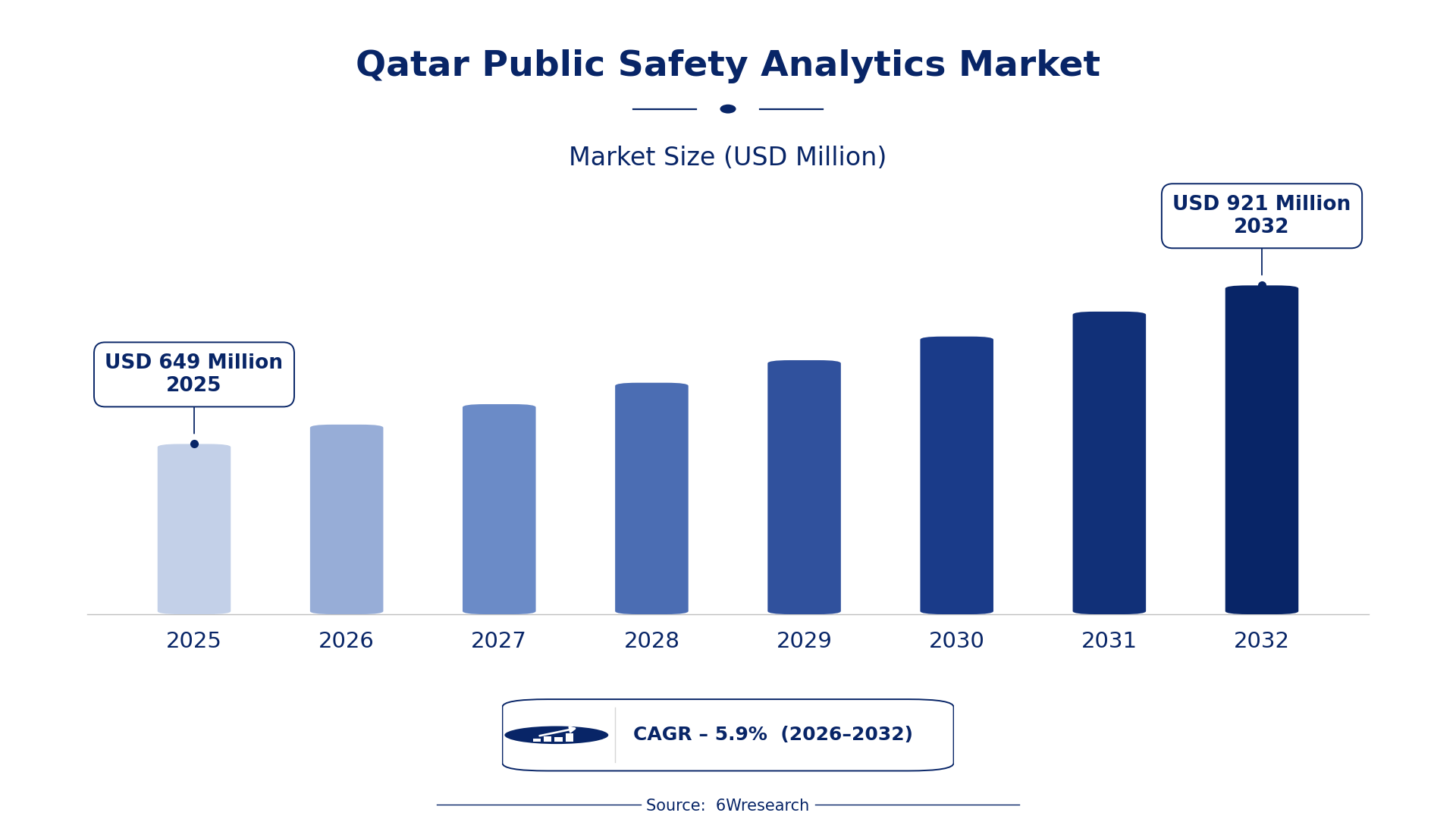
The Qatar Public Safety Analytics Market was estimated at USD 649 Million in 2025 and is projected to reach USD 921 Million by 2032, growing at a CAGR of 5.9% from 2026 to 2032.
Qatar Public Safety Analytics Market Synopsis
The momentum in the Qatar Public Safety Analytics Market has surged recently as authorities adapt to dynamic safety challenges. Investments in smart city initiatives and enhancements to public safety infrastructure signal a shift towards data-driven decision-making.
As Qatar prepares for significant events like the FIFA World Cup, the emphasis on advanced analytics for emergency response becomes increasingly critical. This market is evolving rapidly, driven by the necessity for real-time insights into public safety measures.
Qatar Public Safety Analytics Market Year-wise Growth Rate and Key Drivers
This graph illustrates the annual growth rates of the Qatar Public Safety Analytics Market from 2021 to 2032, highlighting a steady upward trajectory and projected expansion over the forecast period.
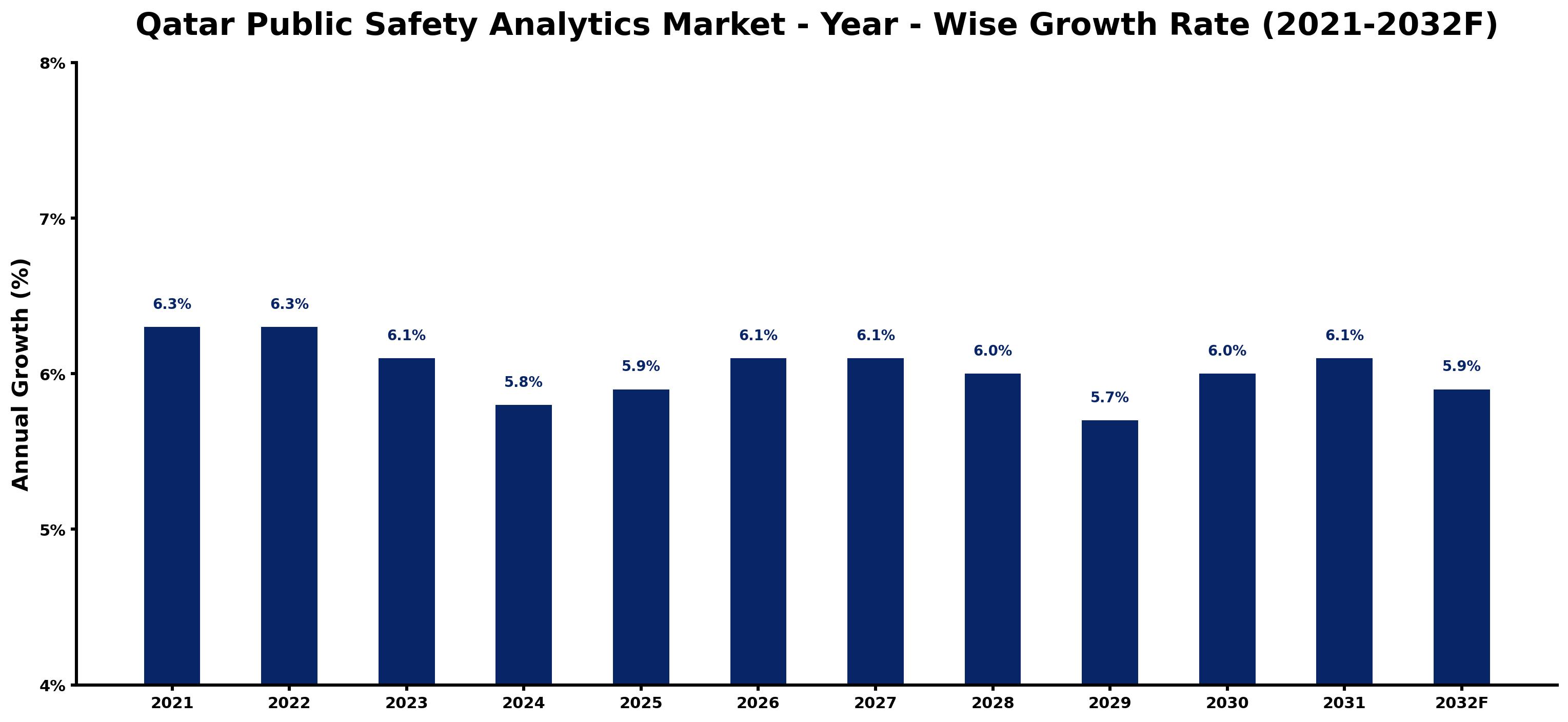
The table below presents the year‑wise growth rates along with the key drivers influencing the market
| Year | Growth Rate | Major Drivers |
| 2021 | 6.3% | Qatar National Vision 2030 prioritizing public safety enhancements. |
| 2022 | 6.3% | Increased funding for predictive policing initiatives in Doha. |
| 2023 | 6.1% | Integration of advanced analytics in law enforcement operations. |
| 2024 | 5.8% | Implementation of smart surveillance technologies across urban areas. |
| 2025 | 5.9% | Growing investment in data-driven emergency response solutions. |
| 2026 | 6.1% | Partnerships with technology firms for safety analytics solutions. |
| 2027 | 6.1% | Rising public awareness of cybersecurity and data protection. |
| 2028 | 6.0% | Deployment of AI to improve crime prediction accuracy. |
| 2029 | 5.7% | Enhanced disaster response planning post-World Cup 2022. |
| 2030 | 6.0% | Focus on community engagement in neighborhood safety programs. |
| 2031 | 6.1% | Increasing alignment with international safety compliance standards. |
| 2032 | 5.9% | Continuous improvement through regional security collaborations. |
Note: Market size estimations and growth projections presented in this report are based on 6Wresearch's proprietary forecasting methodology, utilizing the latest available industry data, government publications, and primary research inputs.
Qatar Public Safety Analytics Market Key Takeaways
Below are some of the specific key takeaways from the market, including:
- Public safety analytics solutions are essential for analyzing data from surveillance cameras, sensors, and social media.
- The market is heavily influenced by Qatar's push towards smart city development and enhanced safety measures.
- AI and machine learning technologies are transforming how safety data is utilized for predictive analytics.
- Government investments and preparations for major events are accelerating market growth.
- Privacy and data protection concerns present ongoing challenges that need addressing.
Evaluation of Restraints in Qatar Public Safety Analytics Market
The Qatar Public Safety Analytics Market faces real limitations stemming from the complexities of data management. Authorities grapple with the need to integrate vast amounts of data from diverse sources. Concerns regarding privacy also weigh heavily on the implementation of analytics solutions. Striking a balance between utilizing data for public safety and protecting individual privacy rights remains a persistent challenge for stakeholders.
Qatar Public Safety Analytics Market Trends
Several trends are shaping the Qatar Public Safety Analytics Market. The integration of AI-driven analytics is at the forefront, allowing for proactive identification of potential threats. on top of that, the growing adoption of IoT devices is providing authorities with unprecedented amounts of data, enhancing surveillance and response capabilities. Collaborative initiatives between public safety agencies and technology providers are increasingly common, paving the way for innovative solutions.
Qatar Public Safety Analytics Market Opportunities
The market presents numerous opportunities for growth and investment. Key areas include the enhancement of data integration frameworks to streamline analytics processes. There's a significant potential in expanding partnerships with technology firms specializing in machine learning and AI. As Qatar continues to invest in its public safety infrastructure, companies that offer cutting-edge solutions stand to benefit immensely.
Government Initiatives in the Qatar Public Safety Analytics Market
The Qatari government is actively shaping the Public Safety Analytics Market through strategic initiatives aimed at enhancing safety and security for its citizens. This commitment reflects a broader agenda to integrate advanced technologies into public service operations, ensuring an efficient response to safety incidents.
- A national digital infrastructure upgrade programme is currently underway, focusing on integrating public safety analytics into existing systems.
- Recently completed, a comprehensive review of emergency response protocols has strengthened the use of analytics for incident management.
- A planned initiative to enhance surveillance systems across urban centers is expected to roll out in late 2025.
- In 2024, the government launched a new regulatory framework aimed at addressing privacy concerns related to data collection in public spaces.
- Current efforts are being made to collaborate with international tech firms to introduce innovative analytics solutions for law enforcement agencies.
Future Insights of the Qatar Public Safety Analytics Market
Looking ahead to 2026-2032, the Qatar Public Safety Analytics Market is expected to continue its upward trajectory. As Qatar invests in smart infrastructure and advanced technologies, demand for innovative safety analytics will rise. Stakeholders who can deliver data-driven insights will play a crucial role in shaping the future of public safety in the region. The continuous evolution of threats necessitates a corresponding evolution in safety analytics, driving growth opportunities in this sector.
Qatar Public Safety Analytics Market Latest Developments
Over the past year, the Qatar Public Safety Analytics Market has witnessed notable developments focused on enhancing public safety capabilities. These advancements highlight the market's momentum and the urgency with which authorities are adopting new technologies.
- A significant partnership was announced in early 2025 between local authorities and a major technology vendor to develop a next-generation surveillance system.
- In Q1 2025, a pilot project to implement AI-based predictive analytics in emergency response was initiated, demonstrating promising results.
- Upcoming in mid-2026, a comprehensive training program for public safety personnel on data analytics tools is set to launch.
- A recent investment was made to upgrade existing video surveillance infrastructure, expected to complete by late 2025.
- A collaboration between government agencies and tech firms has begun to explore integration of social media analytics in public safety measures, currently in progress.
Qatar Public Safety Analytics Market - Key Attractiveness of the Report
- 10 Years of Market Numbers
- Historical Data Starting from 2022 to 2025
- Base Year: 2025
- Forecast Data until 2032
- Key Performance Indicators Impacting the Market
- Major Upcoming Developments and Projects
Key Highlights of the Report:
- Qatar Public Safety Analytics Market Outlook
- Market Size of Qatar Public Safety Analytics Market, 2025
- Forecast of Qatar Public Safety Analytics Market, 2032
- Historical Data and Forecast of Qatar Public Safety Analytics Revenues & Volume for the Period 2022-2032F
- Qatar Public Safety Analytics Market Trend Evolution
- Qatar Public Safety Analytics Market Drivers and Challenges
- Qatar Public Safety Analytics Price Trends
- Qatar Public Safety Analytics Porter's Five Forces
- Qatar Public Safety Analytics Industry Life Cycle
- Historical Data and Forecast of Qatar Public Safety Analytics Market Revenues & Volume By Component for the Period 2022-2032F
- Historical Data and Forecast of Qatar Public Safety Analytics Market Revenues & Volume By Solution for the Period 2022-2032F
- Historical Data and Forecast of Qatar Public Safety Analytics Market Revenues & Volume By Service for the Period 2022-2032F
- Historical Data and Forecast of Qatar Public Safety Analytics Market Revenues & Volume By Analytics Type for the Period 2022-2032F
- Historical Data and Forecast of Qatar Public Safety Analytics Market Revenues & Volume By Predictive for the Period 2022-2032F
- Historical Data and Forecast of Qatar Public Safety Analytics Market Revenues & Volume By Prescriptive for the Period 2022-2032F
- Historical Data and Forecast of Qatar Public Safety Analytics Market Revenues & Volume By Descriptive for the Period 2022-2032F
- Historical Data and Forecast of Qatar Public Safety Analytics Market Revenues & Volume By Deployment Mode for the Period 2022-2032F
- Historical Data and Forecast of Qatar Public Safety Analytics Market Revenues & Volume By On-premises for the Period 2022-2032F
- Historical Data and Forecast of Qatar Public Safety Analytics Market Revenues & Volume By Hosted for the Period 2022-2032F
- Historical Data and Forecast of Qatar Public Safety Analytics Market Revenues & Volume By Application for the Period 2022-2032F
- Historical Data and Forecast of Qatar Public Safety Analytics Market Revenues & Volume By Pattern Recognition for the Period 2022-2032F
- Historical Data and Forecast of Qatar Public Safety Analytics Market Revenues & Volume By Incident detection for the Period 2022-2032F
- Historical Data and Forecast of Qatar Public Safety Analytics Market Revenues & Volume By Person of Interest Screening for the Period 2022-2032F
- Historical Data and Forecast of Qatar Public Safety Analytics Market Revenues & Volume By Surveillance for the Period 2022-2032F
- Historical Data and Forecast of Qatar Public Safety Analytics Market Revenues & Volume By Industry Vertical for the Period 2022-2032F
- Historical Data and Forecast of Qatar Public Safety Analytics Market Revenues & Volume By Law Enforcement and Intelligence Agencies for the Period 2022-2032F
- Historical Data and Forecast of Qatar Public Safety Analytics Market Revenues & Volume By Border Control (Land, Sea, and Air) for the Period 2022-2032F
- Historical Data and Forecast of Qatar Public Safety Analytics Market Revenues & Volume By Public Transportation Security for the Period 2022-2032F
- Historical Data and Forecast of Qatar Public Safety Analytics Market Revenues & Volume By Critical Infrastructure Security for the Period 2022-2032F
- Historical Data and Forecast of Qatar Public Safety Analytics Market Revenues & Volume By Others (manufacturing and emergency services) for the Period 2022-2032F
- Qatar Public Safety Analytics Import Export Trade Statistics
- Market Opportunity Assessment By Component
- Market Opportunity Assessment By Analytics Type
- Market Opportunity Assessment By Deployment Mode
- Market Opportunity Assessment By Application
- Market Opportunity Assessment By Industry Vertical
- Qatar Public Safety Analytics Top Companies Market Share
- Qatar Public Safety Analytics Competitive Benchmarking By Technical and Operational Parameters
- Qatar Public Safety Analytics Company Profiles
- Qatar Public Safety Analytics Key Strategic Recommendations






































