Qatar Radio and Audio Equipment Market Summary
The qatar radio and audio equipment market was estimated at USD 415 Million in 2025 and is projected to reach USD 569 Million by 2032, growing at a CAGR of 5.5% from 2026 to 2032.
Qatar Radio and Audio Equipment Market Year-wise Growth Rate and Key Drivers
This graph highlights how the Qatar Radio and Audio Equipment Market has steadily grown over the past five years, supported by major growth factors.
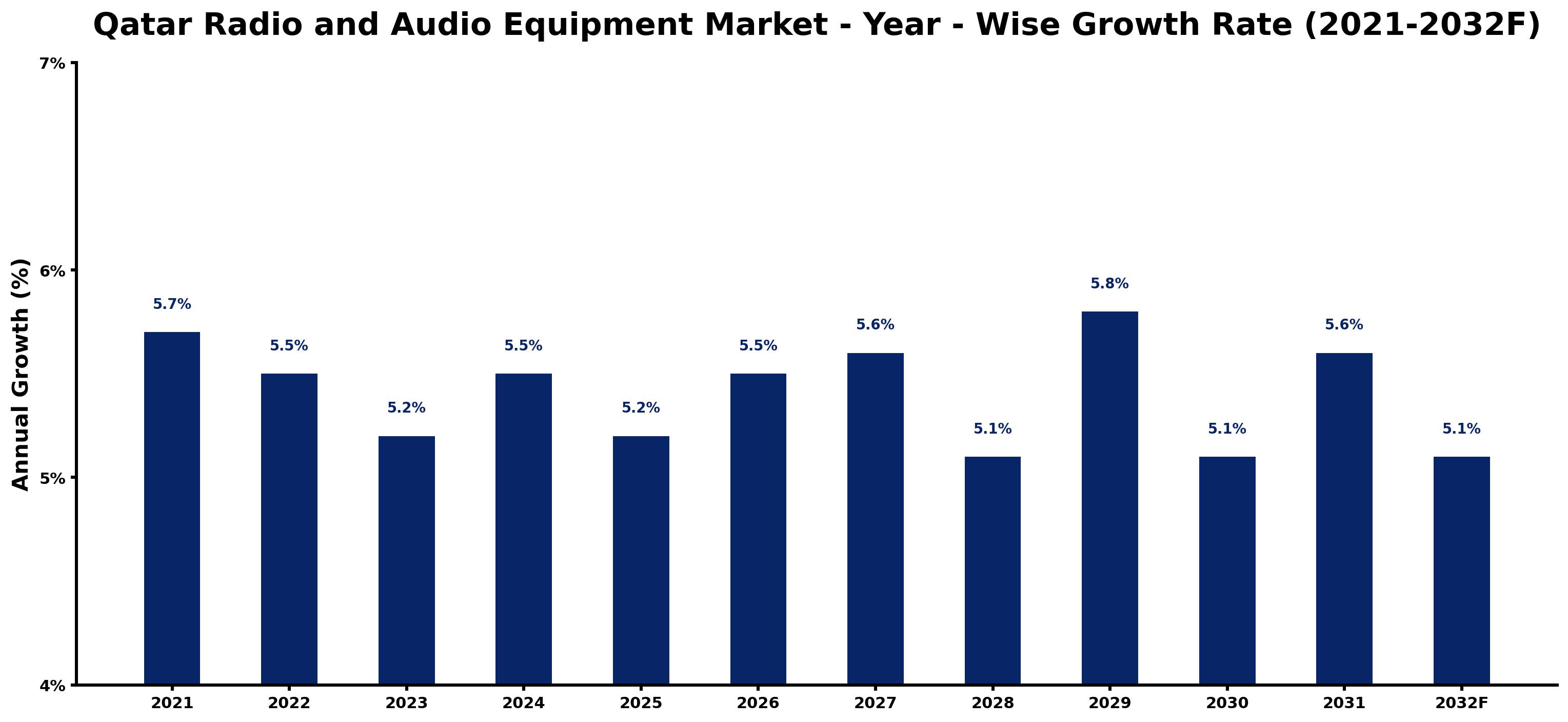
The table below presents the year wise growth rates along with the key drivers influencing the market
| Year | Growth Rate | Major Drivers |
| 2021 | 5.7% | Post-lockdown consumer interest in home entertainment systems significantly increased audio equipment sales. |
| 2022 | 5.5% | Local events and cultural festivals spurred demand for high-quality audio solutions. |
| 2023 | 5.2% | New construction projects in Qatar created opportunities for integrated audio systems installations. |
| 2024 | 5.5% | Technological innovations led to a surge in smart audio device offerings and features. |
| 2025 | 5.2% | An influx of expatriates contributed to diverse preferences in radio and audio products. |
| 2026 | 5.5% | Collaboration between tech firms and local businesses enhanced product localization and relevance. |
| 2027 | 5.6% | Enhanced transportation infrastructure boosted accessibility to audio equipment retailers across Qatar. |
| 2028 | 5.1% | Increased consumer spending on leisure activities drove interest in premium audio experiences. |
| 2029 | 5.8% | Emerging podcasting trends led to a spike in demand for professional audio recording gear. |
| 2030 | 5.1% | Integration of AI and machine learning improved user experience and audio personalization options. |
| 2031 | 5.6% | New regulations promoting sustainability influenced the development of eco-friendly audio products. |
| 2032 | 5.1% | Investment in tourism infrastructure necessitated advanced audio solutions for hospitality venues. |
Note - Market size estimations and growth projections presented in this report are based on 6Wresearch's advanced forecasting approach, validated with industry datasets as of June 2026.
Qatar Radio and Audio Equipment Market Synopsis
The Qatar Radio and Audio Equipment Market is projected to reach 5.5% and witness significant growth during the forecast period (2026-2032). This anticipated growth is primarily driven by a surge in internet usage across households, largely fueled by the increasing prevalence of smartphones and digital media devices. As consumers in Qatar are increasingly inclined towards modern entertainment options, including digital radio and streaming services such as Spotify and Apple Music, the demand for advanced audio equipment has been steadily rising, thereby propelling the expansion of this market.
Qatar Radio and Audio Equipment Market Growth Drivers
Key factors contributing to the growth of the Qatar radio and audio equipment market include:
- An upsurge in broadband connectivity has rendered digital radios and streaming services more accessible, leading to a broadening user base across various income brackets.
- The enhanced purchasing power of consumers, bolstered by rising disposable incomes, has positioned them to invest in high-quality audio systems, which are gaining traction as essential home entertainment assets.
- Technological advancements in audio hardware have resulted in the design of superior audio systems, offering improved sound quality and energy efficiency, thus appealing to environmentally-conscious consumers.
- The growing trend towards home automation, including voice-command technologies, is creating opportunities for innovative audio solutions that integrate seamlessly into smart home environments.
- Cultural shifts towards enhanced entertainment experiences are encouraging consumers to seek higher-quality sound systems for both leisure and professional use, further stimulating market demand.
Qatar Radio and Audio Equipment Market Challenges and Restraints
Despite the positive growth trajectory, the Qatar radio and audio equipment market faces several challenges:
- The prevalence of counterfeit audio products, particularly unbranded items imported from nearby Asian countries, poses a significant threat to the revenues of legitimate retailers and undermines brand credibility.
- Consumer awareness regarding the authenticity of audio products remains low, making it difficult for authorized dealers to compete against lower-priced counterfeit goods.
- Potential regulatory gaps around product authenticity and safety can lead to the proliferation of low-quality audio equipment, affecting consumer trust and market stability.
- Increased noise regulations in residential areas may restrict the use of certain audio equipment during late-night hours, which could impact market demand for specific products.
- The economic impact of global events, including the COVID-19 pandemic, has led to shifting consumer priorities, prompting many to prioritize essential needs over luxury audio products.
Qatar Radio and Audio Equipment Market Government Investment and Initiatives
The Qatari government has demonstrated a commitment to the growth of its radio and audio equipment market through various initiatives aimed at enhancing the technological landscape. Investments in broadband infrastructure and digital literacy programs aim to improve internet access, thereby facilitating the uptake of digital audio solutions. Additionally, public spending on cultural programs and entertainment venues encourages the proliferation of audio equipment usage in public spaces, indirectly boosting market demand. Government policies supporting innovation and entrepreneurship in the tech sector will likely create favorable conditions for new entrants and established firms in the audio equipment space, fostering a competitive and diverse market environment.
Qatar Radio and Audio Equipment Market Latest Developments (May 2025 - June 2026)
Recent developments in the Qatar radio and audio equipment market have highlighted the shift towards more sophisticated and user-friendly audio solutions. Advances in wireless technology and smart home integration features are becoming common trends among new product releases. Manufacturers are increasingly focusing on sustainability, leading to the design of energy-efficient audio systems that cater to eco-conscious consumers. Moreover, the mounting interest in streaming services has prompted improvements in audio quality and connectivity options, resulting in a more enriched user experience. As Qatar continues to invest in digital infrastructure, the market is expected to witness further innovation and growth, positioning itself as a regional leader in audio technology.
Qatar Radio and Audio Equipment Market - Key Attractiveness of the Report
- 10 Years of Market Numbers
- Historical Data Starting from 2022 to 2025
- Base Year: 2025
- Forecast Data until 2032
- Key Performance Indicators Impacting the Market
- Major Upcoming Developments and Projects
Key Highlights of the Report:
- Qatar Radio and Audio Equipment Market Outlook
- Market Size of Qatar Radio and Audio Equipment Market, 2025
- Forecast of Qatar Radio and Audio Equipment Market, 2032
- Historical Data and Forecast of Qatar Radio and Audio Equipment Revenues & Volume for the Period 2022-2032F
- Qatar Radio and Audio Equipment Market Trend Evolution
- Qatar Radio and Audio Equipment Market Drivers and Challenges
- Qatar Radio and Audio Equipment Price Trends
- Qatar Radio and Audio Equipment Porter's Five Forces
- Qatar Radio and Audio Equipment Industry Life Cycle
- Historical Data and Forecast of Qatar Radio and Audio Equipment Market Revenues & Volume By Radio Type for the Period 2022-2032F
- Historical Data and Forecast of Qatar Radio and Audio Equipment Market Revenues & Volume By Broadcast Radio for the Period 2022-2032F
- Historical Data and Forecast of Qatar Radio and Audio Equipment Market Revenues & Volume By Online/Mobile Radio for the Period 2022-2032F
- Historical Data and Forecast of Qatar Radio and Audio Equipment Market Revenues & Volume By Satellite Radio for the Period 2022-2032F
- Historical Data and Forecast of Qatar Radio and Audio Equipment Market Revenues & Volume By Audio Equipment Type for the Period 2022-2032F
- Historical Data and Forecast of Qatar Radio and Audio Equipment Market Revenues & Volume By Loudspeakers for the Period 2022-2032F
- Historical Data and Forecast of Qatar Radio and Audio Equipment Market Revenues & Volume By Microphones for the Period 2022-2032F
- Historical Data and Forecast of Qatar Radio and Audio Equipment Market Revenues & Volume By Amplifiers for the Period 2022-2032F
- Historical Data and Forecast of Qatar Radio and Audio Equipment Market Revenues & Volume By Turntables for the Period 2022-2032F
- Historical Data and Forecast of Qatar Radio and Audio Equipment Market Revenues & Volume By Others ? for the Period 2022-2032F
- Historical Data and Forecast of Qatar Radio and Audio Equipment Market Revenues & Volume By End-users for the Period 2022-2032F
- Historical Data and Forecast of Qatar Radio and Audio Equipment Market Revenues & Volume By B2B for the Period 2022-2032F
- Historical Data and Forecast of Qatar Radio and Audio Equipment Market Revenues & Volume By B2C for the Period 2022-2032F
- Qatar Radio and Audio Equipment Import Export Trade Statistics
- Market Opportunity Assessment By Radio Type
- Market Opportunity Assessment By Audio Equipment Type
- Market Opportunity Assessment By End-users
- Qatar Radio and Audio Equipment Top Companies Market Share
- Qatar Radio and Audio Equipment Competitive Benchmarking By Technical and Operational Parameters
- Qatar Radio and Audio Equipment Company Profiles
- Qatar Radio and Audio Equipment Key Strategic Recommendations






































