Qatar Radio Remote Control Equipment Market Size, Share & Growth Rate
The Qatar Radio Remote Control Equipment Market was estimated at USD 167 Million in 2025 and is projected to reach USD 232 Million by 2032, growing at a CAGR of 4.8% from 2026 to 2032. This growth trajectory is primarily fueled by the increasing demand for sophisticated remote control solutions in various sectors, including industrial automation, agriculture, and telecommunications. As Qatar's economy diversifies and modernizes, the need for advanced communication and control systems is expected to rise significantly, driving further investments in the radio remote control equipment sector.
Qatar Radio Remote Control Equipment Market Year-wise Growth Rate and Key Drivers
This graph highlights how the Qatar Radio Remote Control Equipment Market has steadily grown over the years, supported by major growth factors.
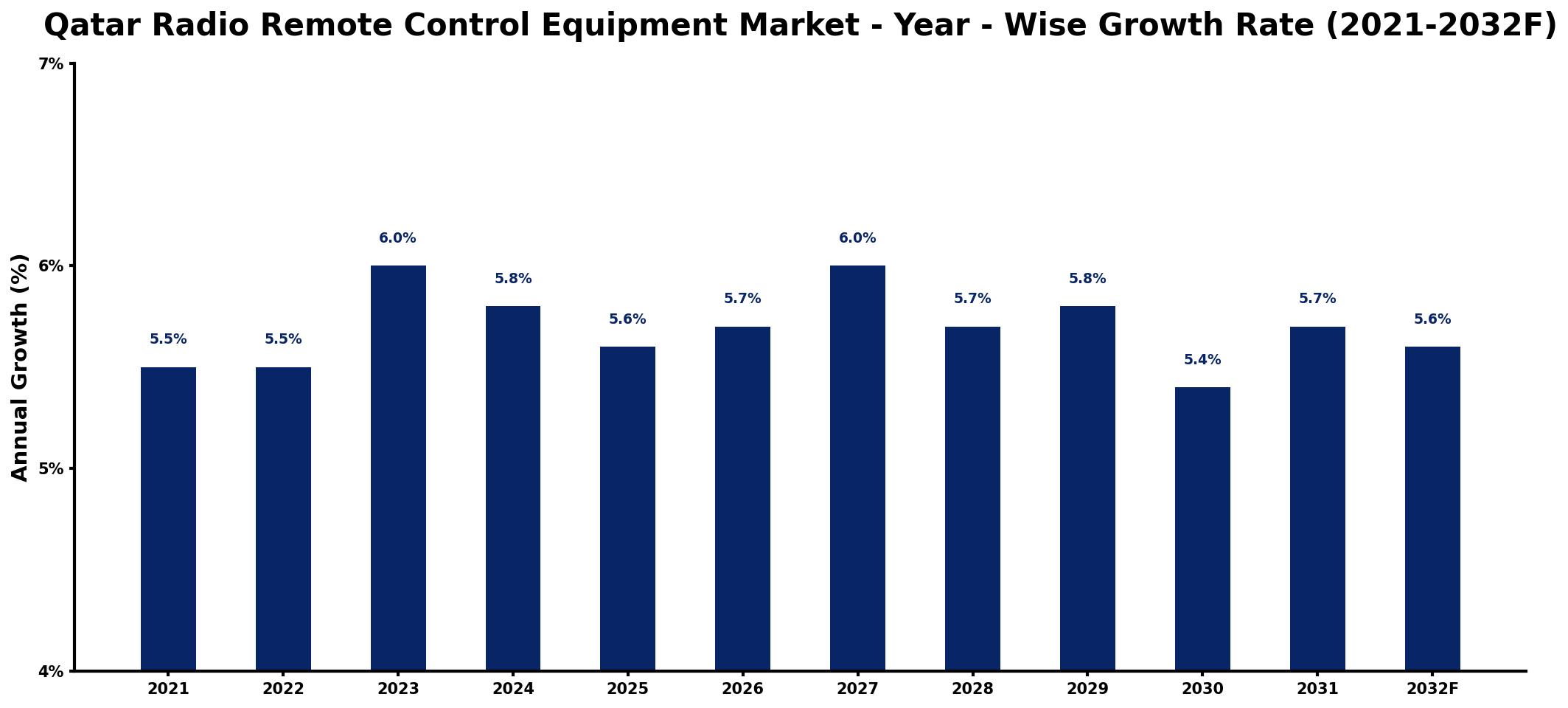
The table below presents the year‑wise growth rates along with the key drivers influencing the market
| Year | Growth Rate | Major Drivers |
| 2021 | 5.5% | Increased demand from entertainment sector |
| 2022 | 5.5% | Growth in smart home applications |
| 2023 | 6.0% | Expansion in industrial automation usage |
| 2024 | 5.8% | Rising popularity of drones |
| 2025 | 5.6% | Investments in telecommunications infrastructure |
| 2026 | 5.7% | Emergence of IoT technology solutions |
| 2027 | 6.0% | Growing commercial aviation applications |
| 2028 | 5.7% | Development of smart city initiatives |
| 2029 | 5.8% | Surge in agricultural automation |
| 2030 | 5.4% | Technological advancements in connectivity |
| 2031 | 5.7% | Increased focus on sustainability practices |
| 2032 | 5.6% | Broadening consumer electronics market |
Note: Market size estimations and growth projections presented in this report are based on 6Wresearch's proprietary forecasting methodology, utilizing the latest available industry data, government publications, and primary research inputs.
Qatar Radio Remote Control Equipment Market Synopsis
The strongest force shaping the Qatar Radio Remote Control Equipment Market is the rapid advancement in technology that enhances the capabilities and reliability of remote control systems. As industries aim to optimize operations and improve efficiency, the adoption of sophisticated radio remote control equipment is becoming increasingly prevalent.
Moreover, the burgeoning construction and infrastructural development projects in Qatar are contributing to this market's evolution. As companies seek to manage equipment and machinery remotely, the demand for innovative solutions that improve safety and operational efficiency is anticipated to continue growing.
Qatar Radio Remote Control Equipment Market Key Takeaways
- The market is driven by significant investments in technology and infrastructure development.
- Increased application across various sectors enhances demand for advanced remote control solutions.
- Market growth is supported by a trend toward automation and remote monitoring in industrial settings.
- The competitive landscape is characterized by both local and international players aiming for technological innovation.
- Future expansions in the telecommunications sector will likely bolster the demand for radio remote control equipment.
Evaluation of Restraints in Qatar Radio Remote Control Equipment Market
Despite the robust growth prospects, the Qatar Radio Remote Control Equipment Market encounters certain restraints that may hinder its potential. One significant barrier is the high initial investment required for sophisticated radio remote control systems, which can deter smaller businesses from entering the market. Additionally, regulatory requirements surrounding communication technologies may create hurdles for rapid deployment. Moreover, the ongoing need for skilled technicians who can operate and maintain advanced systems presents a challenge, as workforce development in this area is still catching up with market demands.
Qatar Radio Remote Control Equipment Market Trends
One prominent trend shaping the market is the increasing integration of IoT (Internet of Things) technologies in radio remote control equipment, which enhances data collection and operational efficiency. Furthermore, there is a growing inclination towards wireless solutions, which enable more flexible and scalable operations across various industries. As sustainability becomes a priority, eco-friendly remote control equipment solutions are also gaining traction, aligning with global environmental initiatives.
Qatar Radio Remote Control Equipment Market Opportunities
There are substantial growth opportunities in the Qatar Radio Remote Control Equipment Market, particularly in sectors such as construction, mining, and agriculture. The rising need for automation and remote monitoring in these industries presents a lucrative avenue for businesses to innovate and expand their product offerings. Moreover, the upcoming major events and projects related to Qatars National Vision 2030 will likely drive demand for advanced remote control solutions as companies seek to enhance operational efficiencies.
Government Initiatives in the Qatar Radio Remote Control Equipment Market
The Qatari government has launched various initiatives to foster technological advancements across different sectors, which include the promotion of smart technologies. By providing incentives for research and development, and supporting public-private partnerships, the government aims to enhance the infrastructure necessary for advanced communication systems. This supportive policy landscape serves to stimulate investments in the radio remote control equipment market, aligning with the countrys goals for economic diversification and innovation.
Future Insights of the Qatar Radio Remote Control Equipment Market
Looking forward to the 2026-2032 period, the Qatar Radio Remote Control Equipment Market is poised for significant evolution. As industries continue to embrace automation, the demand for more sophisticated, reliable, and user-friendly remote control solutions will intensify. Additionally, the convergence of emerging technologies like artificial intelligence and machine learning with traditional remote control systems is likely to revolutionize applications, providing enhanced efficiency and responsiveness across various sectors.
Qatar Radio Remote Control Equipment Market Latest Developments (2025 - 2026)
In recent months, the Qatar Radio Remote Control Equipment Market has experienced a wave of innovative advancements, focusing on improved user interfaces and enhanced communication protocols. Companies are investing in research to develop more resilient and versatile systems that meet the evolving demands of various industries. Collaborations between local firms and international technology providers have also been on the rise, aiming to leverage cutting-edge technologies for better operational solutions.
Qatar Radio Remote Control Equipment Market - Key Attractiveness of the Report
- 10 Years of Market Numbers
- Historical Data Starting from 2022 to 2025
- Base Year: 2025
- Forecast Data until 2032
- Key Performance Indicators Impacting the Market
- Major Upcoming Developments and Projects
Key Highlights of the Report:
- Qatar Radio Remote Control Equipment Market Outlook
- Market Size of Qatar Radio Remote Control Equipment Market, 2025
- Forecast of Qatar Radio Remote Control Equipment Market, 2032
- Historical Data and Forecast of Qatar Radio Remote Control Equipment Revenues & Volume for the Period 2022-2032F
- Qatar Radio Remote Control Equipment Market Trend Evolution
- Qatar Radio Remote Control Equipment Market Drivers and Challenges
- Qatar Radio Remote Control Equipment Price Trends
- Qatar Radio Remote Control Equipment Porter's Five Forces
- Qatar Radio Remote Control Equipment Industry Life Cycle
- Historical Data and Forecast of Qatar Radio Remote Control Equipment Market Revenues & Volume By Type for the Period 2022-2032F
- Historical Data and Forecast of Qatar Radio Remote Control Equipment Market Revenues & Volume By Pushbutton for the Period 2022-2032F
- Historical Data and Forecast of Qatar Radio Remote Control Equipment Market Revenues & Volume By Joystick for the Period 2022-2032F
- Historical Data and Forecast of Qatar Radio Remote Control Equipment Market Revenues & Volume By Application for the Period 2022-2032F
- Historical Data and Forecast of Qatar Radio Remote Control Equipment Market Revenues & Volume By Industry & Logistics for the Period 2022-2032F
- Historical Data and Forecast of Qatar Radio Remote Control Equipment Market Revenues & Volume By Construction Crane for the Period 2022-2032F
- Historical Data and Forecast of Qatar Radio Remote Control Equipment Market Revenues & Volume By Mobile Hydraulics for the Period 2022-2032F
- Historical Data and Forecast of Qatar Radio Remote Control Equipment Market Revenues & Volume By Forestry for the Period 2022-2032F
- Historical Data and Forecast of Qatar Radio Remote Control Equipment Market Revenues & Volume By Mining for the Period 2022-2032F
- Historical Data and Forecast of Qatar Radio Remote Control Equipment Market Revenues & Volume By Others for the Period 2022-2032F
- Qatar Radio Remote Control Equipment Import Export Trade Statistics
- Market Opportunity Assessment By Type
- Market Opportunity Assessment By Application
- Qatar Radio Remote Control Equipment Top Companies Market Share
- Qatar Radio Remote Control Equipment Competitive Benchmarking By Technical and Operational Parameters
- Qatar Radio Remote Control Equipment Company Profiles
- Qatar Radio Remote Control Equipment Key Strategic Recommendations






































