Qatar Recycled Textiles Market Size, Share & Growth Rate
The Qatar Recycled Textiles Market was estimated at USD 474 Million in 2025 and is projected to reach USD 629 Million by 2032, growing at a CAGR of 4.1% from 2026 to 2032. This growth trajectory is driven largely by increasing consumer awareness regarding sustainability and the growing push from the government towards eco-friendly practices. As residents prioritize sustainable clothing options, and with the support for sustainable fashion brands, the market is positioned for substantial growth in the coming years.
Qatar Recycled Textiles Market Year-wise Growth Rate and Key Drivers
This graph highlights how the Qatar Recycled Textiles Market has steadily grown over the years, supported by major growth factors.
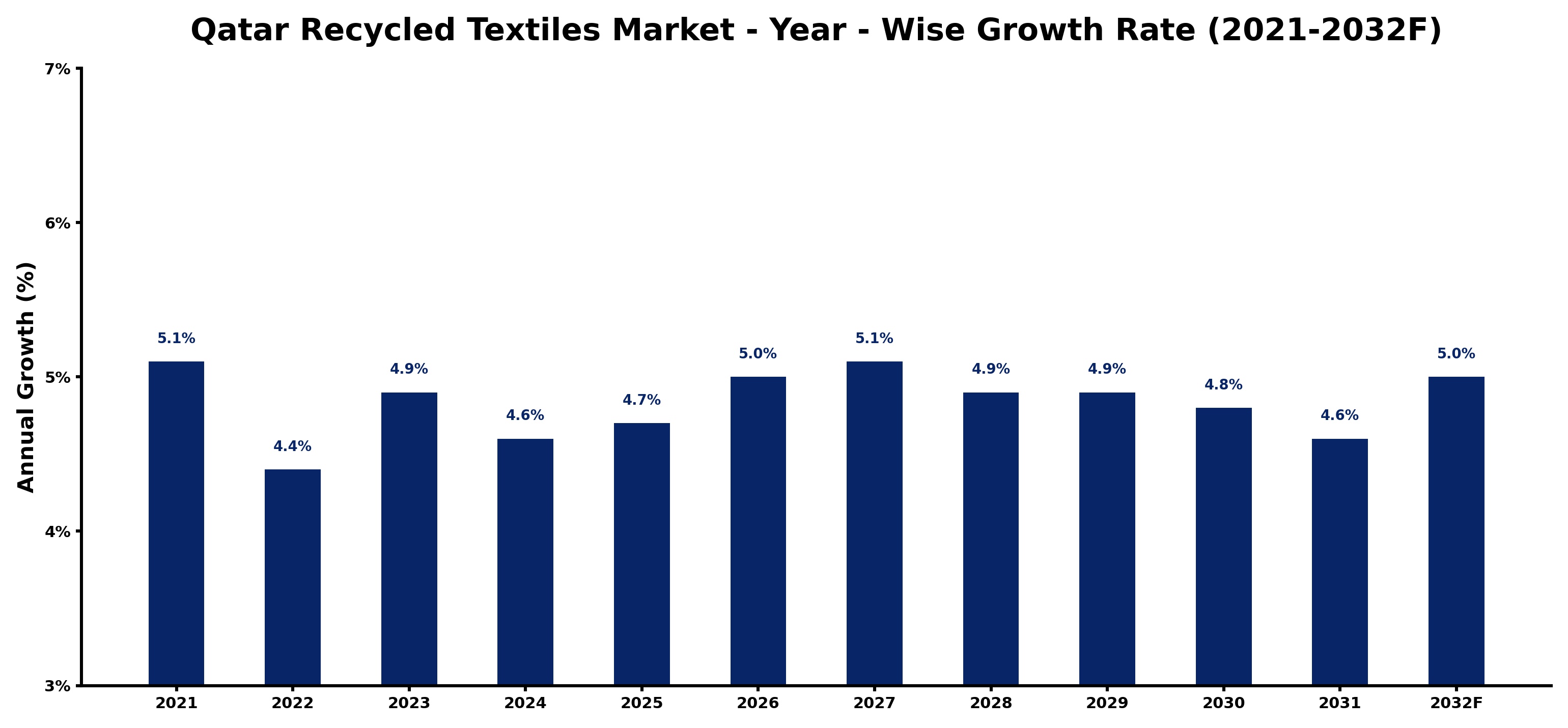
The table below presents the year‑wise growth rates along with the key drivers influencing the market
| Year | Growth Rate | Major Drivers |
| 2021 | 5.1% | Sustainability awareness drove demand |
| 2022 | 4.4% | Government initiatives supported recycling |
| 2023 | 4.9% | Fashion industry embraced circularity |
| 2024 | 4.6% | Consumer preferences shifted sustainably |
| 2025 | 4.7% | Technological advancements enhanced processes |
| 2026 | 5.0% | Partnerships expanded market reach |
| 2027 | 5.1% | Increased eco-friendly product offerings |
| 2028 | 4.9% | Textile waste management improved efficiency |
| 2029 | 4.9% | Collaboration with NGOs strengthened impact |
| 2030 | 4.8% | Investment in recycling infrastructure increased |
| 2031 | 4.6% | Educational campaigns raised awareness |
| 2032 | 5.0% | Global trends influenced local markets |
Note - Market size estimations and growth projections presented in this report are based on 6Wresearch’s advanced forecasting approach, validated with industry datasets as of June 2026.
Qatar Recycled Textiles Market Synopsis
Recently, the Qatar Recycled Textiles Market has experienced momentum due to heightened environmental awareness and government backing for sustainable initiatives. Moving forward, this market is set to expand significantly, bolstered by a larger population and an increasing demand for ethically produced textiles.
The convergence of consumer desire for eco-friendly products and government policies that promote recycling is paving the way for innovation in this sector. However, challenges such as high manufacturing costs and lingering perceptions regarding the quality of recycled textiles could temper growth in the short term.
Qatar Recycled Textiles Market Key Takeaways
- Growing environmental awareness is fueling demand for recycled textiles.
- Government initiatives are enhancing support for sustainable fashion brands.
- Consumer resistance due to quality perceptions poses a challenge.
- Increased adoption of circular economy principles is reshaping market dynamics.
- Online platforms for upcycling are gaining traction, driving market recovery.
Evaluation of Restraints in Qatar Recycled Textiles Market
The Qatar Recycled Textiles Market faces a few notable restraints that could hinder its growth. Chief among these is consumer hesitation to embrace recycled products, often stemming from concerns over quality and hygiene. This skepticism can deter potential buyers from choosing recycled textiles over conventional options. Additionally, establishing efficient collection and recycling systems for textiles remains a logistical challenge. It requires robust collaboration between industries and local authorities to develop effective strategies for proper textile disposal and recycling.
Qatar Recycled Textiles Market Trends
Several trends are shaping the Qatar Recycled Textiles Market, particularly in the context of sustainability and fashion. The increasing incorporation of technology in recycling processes is enhancing efficiency and product quality. Moreover, the rise of circular fashion is pushing brands to innovate with eco-friendly materials. Consumers are gravitating towards brands that offer transparency about their supply chains and production processes, making sustainability a vital selling point in the textile industry.
Qatar Recycled Textiles Market Opportunities
The market presents significant growth and investment opportunities, particularly in developing advanced recycling technologies and innovative textile products. Startups focusing on upcycling and transforming waste into high-quality textiles are poised for success. Moreover, educational campaigns aimed at consumers can help to shift perceptions regarding recycled textiles, fostering a larger market base. With government backing, businesses that align with sustainability goals could find themselves at the forefront of this burgeoning industry.
Government Initiatives in the Qatar Recycled Textiles Market
The Qatari government has been proactive in promoting sustainable practices across various sectors, including textiles. This includes funding initiatives aimed at increasing recycling rates and establishing educational programs to raise awareness about the environmental benefits of recycled materials. By encouraging local brands to adopt sustainable practices, the government is laying the groundwork for a robust market for recycled textiles.
Future Insights of the Qatar Recycled Textiles Market
Looking ahead to the period from 2026 to 2032, the Qatar Recycled Textiles Market is expected to witness continued growth, fueled by an ongoing commitment to sustainability and technological advancements. As consumer preferences evolve towards more eco-conscious choices, brands that effectively leverage recycled materials will likely thrive. The increasing focus on a circular economy will further augment market opportunities, positioning Qatar as a leader in the sustainable textiles landscape.
Qatar Recycled Textiles Market Latest Developments (May 2025 - June 2026)
Recent developments within the Qatar Recycled Textiles Market reflect a growing interest in sustainability initiatives. Key industry players have begun forming collaborations to enhance recycling infrastructure, while various local initiatives aim to promote awareness about the benefits of recycled textiles. Online retail channels for sustainable fashion are also expanding, further aiding market recovery as consumers increasingly prefer eco-friendly options.
Qatar Recycled Textiles Market - Key Attractiveness of the Report
- 10 Years of Market Numbers
- Historical Data Starting from 2022 to 2025
- Base Year: 2025
- Forecast Data until 2032
- Key Performance Indicators Impacting the Market
- Major Upcoming Developments and Projects
Key Highlights of the Report:
- Qatar Recycled Textiles Market Outlook
- Market Size of Qatar Recycled Textiles Market, 2025
- Forecast of Qatar Recycled Textiles Market, 2032
- Historical Data and Forecast of Qatar Recycled Textiles Revenues & Volume for the Period 2022-2032F
- Qatar Recycled Textiles Market Trend Evolution
- Qatar Recycled Textiles Market Drivers and Challenges
- Qatar Recycled Textiles Price Trends
- Qatar Recycled Textiles Porter's Five Forces
- Qatar Recycled Textiles Industry Life Cycle
- Historical Data and Forecast of Qatar Recycled Textiles Market Revenues & Volume By Type for the Period 2022-2032F
- Historical Data and Forecast of Qatar Recycled Textiles Market Revenues & Volume By Recycled Cotton for the Period 2022-2032F
- Historical Data and Forecast of Qatar Recycled Textiles Market Revenues & Volume By Recycled Wool for the Period 2022-2032F
- Historical Data and Forecast of Qatar Recycled Textiles Market Revenues & Volume By Recycled Polyester for the Period 2022-2032F
- Historical Data and Forecast of Qatar Recycled Textiles Market Revenues & Volume By Recycled Nylon for the Period 2022-2032F
- Historical Data and Forecast of Qatar Recycled Textiles Market Revenues & Volume By Others for the Period 2022-2032F
- Historical Data and Forecast of Qatar Recycled Textiles Market Revenues & Volume By End-use Industry for the Period 2022-2032F
- Historical Data and Forecast of Qatar Recycled Textiles Market Revenues & Volume By Automotive for the Period 2022-2032F
- Historical Data and Forecast of Qatar Recycled Textiles Market Revenues & Volume By Retail for the Period 2022-2032F
- Historical Data and Forecast of Qatar Recycled Textiles Market Revenues & Volume By Mining for the Period 2022-2032F
- Historical Data and Forecast of Qatar Recycled Textiles Market Revenues & Volume By Building & Construction for the Period 2022-2032F
- Historical Data and Forecast of Qatar Recycled Textiles Market Revenues & Volume By Others for the Period 2022-2032F
- Qatar Recycled Textiles Import Export Trade Statistics
- Market Opportunity Assessment By Type
- Market Opportunity Assessment By End-use Industry
- Qatar Recycled Textiles Top Companies Market Share
- Qatar Recycled Textiles Competitive Benchmarking By Technical and Operational Parameters
- Qatar Recycled Textiles Company Profiles
- Qatar Recycled Textiles Key Strategic Recommendations






































