Qatar Rubber Market Summary
The qatar rubber market was estimated at USD 398 Million in 2025 and is projected to reach USD 532 Million by 2032, growing at a CAGR of 5.0% from 2026 to 2032.
Qatar Rubber Market Year-wise Growth Rate and Key Drivers
This graph highlights how the Qatar Rubber Market has steadily grown over the past five years, supported by major growth factors.
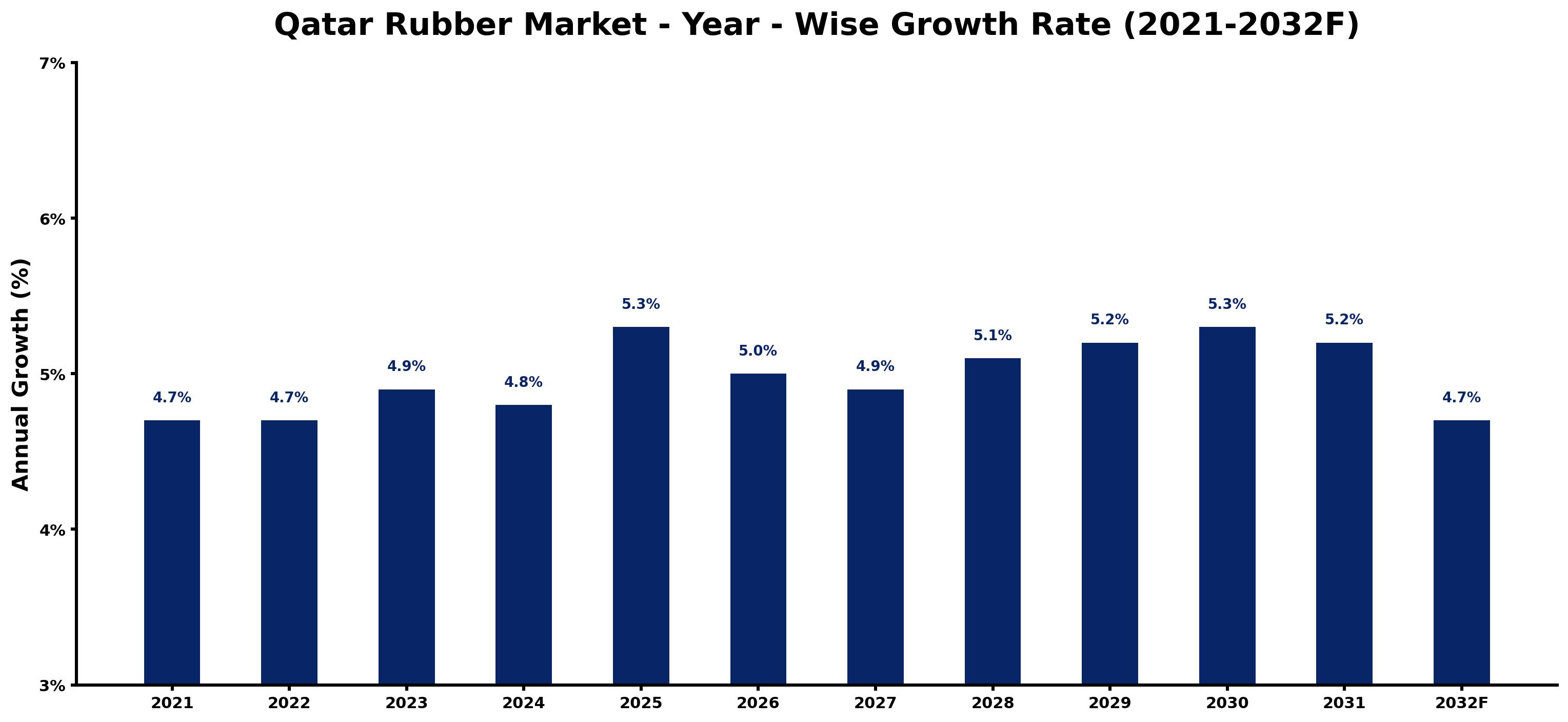
The table below presents the year wise growth rates along with the key drivers influencing the market
| Year | Growth Rate | Major Drivers |
| 2021 | 4.7% | Post-lockdown retail projects spurred a modest recovery in construction-related rubber demand. |
| 2022 | 4.7% | Localization efforts in the GCC resulted in increased manufacturing of rubber products in Qatar. |
| 2023 | 4.9% | Major construction pipelines, including World Cup facilities, boosted short-term rubber consumption significantly. |
| 2024 | 4.8% | Sustainable practices drive manufacturers towards eco-friendly rubber sourcing and production methods. |
| 2025 | 5.3% | Emerging automotive sectors in Qatar are creating new opportunities for rubber components. |
| 2026 | 5.0% | Hot climate requirements necessitate innovative rubber solutions for various infrastructural applications. |
| 2027 | 4.9% | Demand for durable materials in sports infrastructure leads to higher rubber market investments. |
| 2028 | 5.1% | Corporate budgets increasingly favor advanced rubber technologies enhancing product performance and durability. |
| 2029 | 5.2% | Cross-border collaborations with neighboring GCC countries enhance access to diverse rubber markets. |
| 2030 | 5.3% | Infrastructure development projects incorporate smart technologies, requiring advanced rubber solutions for longevity. |
| 2031 | 5.2% | Emerging markets in electric vehicles open pathways for specialized rubber applications and materials. |
| 2032 | 4.7% | Sustainability-focused consumer preferences reshape the demand landscape for rubber products in Qatar. |
Note - Market size estimations and growth projections presented in this report are based on 6Wresearch's advanced forecasting approach, validated with industry datasets as of June 2026.
Qatar Rubber Market Synopsis
The Qatar Rubber Market is projected to reach 5.0% and witness significant growth during the forecast period (2026-2032). This market encompasses a variety of rubber products and materials integral to numerous industries, including automotive, construction, manufacturing, and consumer goods. Key products within this market range from rubber sheets and hoses to tires, belts, seals, and various components critical for operational efficiency.
Qatar Rubber Market Growth Drivers
The growth of the Qatar Rubber Market is primarily driven by several interlinked factors that propel demand across multiple sectors:
- The ongoing industrial development and large-scale infrastructure projects in Qatar have significantly increased the demand for rubber products, particularly in construction and manufacturing.
- A robust growth trajectory in the automotive sector is a critical factor, as it generates substantial demand for rubber components, especially tires and automotive rubber parts.
- Consumer goods, including footwear and various rubber items, continue to stimulate market growth as the population's purchasing power increases.
- Efforts to diversify Qatar's economy are enhancing various sectors, including rubber and plastics manufacturing, creating a more conducive environment for market expansion.
- Government initiatives aimed at fostering a sustainable industrial ecosystem will also encourage investment in the rubber sector, further solidifying its growth potential.
Qatar Rubber Market Challenges and Restraints
Despite promising growth prospects, the Qatar Rubber Market faces distinct challenges that could hinder its expansion:
- A significant dependence on imported rubber products can introduce vulnerabilities related to pricing fluctuations and supply chain management, impacting market stability.
- Competition from synthetic materials, including plastics and elastomers, presents challenges as they may offer cost advantages in certain applications, affecting demand for natural rubber.
- Sustainability concerns and growing regulations regarding waste management and recycling practices are pressuring the rubber industry to adapt, necessitating investment in eco-friendly solutions.
- The volatility in raw material prices can adversely affect profit margins, making financial forecasting and planning an ongoing challenge for market participants.
- Market dynamics influenced by global economic conditions, including trade tensions and tariffs, may also create an unpredictable environment for the Qatar rubber sector.
Qatar Rubber Market Government Investment and Initiatives
The Qatari government has been proactive in fostering a robust economic landscape for the rubber market through various investment initiatives and development plans. Significant public spending on infrastructure projects, such as roads, buildings, and transport systems, has catalyzed an increased need for rubber products. Furthermore, the government has introduced incentives aimed at promoting local rubber and plastics manufacturing, thereby enhancing self-sufficiency and reducing reliance on imports.
Moreover, the National Vision 2030 outlines strategic goals that encompass sustainable development, paving the way for advancements in the rubber sector that prioritize environmental responsibility. Collaborative ventures between public and private sectors are encouraged to stimulate innovation and technological adaptation within the industry, creating a more competitive market landscape.
Qatar Rubber Market Latest Developments (May 2025 - June 2026)
Recent developments within the Qatar Rubber Market indicate a shifting focus towards sustainability and innovation. Industry players are increasingly adopting eco-friendly production practices, responding to heightened consumer demand for sustainable products. The sector is witnessing a gradual integration of recycled materials in rubber production, aligning with both market trends and governmental sustainability initiatives.
Additionally, there is a noticeable upsurge in technological advancements aimed at enhancing manufacturing processes, which promise to improve efficiency and reduce waste. The growing emphasis on personal protective equipment due to public health concerns has created new opportunities for rubber products tailored to meet safety standards. Overall, these developments highlight a dynamic shift in the market, pointing towards a more holistic approach that amalgamates growth with sustainability.
Qatar Rubber Market - Key Attractiveness of the Report
- 10 Years of Market Numbers
- Historical Data Starting from 2022 to 2025
- Base Year: 2025
- Forecast Data until 2032
- Key Performance Indicators Impacting the Market
- Major Upcoming Developments and Projects
Key Highlights of the Report:
- Qatar Rubber Market Outlook
- Market Size of Qatar Rubber Market, 2025
- Forecast of Qatar Rubber Market, 2032
- Historical Data and Forecast of Qatar Rubber Revenues & Volume for the Period 2022-2032F
- Qatar Rubber Market Trend Evolution
- Qatar Rubber Market Drivers and Challenges
- Qatar Rubber Price Trends
- Qatar Rubber Porter's Five Forces
- Qatar Rubber Industry Life Cycle
- Historical Data and Forecast of Qatar Rubber Market Revenues & Volume By Product Type for the Period 2022-2032F
- Historical Data and Forecast of Qatar Rubber Market Revenues & Volume By Natural Rubber for the Period 2022-2032F
- Historical Data and Forecast of Qatar Rubber Market Revenues & Volume By Synthetic Rubber for the Period 2022-2032F
- Historical Data and Forecast of Qatar Rubber Market Revenues & Volume By End-users for the Period 2022-2032F
- Historical Data and Forecast of Qatar Rubber Market Revenues & Volume By Automotive & Transportation for the Period 2022-2032F
- Historical Data and Forecast of Qatar Rubber Market Revenues & Volume By Building & Construction for the Period 2022-2032F
- Historical Data and Forecast of Qatar Rubber Market Revenues & Volume By Industrial Machinery & Equipment for the Period 2022-2032F
- Historical Data and Forecast of Qatar Rubber Market Revenues & Volume By Others for the Period 2022-2032F
- Qatar Rubber Import Export Trade Statistics
- Market Opportunity Assessment By Product Type
- Market Opportunity Assessment By End-users
- Qatar Rubber Top Companies Market Share
- Qatar Rubber Competitive Benchmarking By Technical and Operational Parameters
- Qatar Rubber Company Profiles
- Qatar Rubber Key Strategic Recommendations






































