Qatar Smart Building Market Size, Share & Growth Rate
The Qatar Smart Building Market was estimated at USD 1415 Million in 2025 and is projected to reach USD 2452 Million by 2032, growing at a CAGR of 8.2% from 2026 to 2032. This impressive growth trajectory is largely driven by Qatars commitment to sustainable urban development and the integration of advanced technologies within the construction sector. The rising demand for energy-efficient and automated systems aligns seamlessly with the national goals of reducing carbon footprints and enhancing the quality of urban living.
Qatar Smart Building Market Year-wise Growth Rate and Key Drivers
This graph highlights how the Qatar Smart Building Market has steadily grown over the years, supported by major growth factors.
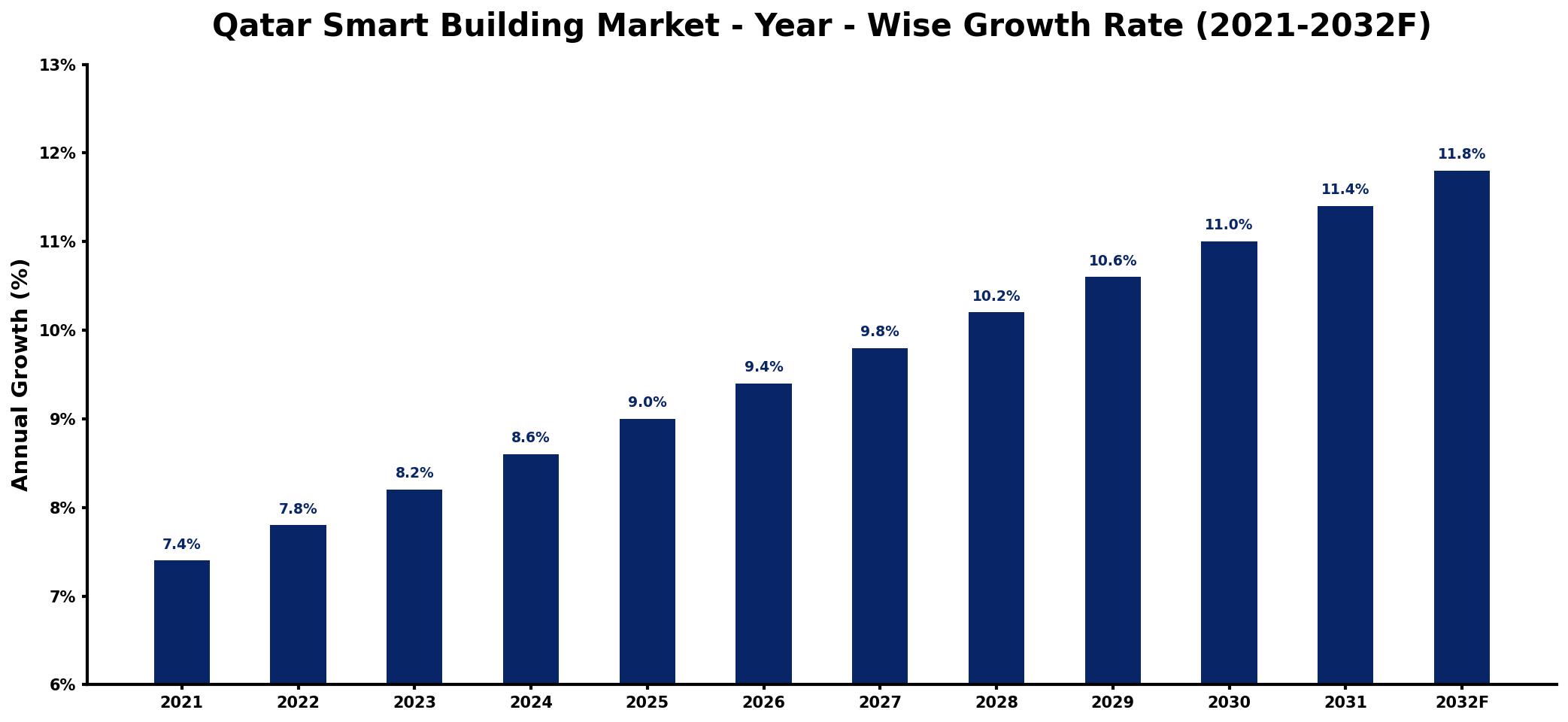
The table below presents the year‑wise growth rates along with the key drivers influencing the market
| Year | Growth Rate | Major Drivers |
| 2021 | 7.4% | Rising demand for energy efficiency |
| 2022 | 7.8% | Increased investment in infrastructure |
| 2023 | 8.2% | Growing interest in automation technologies |
| 2024 | 8.6% | Expansion of IoT applications |
| 2025 | 9.0% | Surge in urbanization trends |
| 2026 | 9.4% | Advancements in renewable energy solutions |
| 2027 | 9.8% | Enhanced focus on sustainability practices |
| 2028 | 10.2% | strengthening international trade flows |
| 2029 | 10.6% | growing emerging market penetration |
| 2030 | 11.0% | Growth in consumer technology adoption |
| 2031 | 11.4% | increased overall sector activity |
| 2032 | 11.8% | Rising awareness of climate change |
Note: Market size estimations and growth projections presented in this report are based on 6Wresearch's proprietary forecasting methodology, utilizing the latest available industry data, government publications, and primary research inputs.
Qatar Smart Building Market Synopsis
A pivotal force shaping the Qatar Smart Building Market is the government's unwavering dedication to smart city initiatives. These efforts are not just a trend; they are a fundamental aspect of Qatar's long-term strategy for urban modernization. As the nation invests heavily in infrastructure, smart buildings have emerged as a cornerstone of this vision, blending efficiency with sustainability.
Furthermore, the increasing incorporation of IoT devices and automated systems within both residential and commercial sectors is catalyzing this transformation. The smart building solutions not only provide enhanced security and comfort but also significantly reduce energy consumption, appealing to environmentally-conscious developers and occupants alike.
Qatar Smart Building Market Key Takeaways
- The market is experiencing robust growth driven by government initiatives and technological advancements.
- Integration of IoT devices and automation is reshaping the operational landscape of buildings.
- There is a growing consumer demand for energy-efficient solutions in both commercial and residential segments.
- The impact of COVID-19 has accelerated the adoption of smart building technologies focused on health and safety.
- Investment in sustainable urban development continues to drive market dynamics and future opportunities.
Evaluation of Restraints in Qatar Smart Building Market
Despite the promising growth of the smart building market in Qatar, certain constraints persist. High initial costs for implementing cutting-edge smart technologies can deter smaller developers and investors, limiting widespread adoption. Additionally, ensuring robust data security in interconnected systems poses challenges as cyber threats become increasingly sophisticated. The pace of technological advancement also necessitates continuous investment, which may strain budgets, particularly amid fluctuating economic conditions.
Qatar Smart Building Market Trends
The market is witnessing a surge in demand for smart solutions that prioritize occupant health and safety, especially following the COVID-19 pandemic. Features like touchless access control, enhanced air quality monitoring, and efficient energy management systems are becoming standard expectations rather than optional extras. Moreover, the rising interest in sustainable materials and renewable energy sources is expected to fuel further innovation and adoption within the sector.
Qatar Smart Building Market Opportunities
The genuine growth opportunities lie in the continuous modernization of infrastructure, as Qatar's urbanization efforts create a fertile ground for investment in smart technologies. Companies focusing on energy efficiency and sustainability will find ample scope for development, particularly within commercial real estate. Additionally, leveraging government incentives and partnerships can further enhance market entry strategies and accelerate project implementation.
Government Initiatives in the Qatar Smart Building Market
The Qatari government has initiated several programs aimed at promoting sustainable infrastructure and smart city concepts. Public spending is channeled into advanced technologies to support urban development while enhancing quality of life for residents. Policies encouraging green building practices and the integration of smart technologies into new constructions are pivotal in shaping the market landscape, ensuring that sustainability is at the forefront of national development.
Future Insights of the Qatar Smart Building Market
Looking forward to 2026-2032, the Qatar Smart Building Market is poised for significant evolution. As the nation continues to prioritize sustainability and technological advancement, smart buildings will increasingly represent the standard rather than the exception. The ongoing integration of innovative solutions will not only enhance operational efficiency but also redefine urban living, driving an upward trend in market growth.
Qatar Smart Building Market Latest Developments (2025 - 2026)
Recently, the smart building sector in Qatar has seen an influx of new technologies aimed at improving energy efficiency and occupant comfort. There is a notable shift towards integrating AI-driven systems that optimize building management, alongside heightened interest in retrofitting existing structures with smart capabilities. The market is also responding to public health concerns by enhancing solutions that monitor and improve air quality within indoor environments.
Qatar Smart Building Market - Key Attractiveness of the Report
- 10 Years of Market Numbers
- Historical Data Starting from 2022 to 2025
- Base Year: 2025
- Forecast Data until 2032
- Key Performance Indicators Impacting the Market
- Major Upcoming Developments and Projects
Key Highlights of the Report:
- Qatar Smart Building Market Outlook
- Market Size of Qatar Smart Building Market, 2025
- Forecast of Qatar Smart Building Market, 2032
- Historical Data and Forecast of Qatar Smart Building Revenues & Volume for the Period 2022-2032F
- Qatar Smart Building Market Trend Evolution
- Qatar Smart Building Market Drivers and Challenges
- Qatar Smart Building Price Trends
- Qatar Smart Building Porter's Five Forces
- Qatar Smart Building Industry Life Cycle
- Historical Data and Forecast of Qatar Smart Building Market Revenues & Volume By Component for the Period 2022-2032F
- Historical Data and Forecast of Qatar Smart Building Market Revenues & Volume By Solution for the Period 2022-2032F
- Historical Data and Forecast of Qatar Smart Building Market Revenues & Volume By Services for the Period 2022-2032F
- Historical Data and Forecast of Qatar Smart Building Market Revenues & Volume By Application for the Period 2022-2032F
- Historical Data and Forecast of Qatar Smart Building Market Revenues & Volume By Residential for the Period 2022-2032F
- Historical Data and Forecast of Qatar Smart Building Market Revenues & Volume By Commercial for the Period 2022-2032F
- Qatar Smart Building Import Export Trade Statistics
- Market Opportunity Assessment By Component
- Market Opportunity Assessment By Application
- Qatar Smart Building Top Companies Market Share
- Qatar Smart Building Competitive Benchmarking By Technical and Operational Parameters
- Qatar Smart Building Company Profiles
- Qatar Smart Building Key Strategic Recommendations






































