United States (US) Smart Building Market Size, Share & Growth Rate
The United States (US) Smart Building Market was estimated at USD 371 Million in 2025 and is projected to reach USD 484 Million by 2032, growing at a CAGR of 3.9% from 2026 to 2032. This growth is primarily driven by the increasing adoption of IoT technologies and the rising demand for energy-efficient solutions in buildings. As organizations seek to enhance occupant comfort and operational efficiency, smart building technologies become indispensable assets in both commercial and residential spaces.
United States (US) Smart Building Market Year-wise Growth Rate and Key Drivers
This graph highlights how the United States (US) Smart Building Market has steadily grown over the years, supported by major growth factors.
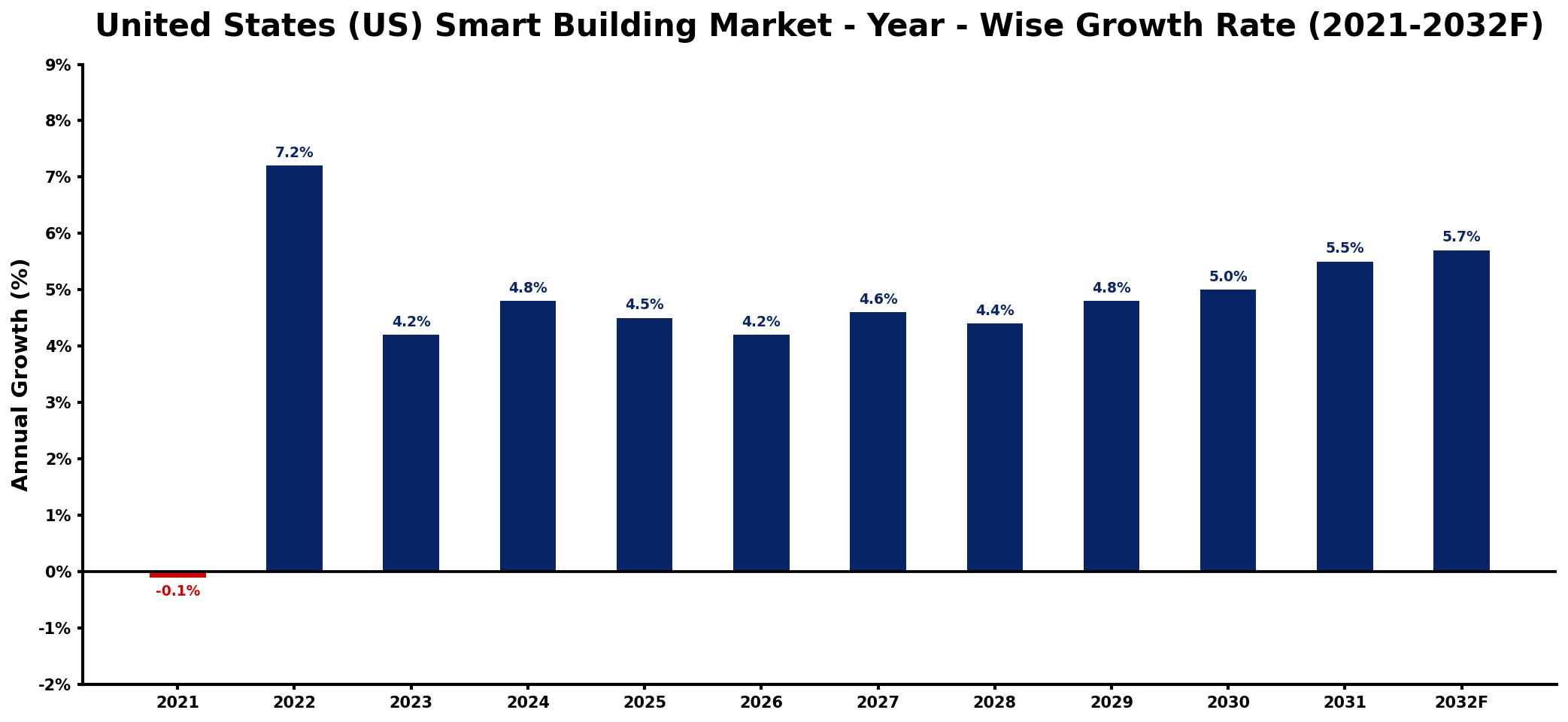
The table below presents the year‑wise growth rates along with the key drivers influencing the market
| Year | Growth Rate | Major Drivers |
| 2021 | -0.1% | decreased investment in technology infrastructure |
| 2022 | 7.2% | increased demand for energy efficiency |
| 2023 | 4.2% | growing interest in automation solutions |
| 2024 | 4.8% | expansion of IoT applications adoption |
| 2025 | 4.5% | rise in sustainable design practices |
| 2026 | 4.2% | enhanced focus on cybersecurity measures |
| 2027 | 4.6% | increased integration of AI technologies |
| 2028 | 4.4% | growing emphasis on user experience |
| 2029 | 4.8% | surge in retrofit project investments |
| 2030 | 5.0% | strengthened regulatory compliance requirements |
| 2031 | 5.5% | increased collaboration among stakeholders |
| 2032 | 5.7% | growing downstream application demand |
Note: Market size estimations and growth projections presented in this report are based on 6Wresearch's proprietary forecasting methodology, utilizing the latest available industry data, government publications, and primary research inputs.
United States (US) Smart Building Market Synopsis
The United States smart building market is at a pivotal moment, characterized by a significant shift towards automated, intelligent infrastructures. With businesses and homeowners increasingly prioritizing energy efficiency and sustainability, the integration of advanced technologies is becoming the norm.
This market is particularly vibrant due to the convergence of IoT devices, data analytics, and automation systems, which collectively enhance operational performance. The result is not only cost savings but also an improved experience for occupants, aligning with broader trends toward smarter, eco-friendly environments.
United States (US) Smart Building Market Key Takeaways
- The market is anticipated to witness robust growth due to heightened energy efficiency demands.
- Integration of IoT and advanced data analytics is optimizing building management systems.
- There is a growing focus on health and wellness features within smart buildings.
- Investment opportunities exist across various sectors, particularly in automation and HVAC systems.
- Government initiatives play a crucial role in fostering market development and innovation.
Evaluation of Restraints in United States (US) Smart Building Market
Despite the promising outlook for the US smart building market, several factors are hindering faster adoption. The high initial costs associated with upgrading existing infrastructures to smart systems often deter building owners. Additionally, interoperability issues arise when attempting to integrate diverse smart technologies, leading to inefficiencies. Privacy and data security concerns also pose significant risks, as the vast amounts of sensitive information collected by smart systems make them potential targets for cyber threats. Lastly, the absence of standardized regulations complicates the implementation of smart technologies across various states, further limiting market expansion.
United States (US) Smart Building Market Trends
Current trends in the US smart building market indicate a pronounced shift towards the incorporation of advanced IoT technologies. Smart sensors and data-driven analytics are being leveraged to enhance energy efficiency and optimize building operations. Moreover, the rise of cloud-based platforms facilitates real-time monitoring and management, streamlining system controls.
A notable development has been the increasing focus on occupant health and wellness, catalyzed by the COVID-19 pandemic. Building features such as air quality monitoring and touchless technologies have gained prominence, reflecting a broader societal emphasis on health-conscious environments. Such trends not only enhance user experience but also align with sustainability initiatives, creating a holistic approach to smart building design.
United States (US) Smart Building Market Opportunities
The US smart building market is rife with opportunities for investors and innovators alike. The demand for building automation systems is soaring, driven by the need to streamline energy management and enhance operational efficiency. There is a particular appetite for solutions that integrate AI and machine learning, which can transform traditional building operations into highly intelligent systems capable of predictive maintenance and real-time responsiveness.
Moreover, sectors such as smart HVAC systems, advanced lighting controls, and security solutions present viable growth avenues. As the industry leans into sustainability, the development of energy-efficient technologies will be paramount, offering substantial returns on investment for stakeholders committed to the smart building landscape.
Government Initiatives in the United States (US) Smart Building Market
Governmental support for the US smart building market is reflected in various initiatives aimed at bolstering energy efficiency and innovation. Tax incentives like the Energy-Efficient Commercial Buildings Tax Deduction encourage investments in smart technologies. Programs such as the Better Buildings Initiative by the Department of Energy focus on enhancing energy efficiency across commercial and residential sectors.
Additionally, the Smart Grid Investment Grant Program seeks to modernize the electric grid, which complements smart building technologies. Continued government backing for research and development in automation and sensor technologies is integral to fostering a conducive environment for smart building advancements.
Future Insights of the United States (US) Smart Building Market
Looking ahead, the future of the US smart building market appears bright, with sustained growth anticipated through 2026 and beyond. The ongoing emphasis on sustainability, coupled with rising energy costs, will drive further adoption of smart technologies. As innovations in IoT and cloud computing gain momentum, the integration of these technologies will enhance operational efficiency and comfort for occupants.
Furthermore, the increasing trend towards smart home technology complements the smart building sector, as consumers seek connected and automated solutions for their living spaces. As the market evolves, the focus will likely shift toward creating more autonomous buildings that enable better decision-making and energy management, positioning the US smart building market for a transformative future.
United States (US) Smart Building Market Latest Developments (2025 - 2026)
In recent months, the smart building market in the United States has seen a surge in innovative technological advancements. Several companies are investing in next-generation building management systems that incorporate AI capabilities, aimed at improving efficiency and reducing energy consumption. Additionally, the trend towards cloud-based solutions is gaining traction, allowing for greater interoperability among various smart building systems.
Moreover, there has been an increased focus on partnerships between technology providers and building operators to enhance system integration and performance. The emphasis on health and wellness technologies continues to grow, with an array of solutions being implemented to ensure optimal indoor environments. This evolving landscape indicates a robust trajectory for the US smart building market.
United States (US) Smart Building Market - Key Attractiveness of the Report
- 10 Years of Market Numbers
- Historical Data Starting from 2022 to 2025
- Base Year: 2025
- Forecast Data until 2032
- Key Performance Indicators Impacting the Market
- Major Upcoming Developments and Projects
Key Highlights of the Report:
- United States (US) Smart Building Market Outlook
- Market Size of United States (US) Smart Building Market, 2025
- Forecast of United States (US) Smart Building Market, 2032
- Historical Data and Forecast of United States (US) Smart Building Revenues & Volume for the Period 2022-2032F
- United States (US) Smart Building Market Trend Evolution
- United States (US) Smart Building Market Drivers and Challenges
- United States (US) Smart Building Price Trends
- United States (US) Smart Building Porter's Five Forces
- United States (US) Smart Building Industry Life Cycle
- Historical Data and Forecast of United States (US) Smart Building Market Revenues & Volume By Component for the Period 2022-2032F
- Historical Data and Forecast of United States (US) Smart Building Market Revenues & Volume By Solution for the Period 2022-2032F
- Historical Data and Forecast of United States (US) Smart Building Market Revenues & Volume By Services for the Period 2022-2032F
- Historical Data and Forecast of United States (US) Smart Building Market Revenues & Volume By Application for the Period 2022-2032F
- Historical Data and Forecast of United States (US) Smart Building Market Revenues & Volume By Residential for the Period 2022-2032F
- Historical Data and Forecast of United States (US) Smart Building Market Revenues & Volume By Commercial for the Period 2022-2032F
- United States (US) Smart Building Import Export Trade Statistics
- Market Opportunity Assessment By Component
- Market Opportunity Assessment By Application
- United States (US) Smart Building Top Companies Market Share
- United States (US) Smart Building Competitive Benchmarking By Technical and Operational Parameters
- United States (US) Smart Building Company Profiles
- United States (US) Smart Building Key Strategic Recommendations






































