Peru Smart Building Market Size, Share & Growth Rate
The Peru Smart Building Market was estimated at USD 1049 Million in 2025 and is projected to reach USD 1962 Million by 2032, growing at a CAGR of 9.4% from 2026 to 2032. This remarkable growth trajectory is spurred by the increasing integration of advanced technologies, particularly IoT and AI, which are enhancing building efficiency and operational management. Additionally, government initiatives aimed at promoting sustainability and energy conservation are playing a significant role in driving demand for smart building solutions across various sectors.
Peru Smart Building Market Year-wise Growth Rate and Key Drivers
This graph highlights how the Peru Smart Building Market has steadily grown over the years, supported by major growth factors.
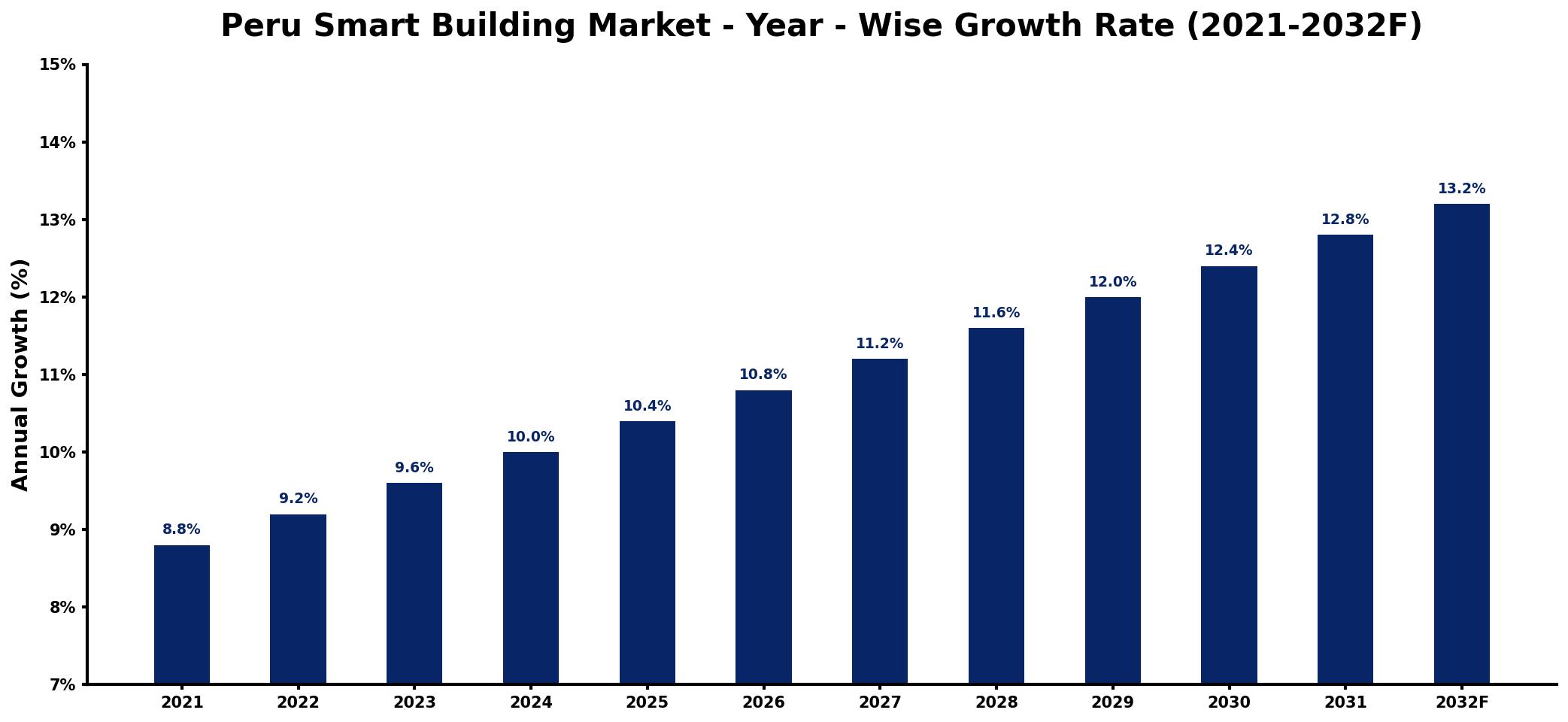
The table below presents the year‑wise growth rates along with the key drivers influencing the market
| Year | Growth Rate | Major Drivers |
| 2021 | 8.8% | Increased urbanization and infrastructure |
| 2022 | 9.2% | Growing adoption of IoT technologies |
| 2023 | 9.6% | Rising energy efficiency regulations |
| 2024 | 10.0% | Expansion of renewable energy sources |
| 2025 | 10.4% | Increased investments in automation |
| 2026 | 10.8% | Surge in sustainability initiatives |
| 2027 | 11.2% | Growth in remote work trends |
| 2028 | 11.6% | Enhanced government support programs |
| 2029 | 12.0% | Rising demand for advanced security |
| 2030 | 12.4% | strengthening underlying market demand |
| 2031 | 12.8% | Increased focus on health standards |
| 2032 | 13.2% | expanding industrial usage applications |
Note: Market size estimations and growth projections presented in this report are based on 6Wresearch's proprietary forecasting methodology, utilizing the latest available industry data, government publications, and primary research inputs.
Peru Smart Building Market Synopsis
The Peru Smart Building Market is currently at a pivotal moment, characterized by robust growth and innovation. With stakeholders increasingly recognizing the advantages of smart technologies, the momentum in this market reflects a broader shift towards digitization and sustainability in the built environment. Future growth is expected as the market evolves, driven by the rising demand for enhanced energy efficiency, security, and occupant comfort.
As smart building solutions gain traction in both urban and rural settings, the implementation of technologies such as smart lighting, building automation systems, and energy management tools is becoming commonplace. These trends are supported by a concerted effort from various sectors, including commercial real estate and government institutions, aiming to meet regulatory requirements while improving operational efficiencies.
Peru Smart Building Market Key Takeaways
- The market is driven by increased urbanization, rising energy costs, and a focus on sustainability.
- Technological advancements, especially in IoT and AI, are enhancing building operational efficiency.
- Government initiatives are fostering awareness and adoption of smart building technologies.
- Investment opportunities lie in retrofitting existing buildings and providing maintenance services.
- Integration challenges exist, necessitating industry collaboration and standardization efforts.
Evaluation of Restraints in Peru Smart Building Market
Despite its promising growth, the Peru Smart Building Market faces several constraints. The initial high costs of implementing smart technologies can deter potential investors and property developers. Furthermore, a significant gap in awareness among building owners about the benefits of smart solutions can lead to slow adoption rates. The shortage of skilled professionals equipped to design, install, and maintain these advanced systems further complicates matters. Additionally, interoperability issues between diverse technological solutions can create integration hurdles that necessitate extensive planning and investment.
Peru Smart Building Market Trends
Key trends shaping the Peru Smart Building Market include the growing adoption of IoT sensors and energy management systems designed to optimize energy consumption and operational efficiency. Furthermore, the demand for intelligent lighting solutions that enhance both energy savings and user comfort is on the rise. As regulatory frameworks continue to emphasize environmental standards, smart buildings are increasingly seen as a viable solution for compliance. The commercial sector is particularly keen on these technologies, aiming to reduce operational costs while enhancing tenant satisfaction.
Peru Smart Building Market Opportunities
The Peru Smart Building Market is ripe with investment opportunities. Companies focusing on developing and providing innovative smart building solutions—such as automated systems, advanced security measures, and efficient energy management—stand to benefit significantly. Moreover, the market presents prospects for retrofitting existing buildings with smart technologies, thus enhancing their operational capabilities and sustainability. Collaborations with local governments and utility providers to promote energy-efficient building practices can also yield substantial returns on investment.
Government Initiatives in the Peru Smart Building Market
The Peruvian government has introduced various policies aimed at boosting the Smart Building Market. These include incentives like tax breaks and subsidies for businesses investing in smart technologies, alongside regulations promoting energy efficiency and sustainable building practices. Public-private partnerships are also being encouraged to drive innovation within the sector. Moreover, initiatives aimed at raising awareness about the advantages of smart buildings are crucial to fostering a more informed market landscape.
Future Insights of the Peru Smart Building Market
Looking ahead to the period from 2026 to 2032, the Peru Smart Building Market is expected to undergo substantial transformation. The convergence of increasing urbanization, supportive government policies, and a heightened awareness of energy efficiency will likely catalyze further growth. As more organizations adopt smart technologies, the market is anticipated to evolve into a more connected and intelligent ecosystem. This will open doors for innovative applications and solutions, enhancing the overall functionality and sustainability of buildings across Peru.
Peru Smart Building Market Latest Developments (2025 - 2026)
Recent developments in the Peru Smart Building Market highlight a focus on innovation and the adoption of new technologies. Industry stakeholders are actively engaging in research and development initiatives to enhance the capabilities of smart building systems. Furthermore, collaborations between technology providers and construction firms are emerging, aimed at integrating advanced smart solutions into new projects. Awareness campaigns are also gaining traction, further promoting the benefits and potentials of smart buildings to a wider audience.
Peru Smart Building Market - Key Attractiveness of the Report
- 10 Years of Market Numbers
- Historical Data Starting from 2022 to 2025
- Base Year: 2025
- Forecast Data until 2032
- Key Performance Indicators Impacting the Market
- Major Upcoming Developments and Projects
Key Highlights of the Report:
- Peru Smart Building Market Outlook
- Market Size of Peru Smart Building Market, 2025
- Forecast of Peru Smart Building Market, 2032
- Historical Data and Forecast of Peru Smart Building Revenues & Volume for the Period 2022-2032F
- Peru Smart Building Market Trend Evolution
- Peru Smart Building Market Drivers and Challenges
- Peru Smart Building Price Trends
- Peru Smart Building Porter's Five Forces
- Peru Smart Building Industry Life Cycle
- Historical Data and Forecast of Peru Smart Building Market Revenues & Volume By Component for the Period 2022-2032F
- Historical Data and Forecast of Peru Smart Building Market Revenues & Volume By Solution for the Period 2022-2032F
- Historical Data and Forecast of Peru Smart Building Market Revenues & Volume By Services for the Period 2022-2032F
- Historical Data and Forecast of Peru Smart Building Market Revenues & Volume By Application for the Period 2022-2032F
- Historical Data and Forecast of Peru Smart Building Market Revenues & Volume By Residential for the Period 2022-2032F
- Historical Data and Forecast of Peru Smart Building Market Revenues & Volume By Commercial for the Period 2022-2032F
- Peru Smart Building Import Export Trade Statistics
- Market Opportunity Assessment By Component
- Market Opportunity Assessment By Application
- Peru Smart Building Top Companies Market Share
- Peru Smart Building Competitive Benchmarking By Technical and Operational Parameters
- Peru Smart Building Company Profiles
- Peru Smart Building Key Strategic Recommendations






































