Singapore Smart Building Market Size, Share & Growth Rate
The Singapore Smart Building Market was estimated at USD 1211 Million in 2025 and is projected to reach USD 2122 Million by 2032, growing at a CAGR of 8.3% from 2026 to 2032. This growth trajectory is largely propelled by an increasing focus on sustainability and energy efficiency within the urban development framework. Moreover, the integration of IoT technologies and smart automation solutions continues to redefine operational standards, ensuring enhanced occupant comfort and building performance across various sectors.
Singapore Smart Building Market Year-wise Growth Rate and Key Drivers
This graph highlights how the Singapore Smart Building Market has steadily grown over the years, supported by major growth factors.
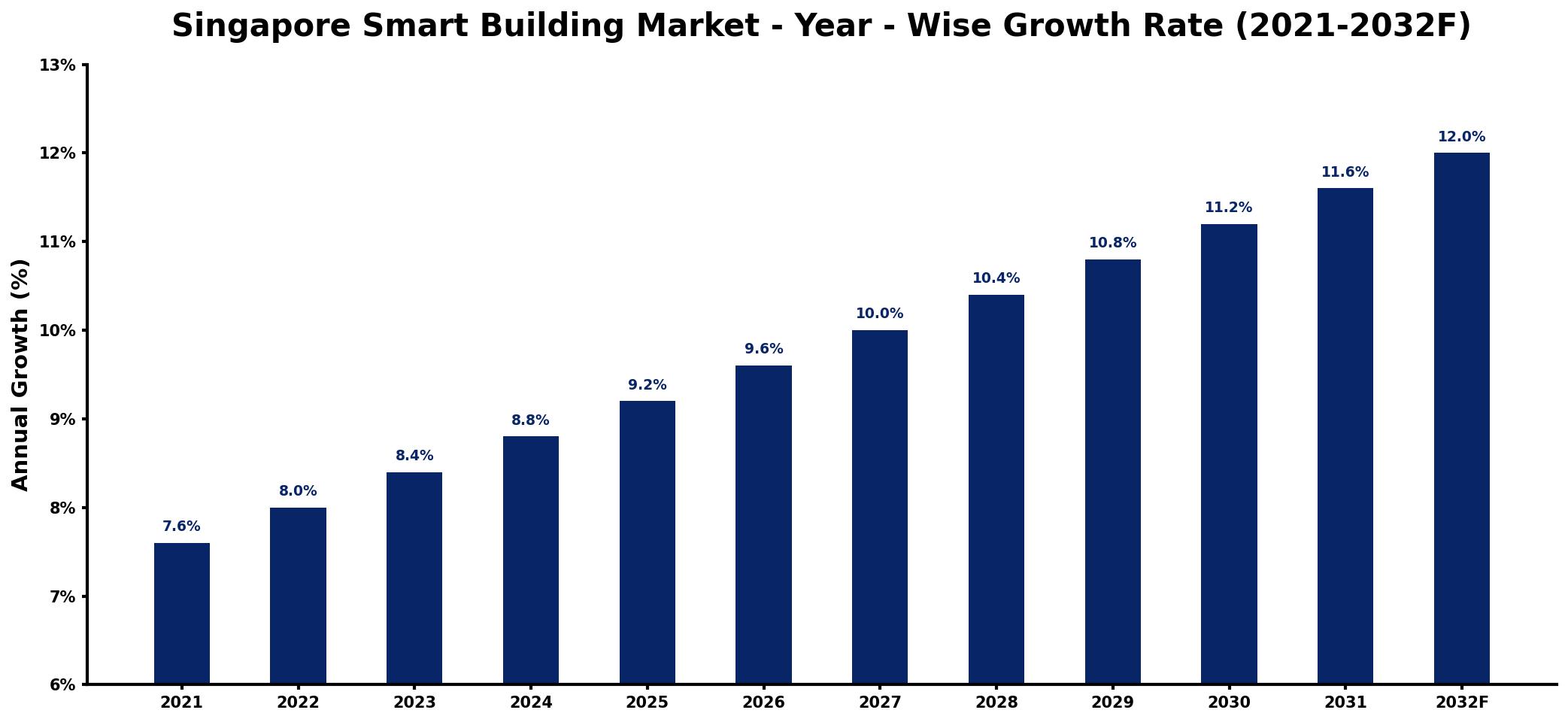
The table below presents the year‑wise growth rates along with the key drivers influencing the market
| Year | Growth Rate | Major Drivers |
| 2021 | 7.6% | Rise in energy efficiency regulations |
| 2022 | 8.0% | Increased urban population density |
| 2023 | 8.4% | Growing interest in automation technologies |
| 2024 | 8.8% | Expansion of green financing initiatives |
| 2025 | 9.2% | Surge in IoT adoption rates |
| 2026 | 9.6% | Rising demand for remote monitoring |
| 2027 | 10.0% | Increased focus on sustainability initiatives |
| 2028 | 10.4% | Growth in energy management solutions |
| 2029 | 10.8% | strengthening underlying market demand |
| 2030 | 11.2% | Advancements in data analytics capabilities |
| 2031 | 11.6% | Increase in real estate investments |
| 2032 | 12.0% | Growing emphasis on occupant experience |
Note: Market size estimations and growth projections presented in this report are based on 6Wresearch's proprietary forecasting methodology, utilizing the latest available industry data, government publications, and primary research inputs.
Singapore Smart Building Market Synopsis
In Singapore, the demand for smart buildings is rapidly increasing as urban planners and architects aim to create environments that are not only technologically advanced but also eco-friendly. With initiatives focused on energy management and automated controls, the market has become a cornerstone of modern construction practices.
The integration of IoT systems has transformed how buildings operate, allowing for real-time data monitoring and management. This shift towards intelligent infrastructure supports not only efficiency but also the well-being of occupants, making smart buildings increasingly attractive to investors and developers alike.
Singapore Smart Building Market Key Takeaways
- Rapid growth is being driven by the rising demand for sustainable construction practices.
- Technological advancements in automation and energy management are reshaping building operations.
- Investment in smart building solutions reflects a growing commitment to environmental stewardship.
- The market is increasingly focused on user-friendly interfaces to enhance adoption rates.
- Public interest in health and safety post-COVID-19 has accelerated the adoption of smart technologies.
Evaluation of Restraints in Singapore Smart Building Market
Despite its promising growth, the Singapore smart building market faces notable restraints. Interoperability between different smart systems can pose integration challenges, complicating the deployment of cohesive solutions. Cybersecurity remains a significant concern, as increased connectivity may expose buildings to digital vulnerabilities. Furthermore, the necessity for user-friendly interfaces is paramount, as complex systems can deter potential users and limit widespread adoption. Addressing these concerns is crucial for unlocking the market's full potential.
Singapore Smart Building Market Trends
Key trends influencing the Singapore Smart Building Market include the rise of integrated building management systems that streamline operations across various functionalities. Additionally, an increased emphasis on health and well-being in building design has prompted the integration of advanced air quality and lighting control systems. Moreover, there is a noticeable shift towards adopting renewable energy sources within smart buildings, aligning with Singapore's broader sustainability goals.
Singapore Smart Building Market Opportunities
The smart building market in Singapore presents numerous growth and investment opportunities, particularly in the development of innovative technologies that enhance energy efficiency. As businesses and developers seek solutions that meet stringent environmental regulations, the demand for cutting-edge smart technologies will likely expand. Collaborations between technology providers and construction firms can further drive the market forward, enabling the integration of advanced automation and analytics into new and existing buildings.
Government Initiatives in the Singapore Smart Building Market
The Singaporean government has been proactive in fostering the smart building sector through various initiatives and incentives. Programs promoting energy efficiency standards and sustainable building practices have been introduced, including financial support for projects that meet green building certifications. Furthermore, public investment in smart infrastructure aims to create a more resilient urban environment, aligning with the nations vision of becoming a smart nation.
Future Insights of the Singapore Smart Building Market
As we look toward the future, the Singapore Smart Building Market is set to continue its upward trajectory. The integration of AI and machine learning into building management systems will enhance operational efficiency and predictive maintenance capabilities. Additionally, ongoing advancements in IoT technology will facilitate more seamless interactions between occupants and building systems, ultimately creating a more intuitive living and working environment. This synergy of technology and sustainability will likely shape the market landscape from 2026 to 2032.
Singapore Smart Building Market Latest Developments (2025 - 2026)
Recent developments in the Singapore smart building market have showcased a surge in investment towards innovative energy management solutions. The focus has shifted to enhancing building automation systems that prioritize occupant comfort while reducing energy consumption. In addition, collaborations between tech companies and construction firms have emerged, aimed at creating smart buildings that adhere to the latest sustainability practices. The market is witnessing a growing trend of incorporating health and safety features into building designs, addressing consumer concerns in the post-pandemic landscape.
Singapore Smart Building Market - Key Attractiveness of the Report
- 10 Years of Market Numbers
- Historical Data Starting from 2022 to 2025
- Base Year: 2025
- Forecast Data until 2032
- Key Performance Indicators Impacting the Market
- Major Upcoming Developments and Projects
Key Highlights of the Report:
- Singapore Smart Building Market Outlook
- Market Size of Singapore Smart Building Market, 2025
- Forecast of Singapore Smart Building Market, 2032
- Historical Data and Forecast of Singapore Smart Building Revenues & Volume for the Period 2022-2032F
- Singapore Smart Building Market Trend Evolution
- Singapore Smart Building Market Drivers and Challenges
- Singapore Smart Building Price Trends
- Singapore Smart Building Porter's Five Forces
- Singapore Smart Building Industry Life Cycle
- Historical Data and Forecast of Singapore Smart Building Market Revenues & Volume By Component for the Period 2022-2032F
- Historical Data and Forecast of Singapore Smart Building Market Revenues & Volume By Solution for the Period 2022-2032F
- Historical Data and Forecast of Singapore Smart Building Market Revenues & Volume By Services for the Period 2022-2032F
- Historical Data and Forecast of Singapore Smart Building Market Revenues & Volume By Application for the Period 2022-2032F
- Historical Data and Forecast of Singapore Smart Building Market Revenues & Volume By Residential for the Period 2022-2032F
- Historical Data and Forecast of Singapore Smart Building Market Revenues & Volume By Commercial for the Period 2022-2032F
- Singapore Smart Building Import Export Trade Statistics
- Market Opportunity Assessment By Component
- Market Opportunity Assessment By Application
- Singapore Smart Building Top Companies Market Share
- Singapore Smart Building Competitive Benchmarking By Technical and Operational Parameters
- Singapore Smart Building Company Profiles
- Singapore Smart Building Key Strategic Recommendations






































