Malaysia Smart Building Market Size, Share & Growth Rate
The Malaysia Smart Building Market was estimated at USD 1486 Million in 2025 and is projected to reach USD 2158 Million by 2032, growing at a CAGR of 5.5% from 2026 to 2032. This growth is propelled by the increasing integration of the Internet of Things (IoT) and artificial intelligence (AI) in building management systems, driving energy efficiency and occupant comfort. Furthermore, a growing emphasis on sustainable urban development and government support for green building initiatives is shaping the markets promising trajectory.
Malaysia Smart Building Market Year-wise Growth Rate and Key Drivers
This graph highlights how the Malaysia Smart Building Market has steadily grown over the years, supported by major growth factors.
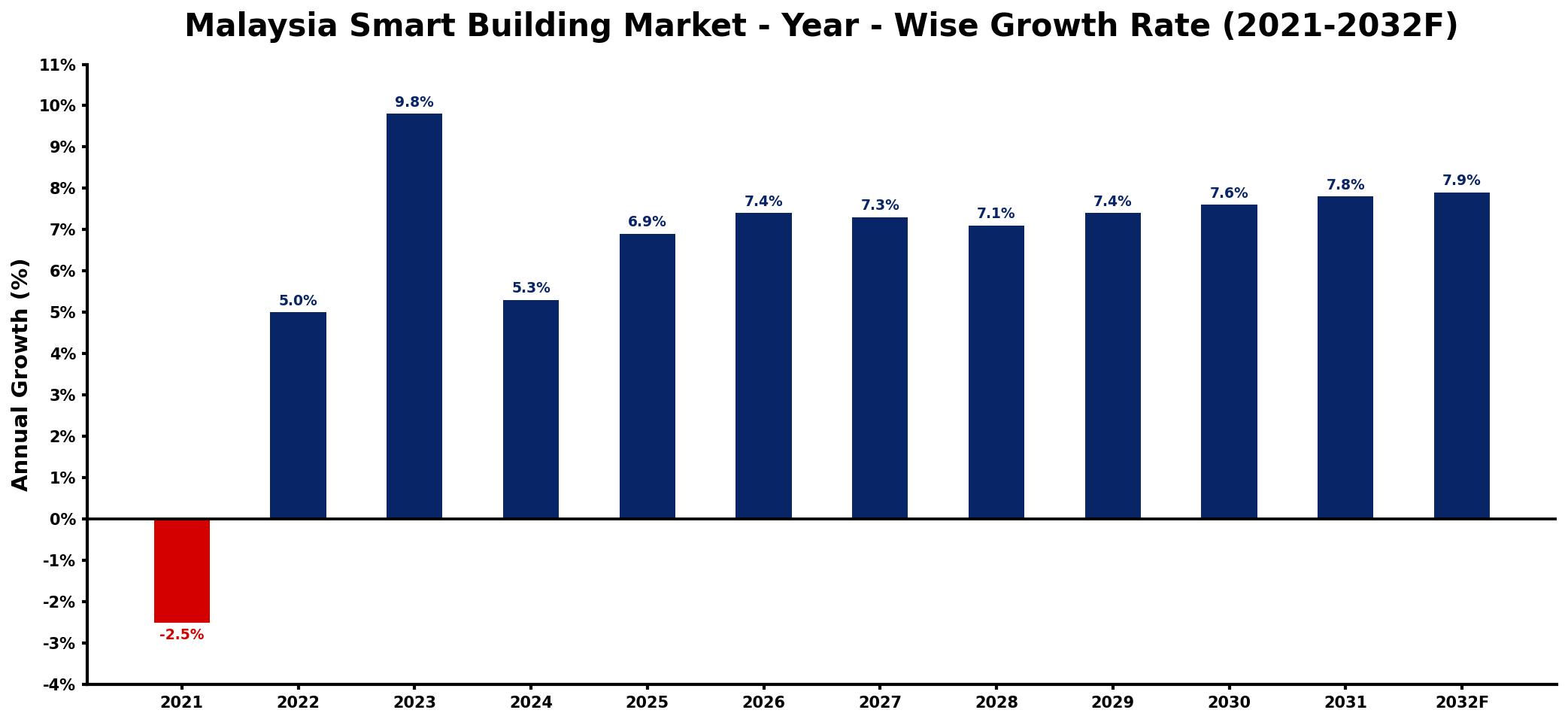
The table below presents the year‑wise growth rates along with the key drivers influencing the market
| Year | Growth Rate | Major Drivers |
| 2021 | -2.5% | decreased investment in technology |
| 2022 | 5.0% | rise in energy efficiency awareness |
| 2023 | 9.8% | increased urbanization and infrastructure |
| 2024 | 5.3% | growing demand for automation solutions |
| 2025 | 6.9% | expansion of green certification programs |
| 2026 | 7.4% | surge in IoT adoption rates |
| 2027 | 7.3% | enhanced focus on sustainability initiatives |
| 2028 | 7.1% | increased regulatory support measures |
| 2029 | 7.4% | growth in digital transformation projects |
| 2030 | 7.6% | rising interest in remote monitoring |
| 2031 | 7.8% | advancements in data analytics applications |
| 2032 | 7.9% | enhanced connectivity in urban areas |
Note: Market size estimations and growth projections presented in this report are based on 6Wresearch's proprietary forecasting methodology, utilizing the latest available industry data, government publications, and primary research inputs.
Malaysia Smart Building Market Synopsis
The strongest force currently shaping the Malaysia Smart Building Market is the rapid advancement of technology, particularly IoT and AI. As businesses and property owners strive for enhanced operational efficiency and security, these technologies are becoming essential components of modern building management.
In parallel, increasing awareness of sustainability is motivating the adoption of smart building solutions. These technologies not only reduce energy consumption but also improve air quality and overall occupant well-being, aligning with Malaysias broader objectives of sustainable infrastructure development.
Malaysia Smart Building Market Key Takeaways
- The market is driven by technological advancements, particularly in IoT and AI.
- Sustainable practices and green building regulations are gaining traction.
- The COVID-19 pandemic has accelerated interest in smart building technologies.
- High initial investment costs remain a concern for potential adopters.
- Leading firms are focusing on developing integrated, user-friendly solutions.
Evaluation of Restraints in Malaysia Smart Building Market
Despite the positive outlook for the Malaysia Smart Building Market, several real restraints are holding it back. High initial costs associated with implementing smart technologies deter many businesses from investing. Additionally, interoperability issues among various smart systems can lead to complications in integration. Data privacy concerns also pose a significant challenge, as organizations become increasingly wary of potential cybersecurity threats. Addressing these limitations is crucial for accelerating market adoption and ensuring comprehensive solutions.
Malaysia Smart Building Market Trends
Several emerging trends are shaping the demand within the Malaysia Smart Building Market. The integration of AI in predictive maintenance is becoming more prevalent, enabling buildings to self-diagnose and address issues before they escalate. Furthermore, the rise of contactless technologies in response to the pandemic is leading to increased investment in automated systems for occupancy management and enhanced air quality monitoring. These trends not only improve operational efficiency but also contribute to a safer environment for occupants.
Malaysia Smart Building Market Opportunities
As urbanization continues to accelerate, significant growth and investment opportunities lie within the Malaysia Smart Building Market. The focus on sustainable infrastructure development presents a chance for companies offering innovative energy-efficient solutions. Additionally, businesses that prioritize cybersecurity and data privacy will find themselves well-positioned to address growing concerns. Engaging with governmental initiatives aimed at promoting smart buildings can also unlock new avenues for growth.
Government Initiatives in the Malaysia Smart Building Market
The Malaysian government is actively promoting smart building technologies through various initiatives and incentives aimed at enhancing sustainable urban infrastructure. Policies encouraging green building practices, as well as financial incentives for adopting energy-efficient solutions, play a crucial role in shaping this market. Additionally, public spending directed towards upgrading existing facilities with smart technology contributes significantly to the markets growth.
Future Insights of the Malaysia Smart Building Market
Looking ahead to 2026-2032, the Malaysia Smart Building Market is expected to evolve with greater emphasis on integrated technologies that enhance both safety and comfort. The increasing demand for energy-efficient solutions coupled with smart technologies will drive innovation in building management systems. Furthermore, as consumer preferences shift towards sustainability, businesses that can provide comprehensive smart building solutions will likely thrive, solidifying their competitive positions in the market.
Malaysia Smart Building Market Latest Developments (2025 - 2026)
Recent developments in the Malaysia Smart Building Market reflect a growing commitment to integrating advanced technologies in urban infrastructure. Industry leaders are increasingly collaborating on projects that enhance energy efficiency and occupant comfort. Additionally, there is a notable trend towards offering contactless building management solutions, which have gained traction in response to changing consumer preferences post-pandemic. These movements signal a strong shift towards a more technology-driven future for smart buildings in Malaysia.
Malaysia Smart Building Market - Key Attractiveness of the Report
- 10 Years of Market Numbers
- Historical Data Starting from 2022 to 2025
- Base Year: 2025
- Forecast Data until 2032
- Key Performance Indicators Impacting the Market
- Major Upcoming Developments and Projects
Key Highlights of the Report:
- Malaysia Smart Building Market Outlook
- Market Size of Malaysia Smart Building Market, 2025
- Forecast of Malaysia Smart Building Market, 2032
- Historical Data and Forecast of Malaysia Smart Building Revenues & Volume for the Period 2022-2032F
- Malaysia Smart Building Market Trend Evolution
- Malaysia Smart Building Market Drivers and Challenges
- Malaysia Smart Building Price Trends
- Malaysia Smart Building Porter's Five Forces
- Malaysia Smart Building Industry Life Cycle
- Historical Data and Forecast of Malaysia Smart Building Market Revenues & Volume By Component for the Period 2022-2032F
- Historical Data and Forecast of Malaysia Smart Building Market Revenues & Volume By Solution for the Period 2022-2032F
- Historical Data and Forecast of Malaysia Smart Building Market Revenues & Volume By Services for the Period 2022-2032F
- Historical Data and Forecast of Malaysia Smart Building Market Revenues & Volume By Application for the Period 2022-2032F
- Historical Data and Forecast of Malaysia Smart Building Market Revenues & Volume By Residential for the Period 2022-2032F
- Historical Data and Forecast of Malaysia Smart Building Market Revenues & Volume By Commercial for the Period 2022-2032F
- Malaysia Smart Building Import Export Trade Statistics
- Market Opportunity Assessment By Component
- Market Opportunity Assessment By Application
- Malaysia Smart Building Top Companies Market Share
- Malaysia Smart Building Competitive Benchmarking By Technical and Operational Parameters
- Malaysia Smart Building Company Profiles
- Malaysia Smart Building Key Strategic Recommendations






































