Qatar Smart Waste Management Market Size & Growth Rate (2026-2032)
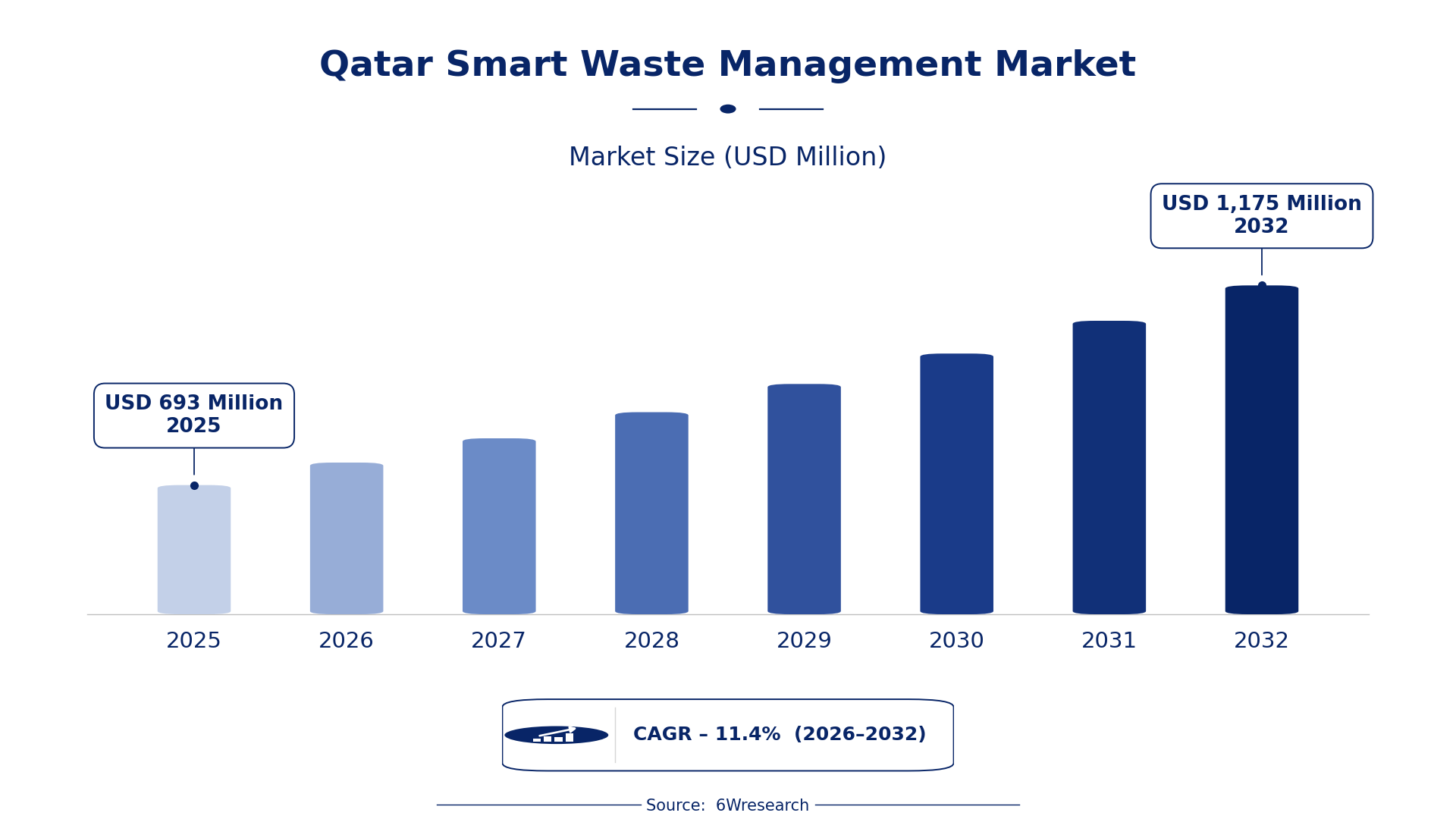
The Qatar Smart Waste Management Market was estimated at USD 693 Million in 2025 and is projected to reach USD 1175 Million by 2032, growing at a CAGR of 11.4% from 2026 to 2032.
Qatar Smart Waste Management Market Synopsis
The commitment to sustainability is the most powerful force currently driving the Qatar Smart Waste Management Market. With increasing urbanization and a growing population, authorities are under pressure to adopt innovative waste management solutions that not only enhance efficiency but also align with Qatar's environmental goals.
As cities expand and waste generation increases, the deployment of smart technologies such as IoT-enabled bins and data analytics platforms is becoming essential. These technologies are transforming waste collection processes, enabling municipalities to optimize routes and reduce the environmental impact of waste disposal.
Qatar Smart Waste Management Market Year-wise Growth Rate and Key Drivers
This graph illustrates the annual growth rates of the Qatar Smart Waste Management Market from 2021 to 2032, highlighting a steady upward trajectory and projected expansion over the forecast period.
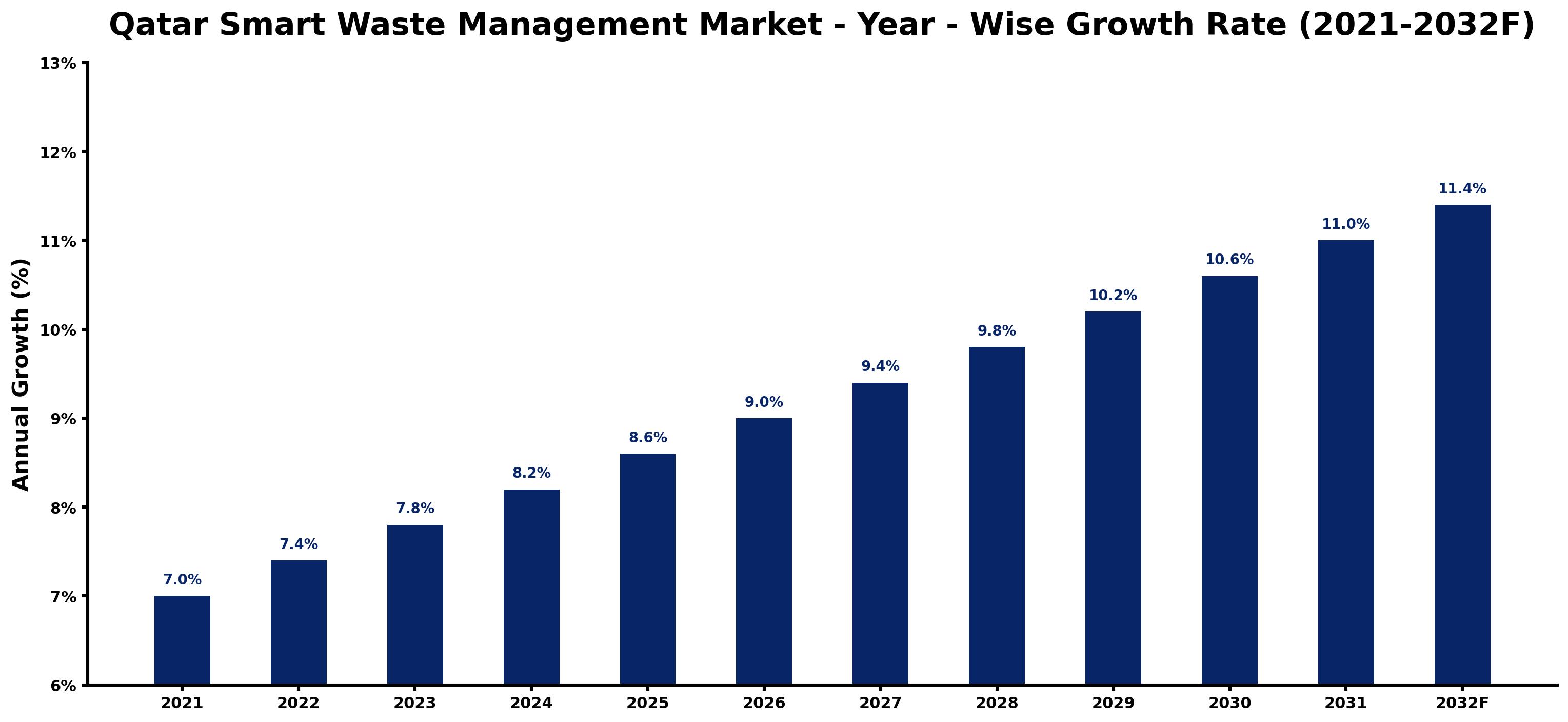
The table below presents the year‑wise growth rates along with the key drivers influencing the market
| Year | Growth Rate | Major Drivers |
| 2021 | 7.0% | Launch of Qatar National Waste Management Strategy |
| 2022 | 7.4% | Increased local investment in smart waste technologies |
| 2023 | 7.8% | Doha's preparations for FIFA World Cup sustainability goals |
| 2024 | 8.2% | Government incentives for eco-friendly waste solutions |
| 2025 | 8.6% | Growth in population driving waste management services demand |
| 2026 | 9.0% | Public awareness campaigns on waste reduction initiated |
| 2027 | 9.4% | Partnerships with tech firms for waste tracking solutions |
| 2028 | 9.8% | Regulatory support for circular economy initiatives |
| 2029 | 10.2% | Adoption of AI in waste sorting processes |
| 2030 | 10.6% | Qatar's commitment to reducing landfill contributions |
| 2031 | 11.0% | Urban development projects prioritizing waste management innovations |
| 2032 | 11.4% | Integration of IoT in waste monitoring systems |
Note: Market size estimations and growth projections presented in this report are based on 6Wresearch's proprietary forecasting methodology, utilizing the latest available industry data, government publications, and primary research inputs.
Qatar Smart Waste Management Market Key Takeaways
Below are some of the specific key takeaways from the market, including:
- Growing urbanization is a primary driver for smart waste management solutions in Qatar.
- The government's commitment to sustainable development is accelerating market growth.
- Technological advancements are reshaping waste collection processes, enhancing efficiency.
- Public awareness campaigns are critical for improving recycling habits among residents.
- Collaboration between government and technology providers is key to successful implementation.
Evaluation of Restraints in Qatar Smart Waste Management Market
Several challenges hinder the growth of the Qatar Smart Waste Management Market. A major issue is the need for significant initial investment to integrate smart solutions with existing infrastructure. In addition, changing public habits regarding waste disposal and recycling requires sustained educational efforts. The management of electronic waste and hazardous materials presents unique hurdles, necessitating specialized disposal technologies and practices. These factors collectively pose challenges that require strategic planning and execution.
Qatar Smart Waste Management Market Trends
Current trends indicate a shift towards greater use of IoT technologies, enabling real-time waste tracking and analytics. Smart bins equipped with sensors are increasingly being adopted, allowing for efficient waste level monitoring and optimized collection schedules. on top of that, the integration of mobile applications is enhancing user engagement and awareness, prompting better recycling habits among the public. These advancements signal a move towards more connected and responsive waste management systems in Qatar.
Qatar Smart Waste Management Market Opportunities
The market presents considerable growth opportunities, particularly in the development of public-private partnerships. These collaborations can drive innovation and investment in smart waste technologies. on top of that, the anticipated increase in regulatory support for sustainability initiatives will likely create favorable conditions for market expansion. The focus on improving recycling rates and managing electronic waste effectively opens avenues for new technologies and solutions to thrive.
Government Initiatives in the Qatar Smart Waste Management Market
Government policies play a crucial role in shaping the Qatar Smart Waste Management Market. The commitment to sustainable development is reflected in various regulatory frameworks and initiatives designed to enhance waste management practices. These efforts are crucial not just for compliance but also for fostering innovation in waste management solutions.
- A recent initiative launched in 2025 introduced smart waste bins across major urban areas, enhancing collection efficiency.
- Currently underway is a public awareness campaign focused on promoting recycling and proper waste disposal among residents.
- A planned regulatory framework is set to be introduced by 2026, mandating transparency in waste management operations.
- A national strategy aimed at integrating digital technologies into waste management processes is expected to roll out by 2028.
Future Insights of the Qatar Smart Waste Management Market
Looking ahead to 2026-2032, the Qatar Smart Waste Management Market is likely to evolve significantly as technology adoption accelerates. The drive for sustainability will continue to push municipalities to invest in smarter solutions, optimizing resource use and minimizing environmental impact. As public awareness grows and technological capabilities expand, the landscape of waste management in Qatar will become increasingly efficient and effective.
Qatar Smart Waste Management Market Latest Developments
In the past year, the Qatar Smart Waste Management Market has witnessed a flurry of activity as stakeholders ramp up efforts to adopt smart solutions. This has included a mix of technology rollouts and public initiatives aimed at enhancing waste management practices across the region.
- A major technology vendor announced the rollout of an advanced waste tracking system in Q1 2025, aimed at optimizing collection routes.
- An ongoing partnership between government entities and local tech firms is focused on developing a comprehensive waste management platform, currently in its pilot phase.
- In mid-2025, a leading waste management company launched a new mobile app designed to engage citizens in recycling efforts, enhancing community participation.
- A planned initiative to introduce automated waste sorting facilities is set to begin construction by late 2025, significantly improving recycling capabilities.
Qatar Smart Waste Management Market - Key Attractiveness of the Report
- 10 Years of Market Numbers
- Historical Data Starting from 2022 to 2025
- Base Year: 2025
- Forecast Data until 2032
- Key Performance Indicators Impacting the Market
- Major Upcoming Developments and Projects
Key Highlights of the Report:
- Qatar Smart Waste Management Market Outlook
- Market Size of Qatar Smart Waste Management Market, 2025
- Forecast of Qatar Smart Waste Management Market, 2032
- Historical Data and Forecast of Qatar Smart Waste Management Revenues & Volume for the Period 2022-2032F
- Qatar Smart Waste Management Market Trend Evolution
- Qatar Smart Waste Management Market Drivers and Challenges
- Qatar Smart Waste Management Price Trends
- Qatar Smart Waste Management Porter's Five Forces
- Qatar Smart Waste Management Industry Life Cycle
- Historical Data and Forecast of Qatar Smart Waste Management Market Revenues & Volume By Solution for the Period 2022-2032F
- Historical Data and Forecast of Qatar Smart Waste Management Market Revenues & Volume By Optimization Solutions for the Period 2022-2032F
- Historical Data and Forecast of Qatar Smart Waste Management Market Revenues & Volume By Analytics and Reporting Solutions for the Period 2022-2032F
- Historical Data and Forecast of Qatar Smart Waste Management Market Revenues & Volume By Asset Management for the Period 2022-2032F
- Historical Data and Forecast of Qatar Smart Waste Management Market Revenues & Volume By Network Management for the Period 2022-2032F
- Historical Data and Forecast of Qatar Smart Waste Management Market Revenues & Volume By Others for the Period 2022-2032F
- Historical Data and Forecast of Qatar Smart Waste Management Market Revenues & Volume By Service for the Period 2022-2032F
- Historical Data and Forecast of Qatar Smart Waste Management Market Revenues & Volume By Professional Services for the Period 2022-2032F
- Historical Data and Forecast of Qatar Smart Waste Management Market Revenues & Volume By Managed Services for the Period 2022-2032F
- Historical Data and Forecast of Qatar Smart Waste Management Market Revenues & Volume By Application for the Period 2022-2032F
- Historical Data and Forecast of Qatar Smart Waste Management Market Revenues & Volume By Food & Retail for the Period 2022-2032F
- Historical Data and Forecast of Qatar Smart Waste Management Market Revenues & Volume By Construction for the Period 2022-2032F
- Historical Data and Forecast of Qatar Smart Waste Management Market Revenues & Volume By Manufacturing & Industrial for the Period 2022-2032F
- Historical Data and Forecast of Qatar Smart Waste Management Market Revenues & Volume By HealthCare for the Period 2022-2032F
- Historical Data and Forecast of Qatar Smart Waste Management Market Revenues & Volume By Municipalities for the Period 2022-2032F
- Historical Data and Forecast of Qatar Smart Waste Management Market Revenues & Volume By Colleges & Universities for the Period 2022-2032F
- Qatar Smart Waste Management Import Export Trade Statistics
- Market Opportunity Assessment By Solution
- Market Opportunity Assessment By Service
- Market Opportunity Assessment By Application
- Qatar Smart Waste Management Top Companies Market Share
- Qatar Smart Waste Management Competitive Benchmarking By Technical and Operational Parameters
- Qatar Smart Waste Management Company Profiles
- Qatar Smart Waste Management Key Strategic Recommendations






































