Qatar Sodium Aluminium Phosphate Market Size, Share & Growth Rate
The Qatar Sodium Aluminium Phosphate Market was estimated at USD 1026 Million in 2025 and is projected to reach USD 1456 Million by 2032, growing at a CAGR of 5.1% from 2026 to 2032. This growth trajectory is primarily driven by increasing demand in the food processing sector, especially for applications in baked goods, which leverage sodium aluminium phosphate as a leavening agent. The shift towards convenience foods and evolving consumer preferences for high-quality and textured products are also key factors bolstering market expansion.
Qatar Sodium Aluminium Phosphate Market Year-wise Growth Rate and Key Drivers
This graph highlights how the Qatar Sodium Aluminium Phosphate Market has steadily grown over the years, supported by major growth factors.
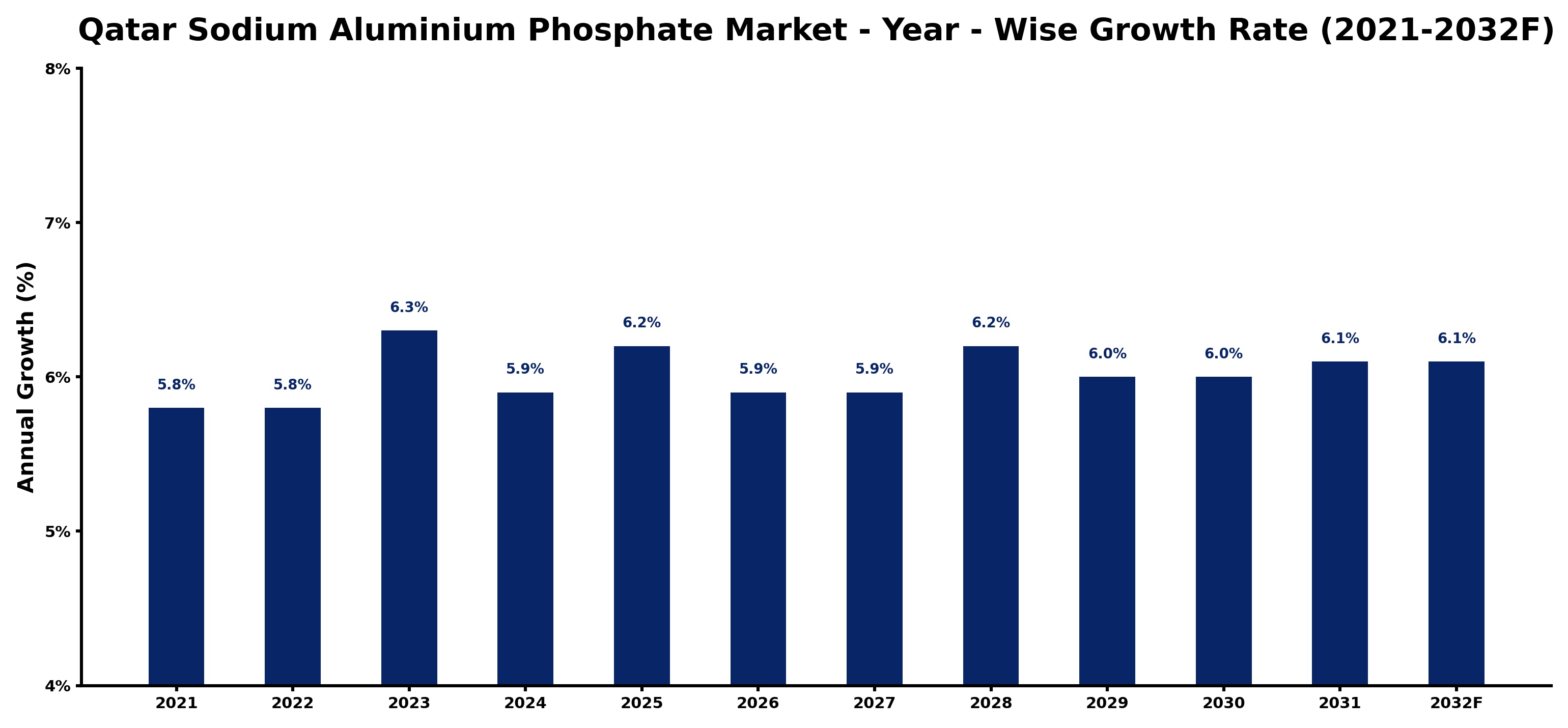
The table below presents the year‑wise growth rates along with the key drivers influencing the market
| Year | Growth Rate | Major Drivers |
| 2021 | 5.8% | Rising demand for processed foods |
| 2022 | 5.8% | Increased focus on food safety |
| 2023 | 6.3% | Growing health consciousness among consumers |
| 2024 | 5.9% | Expansion of food manufacturing facilities |
| 2025 | 6.2% | Rising popularity of convenience foods |
| 2026 | 5.9% | Increased investment in food technology |
| 2027 | 5.9% | Growth in export opportunities abroad |
| 2028 | 6.2% | Surge in organic food trends |
| 2029 | 6.0% | Enhanced food preservation techniques adopted |
| 2030 | 6.0% | Industrial activity supported growth |
| 2031 | 6.1% | Increased collaboration with food brands |
| 2032 | 6.1% | Market expansion drove consumption |
Note - Market size estimations and growth projections presented in this report are based on 6Wresearch’s advanced forecasting approach, validated with industry datasets as of June 2026.
Qatar Sodium Aluminium Phosphate Market Synopsis
In recent years, the Qatar sodium aluminium phosphate market has seen a notable rise in demand, spurred by its critical role as a food additive. As the food sector diversifies and expands, the reliance on sodium aluminium phosphate in various applications, particularly in baked goods, has intensified.
Additionally, the market benefits from a robust import-export framework, with a total trade volume of approximately USD 4 million. Most imports are sourced from European suppliers, while a significant portion of exports reaches growing markets across Asia, such as India and Pakistan.
Qatar Sodium Aluminium Phosphate Market Key Takeaways
- Significant growth is expected in the food industry, especially in the production of baked goods.
- Rising consumer demand for convenience foods is a primary driver of market expansion.
- Market resilience has been evident even amidst pandemic disruptions, with stable demand for processed foods.
- Import channels are primarily dominated by European suppliers, ensuring quality and consistency.
- Regulatory challenges are prompting innovation towards safer food additive alternatives.
Evaluation of Restraints in Qatar Sodium Aluminium Phosphate Market
Despite its growth prospects, the Qatar sodium aluminium phosphate market contends with several restraints. Fluctuating raw material costs continue to challenge producers, affecting overall pricing stability and production consistency. Additionally, manufacturers face mounting pressure from stringent regulations concerning food additives. These evolving compliance standards necessitate investments in research and development, which can strain operational capacities and resources, ultimately impacting market dynamics.
Qatar Sodium Aluminium Phosphate Market Trends
Current trends indicate a growing inclination towards natural and healthier food additives, as consumers become increasingly health-conscious. This shift is steering some producers to explore alternative leavening agents, which could reshape demand dynamics. Furthermore, advancements in production technologies aimed at enhancing product safety and quality are emerging as critical factors influencing market strategies.
Qatar Sodium Aluminium Phosphate Market Opportunities
The evolving landscape of the food industry presents several opportunities for growth within the Qatar sodium aluminium phosphate market. As the demand for processed and convenience foods continues to rise, manufacturers can capitalize on this trend by enhancing their product offerings. There is also substantial potential in developing innovative solutions that meet health regulations while maintaining product performance, thereby attracting health-conscious consumers.
Government Initiatives in the Qatar Sodium Aluminium Phosphate Market
The Qatari government has been actively promoting the food processing sector as part of its broader economic diversification strategy. This includes encouraging investments in food safety and quality regulations, which, in turn, stimulate the demand for compliant additives like sodium aluminium phosphate. Initiatives aimed at boosting local production capabilities are also under development, potentially reducing dependency on imports while fostering growth in domestic industries.
Future Insights of the Qatar Sodium Aluminium Phosphate Market
Looking ahead to 2026-2032, the Qatar sodium aluminium phosphate market is positioned for consistent growth. With the food and beverage industry projected to expand further, demand for sodium aluminium phosphate will likely increase, driven by innovations in product formulations and the continued trend towards processed foods. As market players navigate regulatory landscapes and seek to enhance product safety, the overall trajectory will remain positive, underpinned by a commitment to quality and compliance.
Qatar Sodium Aluminium Phosphate Market Latest Developments (May 2025 - June 2026)
Recent developments in the Qatar sodium aluminium phosphate market highlight a focus on sustainability and the exploration of alternative additives. Industry stakeholders are increasingly investing in research to find safer and more effective substitutes, aiming to align with global health trends. Additionally, the market is witnessing strategic partnerships aimed at improving supply chain efficiencies and increasing production capabilities, further enhancing the resilience of the sector.
Qatar Sodium Aluminium Phosphate Market - Key Attractiveness of the Report
- 10 Years of Market Numbers
- Historical Data Starting from 2022 to 2025
- Base Year: 2025
- Forecast Data until 2032
- Key Performance Indicators Impacting the Market
- Major Upcoming Developments and Projects
Key Highlights of the Report:
- Qatar Sodium Aluminium Phosphate Market Outlook
- Market Size of Qatar Sodium Aluminium Phosphate Market, 2025
- Forecast of Qatar Sodium Aluminium Phosphate Market, 2032
- Historical Data and Forecast of Qatar Sodium Aluminium Phosphate Revenues & Volume for the Period 2022-2032F
- Qatar Sodium Aluminium Phosphate Market Trend Evolution
- Qatar Sodium Aluminium Phosphate Market Drivers and Challenges
- Qatar Sodium Aluminium Phosphate Price Trends
- Qatar Sodium Aluminium Phosphate Porter's Five Forces
- Qatar Sodium Aluminium Phosphate Industry Life Cycle
- Historical Data and Forecast of Qatar Sodium Aluminium Phosphate Market Revenues & Volume By Product Type for the Period 2022-2032F
- Historical Data and Forecast of Qatar Sodium Aluminium Phosphate Market Revenues & Volume By Acidic Sodium Aluminium Phosphate for the Period 2022-2032F
- Historical Data and Forecast of Qatar Sodium Aluminium Phosphate Market Revenues & Volume By Basic Sodium Aluminium Phosphate for the Period 2022-2032F
- Historical Data and Forecast of Qatar Sodium Aluminium Phosphate Market Revenues & Volume By End use for the Period 2022-2032F
- Historical Data and Forecast of Qatar Sodium Aluminium Phosphate Market Revenues & Volume By Bakery Products for the Period 2022-2032F
- Historical Data and Forecast of Qatar Sodium Aluminium Phosphate Market Revenues & Volume By Confectionery for the Period 2022-2032F
- Historical Data and Forecast of Qatar Sodium Aluminium Phosphate Market Revenues & Volume By Tortillas for the Period 2022-2032F
- Historical Data and Forecast of Qatar Sodium Aluminium Phosphate Market Revenues & Volume By Donut and Cake Mixes for the Period 2022-2032F
- Historical Data and Forecast of Qatar Sodium Aluminium Phosphate Market Revenues & Volume By Cheese for the Period 2022-2032F
- Historical Data and Forecast of Qatar Sodium Aluminium Phosphate Market Revenues & Volume By Function for the Period 2022-2032F
- Historical Data and Forecast of Qatar Sodium Aluminium Phosphate Market Revenues & Volume By Dough Strengtheners and Conditioners for the Period 2022-2032F
- Historical Data and Forecast of Qatar Sodium Aluminium Phosphate Market Revenues & Volume By Leavening Agent for the Period 2022-2032F
- Historical Data and Forecast of Qatar Sodium Aluminium Phosphate Market Revenues & Volume By pH Control Agent for the Period 2022-2032F
- Historical Data and Forecast of Qatar Sodium Aluminium Phosphate Market Revenues & Volume By Acidulant for the Period 2022-2032F
- Qatar Sodium Aluminium Phosphate Import Export Trade Statistics
- Market Opportunity Assessment By Product Type
- Market Opportunity Assessment By End use
- Market Opportunity Assessment By Function
- Qatar Sodium Aluminium Phosphate Top Companies Market Share
- Qatar Sodium Aluminium Phosphate Competitive Benchmarking By Technical and Operational Parameters
- Qatar Sodium Aluminium Phosphate Company Profiles
- Qatar Sodium Aluminium Phosphate Key Strategic Recommendations






































