Qatar Split Air conditioners Market Summary
The qatar split air conditioners market was estimated at USD 441 Million in 2025 and is projected to reach USD 794 Million by 2032, growing at a CAGR of 10.1% from 2026 to 2032.
Qatar Split Air conditioners Market Year-wise Growth Rate and Key Drivers
This graph highlights how the Qatar Split Air conditioners Market has steadily grown over the past five years, supported by major growth factors.
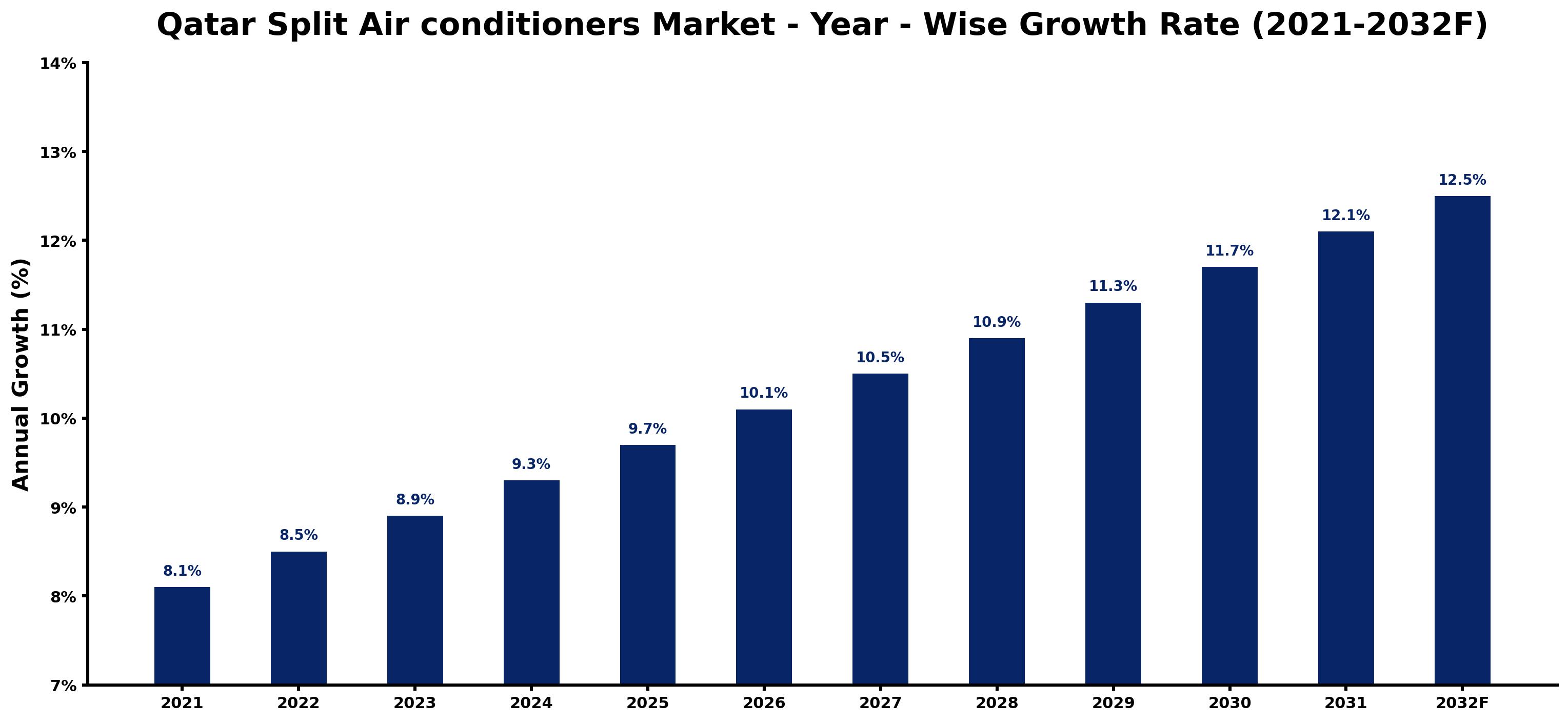
The table below presents the year wise growth rates along with the key drivers influencing the market
| Year | Growth Rate | Major Drivers |
| 2021 | 8.1% | Consumer awareness about energy efficiency significantly influences purchasing decisions this year. |
| 2022 | 8.5% | Expansion of luxury real estate projects increases demand for high-performance air conditioning systems. |
| 2023 | 8.9% | Intense summer temperatures prompt homeowners to upgrade outdated air conditioning units now. |
| 2024 | 9.3% | Investment in sustainable building practices drives interest in eco-friendly cooling solutions. |
| 2025 | 9.7% | Local manufacturers begin producing split air conditioners to meet rising regional needs effectively. |
| 2026 | 10.1% | Integration of smart technologies in cooling systems enhances user experience and efficiency. |
| 2027 | 10.5% | The influx of expatriates contributes to a consistent rise in household air conditioning installations. |
| 2028 | 10.9% | Urbanization accelerates construction projects, increasing the necessity for reliable air conditioning. |
| 2029 | 11.3% | Emergence of online sales channels transforms traditional retail strategies in the market. |
| 2030 | 11.7% | Consumer preferences shift toward niche products emphasizing quality and energy savings. |
| 2031 | 12.1% | Partnerships between local firms and international brands expand product offerings in Qatar. |
| 2032 | 12.5% | Technological innovations continue to reshape air conditioning solutions, driving competitive dynamics. |
Note - Market size estimations and growth projections presented in this report are based on 6Wresearch's advanced forecasting approach, validated with industry datasets as of June 2026.
Qatar Split Air conditioners Market Synopsis
The Qatar Split Air conditioners Market is projected to reach 10.1% and witness significant growth during the forecast period (2026-2032). The ongoing rise in temperatures and the country's commitment to energy-efficient solutions are key factors driving this market. The demand for split air conditioners continues to surge as consumers and businesses recognize their effectiveness, low maintenance costs, and diverse features tailored for various applications. Additionally, the influx of tourists is anticipated to bolster sales across the hospitality sector, further enhancing the need for cooling solutions in Qatar.
Qatar Split Air conditioners Market Growth Drivers
Several factors contribute to the robust growth of the Qatar Split Air conditioners Market, including:
- The soaring temperatures and high humidity levels prevalent in Qatar necessitate effective climate control solutions, making split air conditioners an attractive option for both residential and commercial spaces.
- With the rise in purchasing power parity, consumers have greater financial capacity to invest in energy-efficient cooling technologies that promise long-term savings.
- Government initiatives, particularly the Green Building Regulations, mandate energy-efficient solutions, promoting the adoption of advanced air conditioning systems within new construction projects.
- The shift towards smart homes is driving demand for split air conditioners equipped with intelligent control features, enhancing convenience and user experience.
- Technological advancements have led to improved product quality and efficiency, fostering consumer trust and encouraging investments in modern HVAC systems.
Qatar Split Air conditioners Market Challenges and Restraints
While the Qatar Split Air conditioners Market displays significant growth potential, it faces challenges that may impede progress:
- The initial high costs associated with purchasing and installing split air conditioning systems can deter potential buyers, particularly when compared to more traditional cooling solutions.
- Lack of awareness regarding the benefits of solar-powered air conditioning systems limits market growth, as consumers remain hesitant to invest in these options due to perceived higher costs.
- Stringent regulations surrounding noise pollution can pose challenges for manufacturers, particularly if future standards become more stringent and affect product designs.
- The global supply chain disruptions caused by the Covid-19 pandemic have led to increased lead times and availability issues for crucial components, impacting overall market growth.
- Limited promotional efforts by manufacturers, particularly in certain regions, can restrict consumer engagement and awareness of the latest offerings in the market.
Qatar Split Air conditioners Market Government Investment and Initiatives
The Qatari government plays a pivotal role in shaping the Split Air conditioners Market through various policies and initiatives. By implementing the National Vision 2030, the government aims to diversify its economy and invest in sustainable practices.
- The government is actively promoting energy-efficient solutions through legislation and incentives that encourage builders and developers to incorporate advanced HVAC systems in new projects.
- Public spending on infrastructure development, particularly in the hospitality and tourism sectors, has led to increased demand for split air conditioners, aligning with government efforts to boost tourism.
- Through partnerships with international sustainability organizations, Qatar is reinforcing its commitment to reducing energy consumption within buildings, which directly benefits the air conditioning sector.
- Awareness campaigns aimed at educating consumers about the advantages of energy-efficient air conditioning solutions are supported by governmental bodies, fostering a more informed market.
- Investment in research and development initiatives focused on enhancing HVAC technology further complements government objectives for a greener and more energy-efficient environment.
Qatar Split Air conditioners Market Latest Developments (May 2025 - June 2026)
During the period from May 2025 to June 2026, the Qatar Split Air conditioners Market has seen noteworthy advancements in technology and consumer engagement. Manufacturers have introduced new models equipped with enhanced energy-saving features, aligning with global trends toward sustainability.
- Innovations in smart technology have been prominently featured, allowing consumers to integrate air conditioning systems with home automation platforms for greater control and energy efficiency.
- In response to growing consumer demand, manufacturers have participated in promotional campaigns emphasizing energy savings and lower operational costs associated with split air conditioners.
- The market has witnessed an increase in localized production efforts aimed at reducing lead times and ensuring availability of essential components, thereby stabilizing supply chains post-pandemic.
- Collaborations between manufacturers and local governments have led to pilot projects demonstrating the efficacy of energy-efficient air conditioning solutions in public facilities.
- Consumer education initiatives have gained traction, enabling potential buyers to make informed decisions regarding the benefits and options available in the split air conditioning market.
Qatar Split Air conditioners Market - Key Attractiveness of the Report
- 10 Years of Market Numbers
- Historical Data Starting from 2022 to 2025
- Base Year: 2025
- Forecast Data until 2032
- Key Performance Indicators Impacting the Market
- Major Upcoming Developments and Projects
Key Highlights of the Report:
- Qatar Split Air conditioners Market Outlook
- Market Size of Qatar Split Air conditioners Market, 2025
- Forecast of Qatar Split Air conditioners Market, 2032
- Historical Data and Forecast of Qatar Split Air conditioners Revenues & Volume for the Period 2022-2032F
- Qatar Split Air conditioners Market Trend Evolution
- Qatar Split Air conditioners Market Drivers and Challenges
- Qatar Split Air conditioners Price Trends
- Qatar Split Air conditioners Porter's Five Forces
- Qatar Split Air conditioners Industry Life Cycle
- Historical Data and Forecast of Qatar Split Air conditioners Market Revenues & Volume By Product Type for the Period 2022-2032F
- Historical Data and Forecast of Qatar Split Air conditioners Market Revenues & Volume By Ductless for the Period 2022-2032F
- Historical Data and Forecast of Qatar Split Air conditioners Market Revenues & Volume By VRF for the Period 2022-2032F
- Historical Data and Forecast of Qatar Split Air conditioners Market Revenues & Volume By Ducted for the Period 2022-2032F
- Historical Data and Forecast of Qatar Split Air conditioners Market Revenues & Volume By Application for the Period 2022-2032F
- Historical Data and Forecast of Qatar Split Air conditioners Market Revenues & Volume By Residential for the Period 2022-2032F
- Historical Data and Forecast of Qatar Split Air conditioners Market Revenues & Volume By Commercial for the Period 2022-2032F
- Qatar Split Air conditioners Import Export Trade Statistics
- Market Opportunity Assessment By Product Type
- Market Opportunity Assessment By Application
- Qatar Split Air conditioners Top Companies Market Share
- Qatar Split Air conditioners Competitive Benchmarking By Technical and Operational Parameters
- Qatar Split Air conditioners Company Profiles
- Qatar Split Air conditioners Key Strategic Recommendations






































