Qatar Tailors Scissor Market Size, Share & Growth Rate
The Qatar Tailors Scissor Market was estimated at USD 1067 Million in 2025 and is projected to reach USD 1839 Million by 2032, growing at a CAGR of 8.1% from 2026 to 2032. This remarkable trajectory is primarily driven by the burgeoning fashion industry in Qatar, with a notable rise in demand for custom-tailored clothing. As fashion-conscious consumers increasingly seek personalized styles, the need for high-quality and precise tailoring tools has surged, enhancing the market's growth prospects.
Qatar Tailors Scissor Market Year-wise Growth Rate and Key Drivers
This graph highlights how the Qatar Tailors Scissor Market has steadily grown over the years, supported by major growth factors.
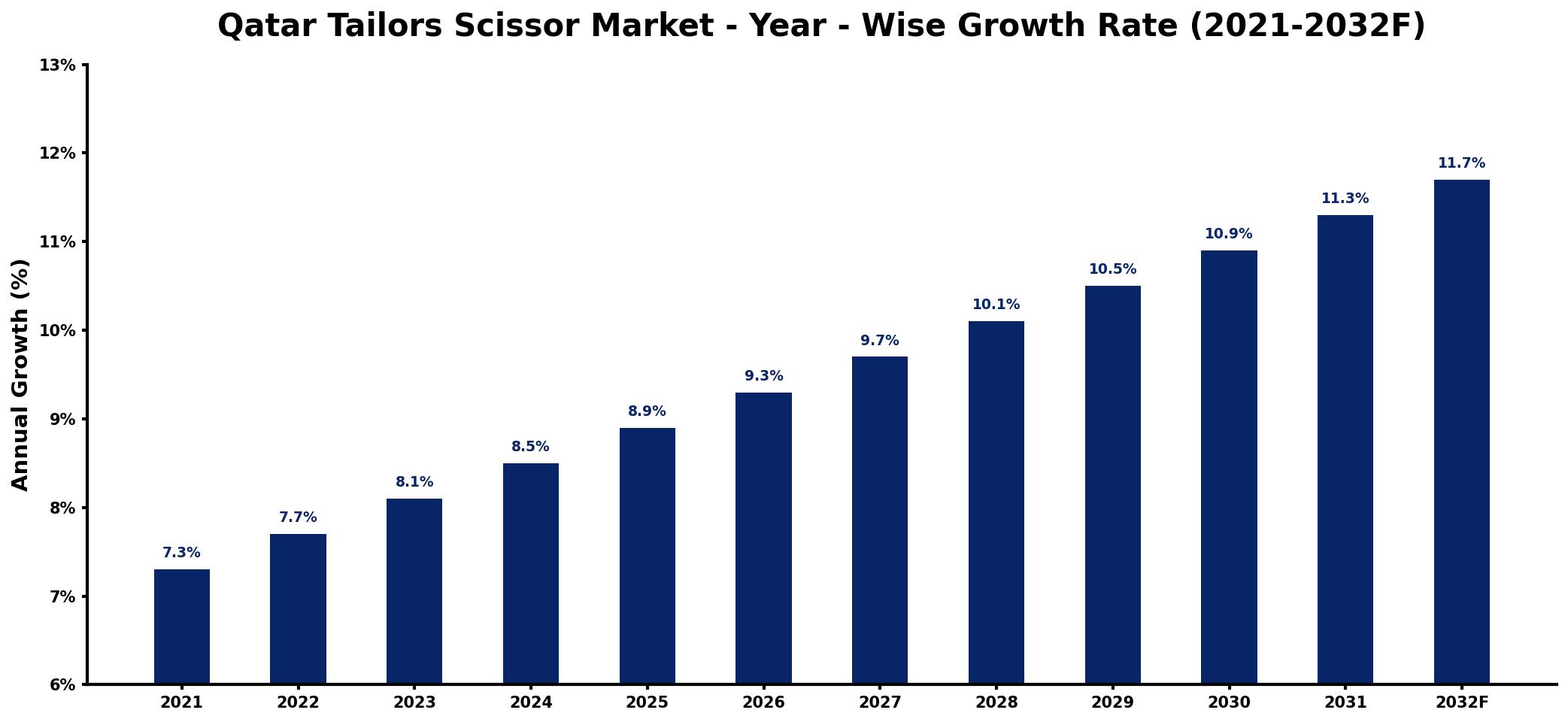
The table below presents the year‑wise growth rates along with the key drivers influencing the market
| Year | Growth Rate | Major Drivers |
| 2021 | 7.3% | Rising demand for craftsmanship tools |
| 2022 | 7.7% | Increase in textile industry activities |
| 2023 | 8.1% | Growth in fashion design schools |
| 2024 | 8.5% | Expansion of home sewing markets |
| 2025 | 8.9% | Investment in artisanal workshops |
| 2026 | 9.3% | Surge in DIY home projects |
| 2027 | 9.7% | Growing popularity of customization |
| 2028 | 10.1% | Boost in online craft communities |
| 2029 | 10.5% | increased overall sector activity |
| 2030 | 10.9% | improved raw material availability |
| 2031 | 11.3% | Rising interest in sustainable fashion |
| 2032 | 11.7% | rising export shipment volumes |
Note: Market size estimations and growth projections presented in this report are based on 6Wresearch's proprietary forecasting methodology, utilizing the latest available industry data, government publications, and primary research inputs.
Qatar Tailors Scissor Market Synopsis
The expanding textile and fashion industry stands as the most significant force shaping the Qatar tailors scissor market today. As bespoke tailoring gains traction among consumers, the reliance on superior cutting instruments has intensified, further boosting market demand. In addition, advancements in ergonomic designs and materials have attracted both professional tailors and DIY enthusiasts, fostering a competitive environment in the market.
Moreover, the local presence of skilled tailors and a vibrant textile sector support the growing need for precision tools. These developments ensure that Qatar remains a crucial player in the fashion and tailoring landscape, driving innovations in product offerings while meeting the demands of a dynamic consumer base.
Qatar Tailors Scissor Market Key Takeaways
- The Qatar tailors scissor market is poised for robust growth driven by the booming fashion industry.
- Custom tailoring and fashion personalization are significant contributors to the rising demand for high-quality scissors.
- Technological advancements in design and materials have enhanced the product appeal for both professionals and hobbyists.
- Local manufacturers face competition from imports, impacting pricing strategies in a sensitive market.
- The ongoing recovery post-COVID-19 positions the market for positive growth and greater investment opportunities.
Evaluation of Restraints in Qatar Tailors Scissor Market
Despite the promising growth outlook, the Qatar tailors scissor market is constrained by certain factors. The demand for specialized scissors remains relatively stable, primarily limited to a niche segment of the market. Local manufacturers must contend with imported products that, while often more affordable, may not always meet the quality expectations of professional tailors. Furthermore, the price sensitivity of consumers in the region can make it challenging to maintain competitive pricing while upholding product integrity. The industry's reliance on the fluctuating textile and fashion sector also introduces an unpredictable element, potentially impacting the overall demand for tailoring tools.
Qatar Tailors Scissor Market Trends
Several trends are currently shaping the Qatar tailors scissor market. There is a growing emphasis on ergonomic design, with scissors engineered to reduce strain and enhance user comfort during prolonged use. Additionally, the rise of sustainable materials in manufacturing is resonating with eco-conscious consumers and businesses alike. Customization options are becoming increasingly popular, allowing tailors to select scissors that fit their specific needs, thus enhancing precision and efficiency. As Qatar's fashion scene continues to evolve, these trends will undoubtedly play a crucial role in meeting the demands of an increasingly sophisticated market.
Qatar Tailors Scissor Market Opportunities
The Qatar tailors scissor market presents several growth opportunities for stakeholders. With the increasing popularity of custom-tailored clothing, there is a significant opportunity for manufacturers to develop innovative products tailored to the needs of high-end tailors. The rise of online retail channels also opens avenues for reaching a broader audience, including DIY enthusiasts who seek quality tools for personal use. Moreover, collaborations with fashion schools and design institutes could serve as a strategic move to foster brand loyalty among emerging professionals in the industry.
Government Initiatives in the Qatar Tailors Scissor Market
The Qatari government has taken steps to bolster its textile and fashion industries through various initiatives aimed at promoting local craftsmanship and innovation. Public spending on infrastructure and incentives for small businesses encourage the growth of local manufacturers. Additionally, support for vocational training programs in fashion and tailoring ensures a steady pipeline of skilled professionals, further enhancing the market's potential. These initiatives are expected to stimulate demand for quality tailoring tools, including scissors, fostering a supportive environment for industry growth.
Future Insights of the Qatar Tailors Scissor Market
Looking ahead to 2026-2032, the Qatar tailors scissor market is expected to continue its upward trajectory, fueled by ongoing developments in the fashion sector. As Qatar positions itself as a hub for design and fashion, demand for high-quality tailoring tools will likely rise in tandem. The market's ability to innovate and adapt to changing consumer preferences, such as sustainability and customization, will be pivotal in capturing growth opportunities. Furthermore, the recovery from the pandemic will reinforce the importance of precision tools in a rejuvenated textile landscape.
Qatar Tailors Scissor Market Latest Developments (2025 - 2026)
Recent developments in the Qatar tailors scissor market reflect a renewed focus on product innovation and quality enhancement. Manufacturers are increasingly prioritizing ergonomic designs to address user comfort and efficiency. Additionally, collaborations with fashion institutions have emerged as a strategy to promote new products and gather valuable feedback from professionals. As consumer preferences shift towards customized solutions, companies are adapting their offerings to meet these demands, setting the stage for a dynamic market landscape in the coming years.
Qatar Tailors Scissor Market - Key Attractiveness of the Report
- 10 Years of Market Numbers
- Historical Data Starting from 2022 to 2025
- Base Year: 2025
- Forecast Data until 2032
- Key Performance Indicators Impacting the Market
- Major Upcoming Developments and Projects
Key Highlights of the Report:
- Qatar Tailors Scissor Market Outlook
- Market Size of Qatar Tailors Scissor Market, 2025
- Forecast of Qatar Tailors Scissor Market, 2032
- Historical Data and Forecast of Qatar Tailors Scissor Revenues & Volume for the Period 2022-2032F
- Qatar Tailors Scissor Market Trend Evolution
- Qatar Tailors Scissor Market Drivers and Challenges
- Qatar Tailors Scissor Price Trends
- Qatar Tailors Scissor Porter's Five Forces
- Qatar Tailors Scissor Industry Life Cycle
- Historical Data and Forecast of Qatar Tailors Scissor Market Revenues & Volume By Product for the Period 2022-2032F
- Historical Data and Forecast of Qatar Tailors Scissor Market Revenues & Volume By Standard Scissors for the Period 2022-2032F
- Historical Data and Forecast of Qatar Tailors Scissor Market Revenues & Volume By Customized Scissors for the Period 2022-2032F
- Historical Data and Forecast of Qatar Tailors Scissor Market Revenues & Volume By Applications for the Period 2022-2032F
- Historical Data and Forecast of Qatar Tailors Scissor Market Revenues & Volume By Household for the Period 2022-2032F
- Historical Data and Forecast of Qatar Tailors Scissor Market Revenues & Volume By Commercial for the Period 2022-2032F
- Qatar Tailors Scissor Import Export Trade Statistics
- Market Opportunity Assessment By Product
- Market Opportunity Assessment By Applications
- Qatar Tailors Scissor Top Companies Market Share
- Qatar Tailors Scissor Competitive Benchmarking By Technical and Operational Parameters
- Qatar Tailors Scissor Company Profiles
- Qatar Tailors Scissor Key Strategic Recommendations






































