Qatar Textile Bags Market Size, Share & Growth Rate
The Qatar Textile Bags Market was estimated at USD 881 Million in 2025 and is projected to reach USD 1272 Million by 2032, growing at a CAGR of 5.4% from 2026 to 2032. This impressive growth trajectory can be attributed to heightened environmental awareness among consumers, alongside governmental measures encouraging sustainable practices. The increasing shift towards e-commerce platforms further supports the demand for reusable textile bags as packaging solutions, effectively replacing traditional plastic options.
Qatar Textile Bags Market Year-wise Growth Rate and Key Drivers
This graph highlights how the Qatar Textile Bags Market has steadily grown over the years, supported by major growth factors.
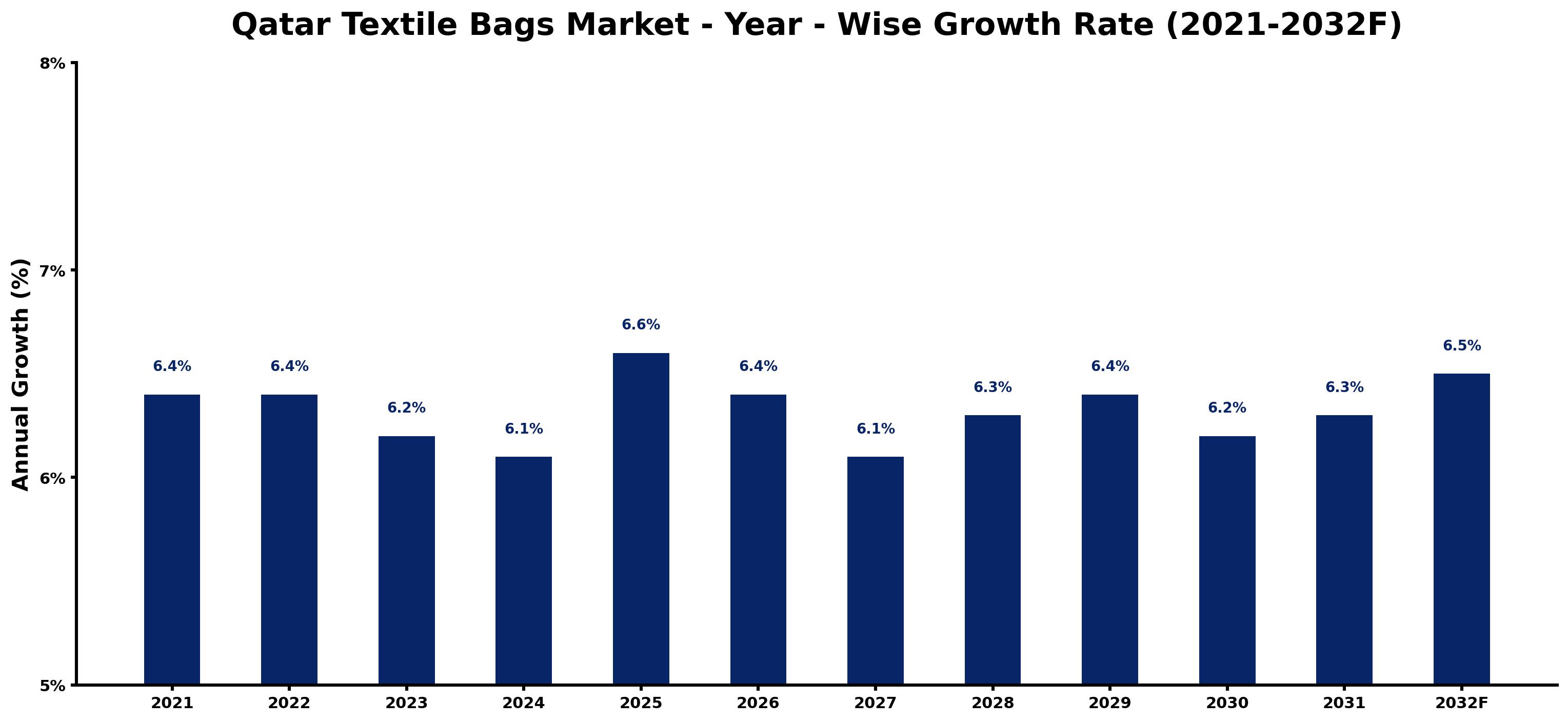
The table below presents the year‑wise growth rates along with the key drivers influencing the market
| Year | Growth Rate | Major Drivers |
| 2021 | 6.4% | Growing renewable energy integration projects |
| 2022 | 6.4% | Rising electricity demand across industries |
| 2023 | 6.2% | Rising electricity demand across industries |
| 2024 | 6.1% | Expansion of commercial construction activities |
| 2025 | 6.6% | Government infrastructure modernization initiatives |
| 2026 | 6.4% | Government infrastructure modernization initiatives |
| 2027 | 6.1% | Expansion of manufacturing activities |
| 2028 | 6.3% | Increasing industrial infrastructure investments |
| 2029 | 6.4% | Expansion of transportation and logistics networks |
| 2030 | 6.2% | Growing urbanization and commercial development |
| 2031 | 6.3% | Increasing smart city development projects |
| 2032 | 6.5% | Rapid growth in telecom and data center sectors |
Note - Market size estimations and growth projections presented in this report are based on 6Wresearch’s advanced forecasting approach, validated with industry datasets as of June 2026.
Qatar Textile Bags Market Synopsis
The Qatar textile bags market has experienced notable momentum in recent years, fueled by both regulatory changes and shifting consumer preferences. As the market matures, it is poised for continued growth, driven by a deeper integration of sustainability into everyday practices.
Looking ahead, the market is expected to capitalize on the growing e-commerce landscape and the rising popularity of eco-friendly products. As awareness of environmental impacts increases, textile bags made from sustainable materials are set to become a staple across various sectors, from retail to promotional gifting.
Qatar Textile Bags Market Key Takeaways
- The market is experiencing robust growth due to increasing demand for eco-friendly products.
- Government initiatives promoting sustainability are reshaping consumer habits towards reusable bags.
- Retail and e-commerce channels are expanding, bolstering the adoption of textile bags.
- Quality and durability of textile bags are critical for sustaining consumer interest and loyalty.
- Corporate gifting trends are enhancing the visibility and utility of branded textile bags.
Evaluation of Restraints in Qatar Textile Bags Market
Despite the positive market dynamics, there are several challenges that may hinder growth in the Qatar textile bags sector. The primary restraint is competition from low-cost plastic alternatives, which, despite growing environmental awareness, still attract price-sensitive consumers. Additionally, the reliance on high-quality materials to ensure durability and effectiveness poses a challenge in terms of production costs and supply chain management. Lastly, the establishment of effective recycling and collection mechanisms remains a logistical hurdle, necessitating collaboration among multiple stakeholders.
Qatar Textile Bags Market Trends
A noticeable trend in the Qatar textile bags market is the increased preference for materials such as jute, cotton, and canvas, reflecting a collective move towards sustainable options. As more consumers recognize the environmental impact of their choices, they are opting for stylish and reusable bags that not only serve a functional purpose but also align with their values. Furthermore, innovative designs and customization options are emerging as key differentiators in the marketplace, enabling businesses to cater to unique consumer preferences.
Qatar Textile Bags Market Opportunities
The opportunities for growth in the Qatar textile bags market are abundant. With ongoing governmental support for environmentally sustainable initiatives, companies are well-positioned to expand their offerings. The rising trend in corporate responsibility has opened avenues for businesses to promote their brands through custom-branded textile bags. Additionally, as e-commerce continues to flourish, there is a significant potential for textile bags as a go-to packaging solution for online retailers, tapping into a growing consumer base that prioritizes sustainability.
Government Initiatives in the Qatar Textile Bags Market
The Qatari government has implemented several initiatives aimed at reducing plastic waste, including the regulation and eventual ban of single-use plastic bags. Such measures are encouraging businesses and consumers to transition toward more sustainable alternatives, creating a favorable environment for the textile bags market. Public campaigns promoting environmental responsibility and sustainability are also playing a crucial role in raising awareness and motivating consumers to adopt eco-friendly practices.
Future Insights of the Qatar Textile Bags Market
As we look towards 2026 and beyond, the Qatar textile bags market is set to evolve significantly, with sustainability becoming an even more central theme. Continuous innovation in materials and designs is likely to keep pace with consumer preferences. Coupled with anticipated regulatory support and an expanding e-commerce sector, the market is projected to thrive, making it an attractive segment for investment and development. Companies that prioritize quality and sustainability will likely lead the charge in capturing market share.
Qatar Textile Bags Market Latest Developments (May 2025 - June 2026)
Recently, the textile bags industry in Qatar has seen an influx of innovative designs and materials that cater to environmentally conscious consumers. The increase in partnerships between retailers and manufacturers to develop customized solutions further reflects the growing emphasis on sustainability. Additionally, there has been a noticeable rise in public awareness campaigns, highlighting the advantages of using textile bags over single-use plastics, thereby enhancing their market appeal.
Qatar Textile Bags Market - Key Attractiveness of the Report
- 10 Years of Market Numbers
- Historical Data Starting from 2022 to 2025
- Base Year: 2025
- Forecast Data until 2032
- Key Performance Indicators Impacting the Market
- Major Upcoming Developments and Projects
Key Highlights of the Report:
- Qatar Textile Bags Market Outlook
- Market Size of Qatar Textile Bags Market, 2025
- Forecast of Qatar Textile Bags Market, 2032
- Historical Data and Forecast of Qatar Textile Bags Revenues & Volume for the Period 2022-2032F
- Qatar Textile Bags Market Trend Evolution
- Qatar Textile Bags Market Drivers and Challenges
- Qatar Textile Bags Price Trends
- Qatar Textile Bags Porter's Five Forces
- Qatar Textile Bags Industry Life Cycle
- Historical Data and Forecast of Qatar Textile Bags Market Revenues & Volume By Size for the Period 2022-2032F
- Historical Data and Forecast of Qatar Textile Bags Market Revenues & Volume By Less than 14" x 26" for the Period 2022-2032F
- Historical Data and Forecast of Qatar Textile Bags Market Revenues & Volume By 18" x 30" for the Period 2022-2032F
- Historical Data and Forecast of Qatar Textile Bags Market Revenues & Volume By 22" x 36" for the Period 2022-2032F
- Historical Data and Forecast of Qatar Textile Bags Market Revenues & Volume By 22" x 40" for the Period 2022-2032F
- Historical Data and Forecast of Qatar Textile Bags Market Revenues & Volume By Above 28" x 40" for the Period 2022-2032F
- Historical Data and Forecast of Qatar Textile Bags Market Revenues & Volume By Material Type for the Period 2022-2032F
- Historical Data and Forecast of Qatar Textile Bags Market Revenues & Volume By Cotton for the Period 2022-2032F
- Historical Data and Forecast of Qatar Textile Bags Market Revenues & Volume By Burlap for the Period 2022-2032F
- Historical Data and Forecast of Qatar Textile Bags Market Revenues & Volume By Others for the Period 2022-2032F
- Historical Data and Forecast of Qatar Textile Bags Market Revenues & Volume By Sales Channel for the Period 2022-2032F
- Historical Data and Forecast of Qatar Textile Bags Market Revenues & Volume By Retailers for the Period 2022-2032F
- Historical Data and Forecast of Qatar Textile Bags Market Revenues & Volume By Wholesalers for the Period 2022-2032F
- Historical Data and Forecast of Qatar Textile Bags Market Revenues & Volume By E-commerce for the Period 2022-2032F
- Qatar Textile Bags Import Export Trade Statistics
- Market Opportunity Assessment By Size
- Market Opportunity Assessment By Material Type
- Market Opportunity Assessment By Sales Channel
- Qatar Textile Bags Top Companies Market Share
- Qatar Textile Bags Competitive Benchmarking By Technical and Operational Parameters
- Qatar Textile Bags Company Profiles
- Qatar Textile Bags Key Strategic Recommendations






































