Qatar Textile Market Summary
The qatar textile market was estimated at USD 453 Million in 2025 and is projected to reach USD 617 Million by 2032, growing at a CAGR of 5.4% from 2026 to 2032.
Qatar Textile Market Year-wise Growth Rate and Key Drivers
This graph highlights how the Qatar Textile Market has steadily grown over the past five years, supported by major growth factors.
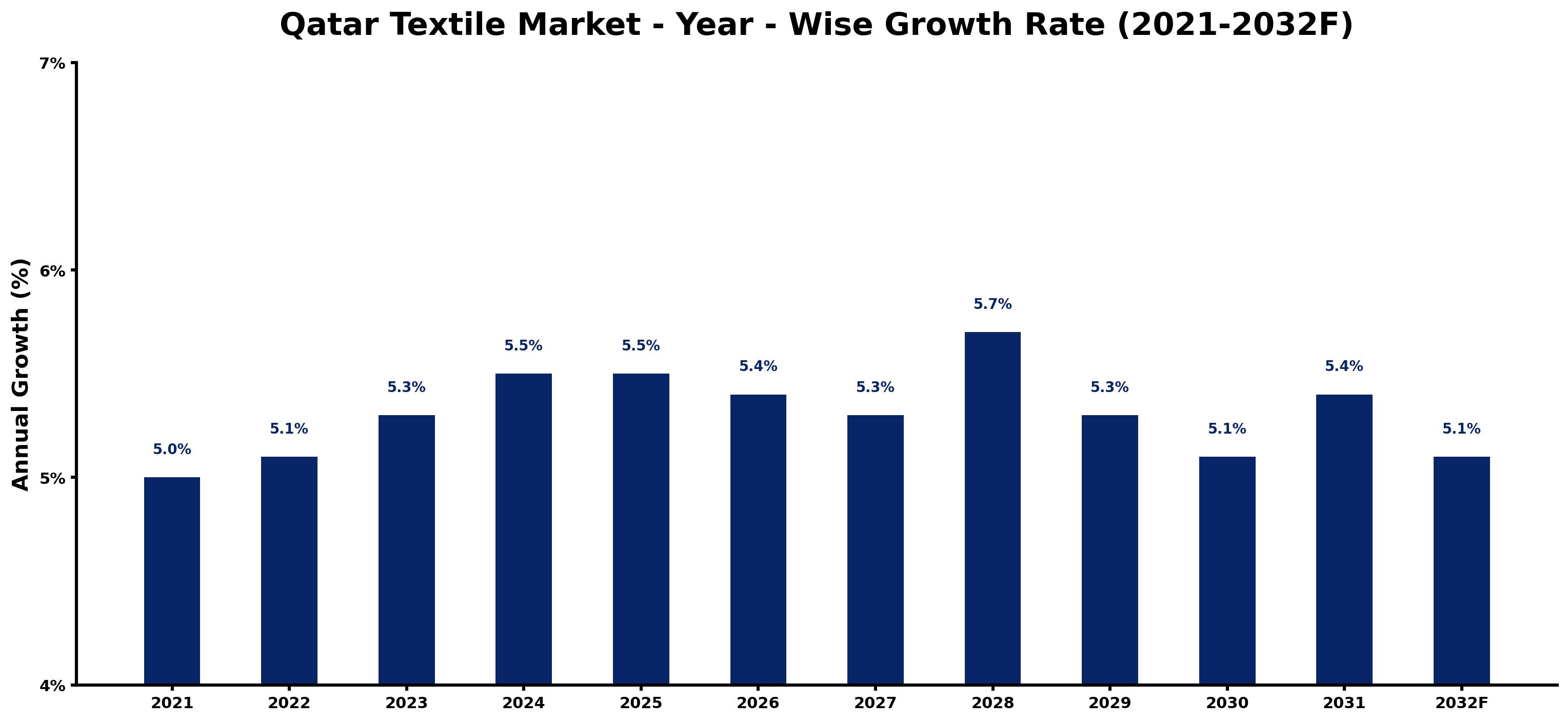
The table below presents the year wise growth rates along with the key drivers influencing the market
| Year | Growth Rate | Major Drivers |
| 2021 | 5.0% | Consumer preferences increasingly favor sustainable and ethically produced textile products. |
| 2022 | 5.1% | Luxury brands show interest in establishing a foothold within the Qatari market. |
| 2023 | 5.3% | E-commerce platforms expand, enabling local artisans to reach broader audiences efficiently. |
| 2024 | 5.5% | Major international trade shows in Qatar attract global textile manufacturers and designers. |
| 2025 | 5.5% | Investment in manufacturing facilities supports the local production of high-quality textiles. |
| 2026 | 5.4% | Collaborations between fashion designers and local weavers highlight Qatar's rich cultural heritage. |
| 2027 | 5.3% | New trade agreements within the GCC enhance cross-border textile supply chain efficiency. |
| 2028 | 5.7% | Demand for technical textiles increases in the sports and healthcare sectors significantly. |
| 2029 | 5.3% | Qatar's construction boom necessitates innovative textile applications for interior design. |
| 2030 | 5.1% | Sustainable practices become essential as businesses seek to enhance their brand equity. |
| 2031 | 5.4% | Increased regional tourism boosts demand for unique, culturally inspired textile products. |
| 2032 | 5.1% | Digital transformation initiatives provide textile firms with enhanced operational capabilities. |
Note - Market size estimations and growth projections presented in this report are based on 6Wresearch's advanced forecasting approach, validated with industry datasets as of June 2026.
Qatar Textile Market Synopsis
The Qatar Textile Market is projected to reach 5.4% and witness significant growth during the forecast period (2026-2032). This market encompasses a diverse range of products, including fibers, fabrics, apparel, and home textiles, catering to both domestic consumption and export. Its multifaceted nature serves a variety of sectors such as fashion, home furnishings, and industrial applications, playing a crucial role in the overall economic landscape of Qatar.
Qatar Textile Market Growth Drivers
The expansion of the Qatar Textile Market can be attributed to several key drivers:
- The increasing population and urbanization in Qatar create a heightened demand for everyday textiles and apparel products, leading to a robust consumer base.
- The retail sector's growth, marked by the proliferation of shopping malls and online shopping platforms, enhances accessibility and stimulates demand for diverse textile offerings.
- Tourism and the hospitality industry significantly elevate the need for textiles in hotels, resorts, and various accommodation establishments, further driving market growth.
- Shifts in fashion preferences and lifestyle trends encourage consumers to seek innovative and unique textile products, fostering an environment of continuous product development.
- Strategic investments in infrastructure and improvements in supply chains contribute positively to the overall efficiency and responsiveness of the market.
Qatar Textile Market Challenges and Restraints
Despite its growth potential, the Qatar Textile Market faces several challenges that could impede its progress:
- Intense competition from imported textile products poses a challenge, as these may provide more competitive pricing and a broader variety of options for consumers.
- Growing consumer awareness surrounding environmental sustainability is shifting preferences toward eco-friendly and ethically produced textiles, necessitating changes in manufacturing practices.
- Potential disruptions in the supply chain, influenced by international trade dynamics, can impact product availability and pricing.
- The lingering effects of the Covid-19 pandemic have influenced demand across various textile segments, particularly fashion and home furnishings, as economic activities fluctuate.
- Fluctuations in global economic conditions can also indirectly affect the textile market, as they influence consumer spending patterns and import-export dynamics.
Qatar Textile Market Government Investment and Initiatives
The Qatari government has recognized the importance of the textile sector in diversifying the economy and has implemented several initiatives aimed at boosting market growth. Key government policies include:
- Investment in infrastructure development to enhance logistics and supply chain management for the textile industry, thereby improving efficiency and accessibility to markets.
- Support for local textile manufacturers through financial incentives and grants, aimed at reducing operational costs and encouraging innovation.
- Promotion of sustainable practices within the textile sector, encouraging manufacturers to adopt eco-friendly processes and materials in production.
- Facilitation of trade agreements that allow for easier export of textile products, thus expanding the market reach for local manufacturers.
- Collaboration with international organizations and participation in global textile exhibitions to showcase Qatari textile products and improve international competitiveness.
Qatar Textile Market Latest Developments (May 2025 - June 2026)
Between May 2025 and June 2026, the Qatar Textile Market has experienced a series of notable developments that indicate its evolving landscape. The focus on sustainability has gained momentum, with many companies looking to integrate eco-friendly materials and processes into their operations. Additionally, the rise of online retail has prompted local businesses to enhance their e-commerce platforms, enabling them to reach a broader audience. Training and development initiatives aimed at upskilling the workforce in modern textile technologies have also been a key focus, ensuring that the sector remains competitive. Furthermore, collaborations between local designers and international brands have emerged, fostering innovation and creativity within the market. These developments reflect the dynamic nature of the Qatar Textile Market as it adapts to changing consumer preferences and global trends.
Qatar Textile Market - Key Attractiveness of the Report
- 10 Years of Market Numbers
- Historical Data Starting from 2022 to 2025
- Base Year: 2025
- Forecast Data until 2032
- Key Performance Indicators Impacting the Market
- Major Upcoming Developments and Projects
Key Highlights of the Report:
- Qatar Textile Market Outlook
- Market Size of Qatar Textile Market, 2025
- Forecast of Qatar Textile Market, 2032
- Historical Data and Forecast of Qatar Textile Revenues & Volume for the Period 2022-2032F
- Qatar Textile Market Trend Evolution
- Qatar Textile Market Drivers and Challenges
- Qatar Textile Price Trends
- Qatar Textile Porter's Five Forces
- Qatar Textile Industry Life Cycle
- Historical Data and Forecast of Qatar Textile Market Revenues & Volume By Raw Material Types for the Period 2022-2032F
- Historical Data and Forecast of Qatar Textile Market Revenues & Volume By Cotton for the Period 2022-2032F
- Historical Data and Forecast of Qatar Textile Market Revenues & Volume By Chemical for the Period 2022-2032F
- Historical Data and Forecast of Qatar Textile Market Revenues & Volume By Wool for the Period 2022-2032F
- Historical Data and Forecast of Qatar Textile Market Revenues & Volume By Silk for the Period 2022-2032F
- Historical Data and Forecast of Qatar Textile Market Revenues & Volume By Others for the Period 2022-2032F
- Historical Data and Forecast of Qatar Textile Market Revenues & Volume By Product Types for the Period 2022-2032F
- Historical Data and Forecast of Qatar Textile Market Revenues & Volume By Natural Fibers for the Period 2022-2032F
- Historical Data and Forecast of Qatar Textile Market Revenues & Volume By Polyesters for the Period 2022-2032F
- Historical Data and Forecast of Qatar Textile Market Revenues & Volume By Nylon for the Period 2022-2032F
- Historical Data and Forecast of Qatar Textile Market Revenues & Volume By Others for the Period 2022-2032F
- Historical Data and Forecast of Qatar Textile Market Revenues & Volume By Applications for the Period 2022-2032F
- Historical Data and Forecast of Qatar Textile Market Revenues & Volume By Household for the Period 2022-2032F
- Historical Data and Forecast of Qatar Textile Market Revenues & Volume By Technical for the Period 2022-2032F
- Historical Data and Forecast of Qatar Textile Market Revenues & Volume By Fashion & Clothing for the Period 2022-2032F
- Historical Data and Forecast of Qatar Textile Market Revenues & Volume By Others for the Period 2022-2032F
- Qatar Textile Import Export Trade Statistics
- Market Opportunity Assessment By Raw Material Types
- Market Opportunity Assessment By Product Types
- Market Opportunity Assessment By Applications
- Qatar Textile Top Companies Market Share
- Qatar Textile Competitive Benchmarking By Technical and Operational Parameters
- Qatar Textile Company Profiles
- Qatar Textile Key Strategic Recommendations






































