Qatar Toys and Hobby Goods Market Summary
The qatar toys and hobby goods market was estimated at USD 414 Million in 2025 and is projected to reach USD 567 Million by 2032, growing at a CAGR of 5.4% from 2026 to 2032.
Qatar Toys and Hobby Goods Market Year-wise Growth Rate and Key Drivers
This graph highlights how the Qatar Toys and Hobby Goods Market has steadily grown over the past five years, supported by major growth factors.
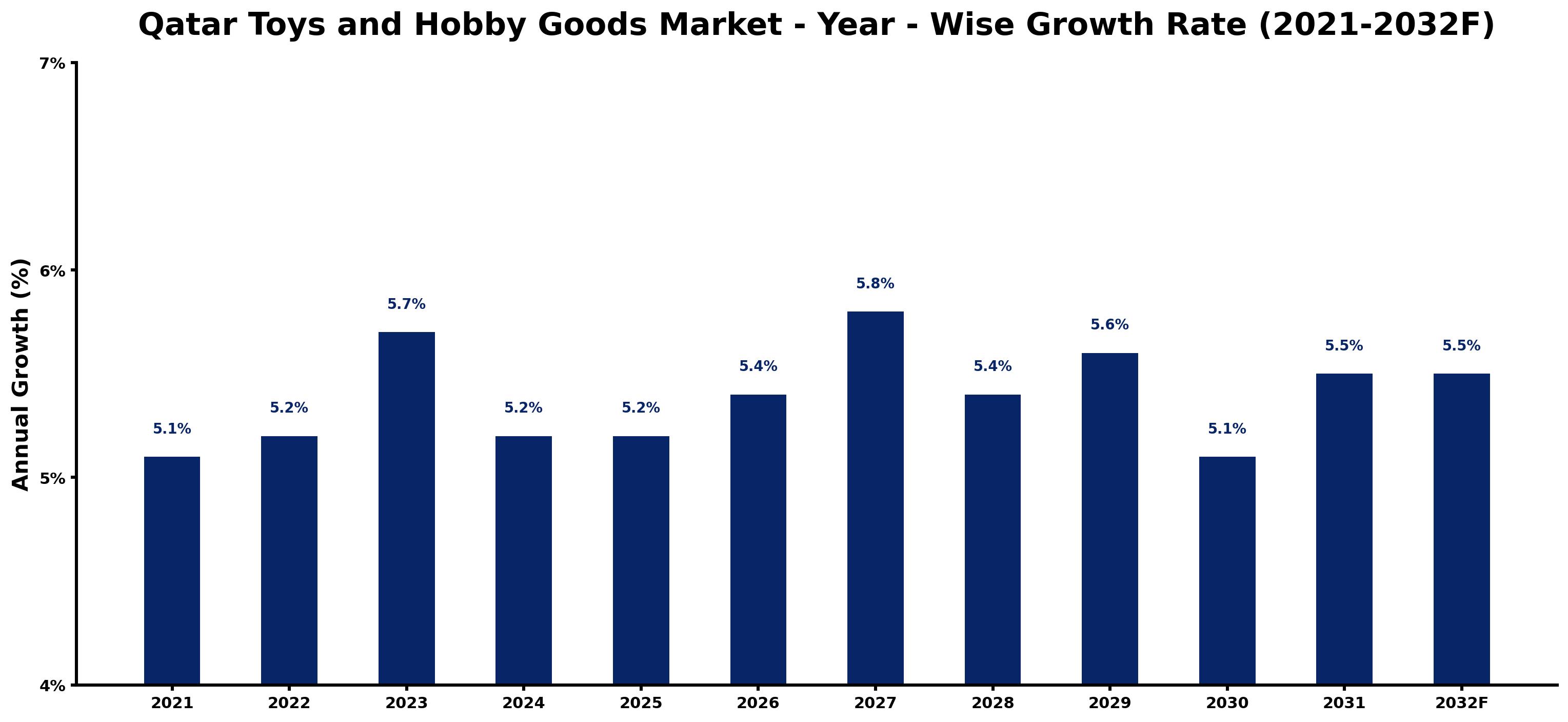
The table below presents the year wise growth rates along with the key drivers influencing the market
| Year | Growth Rate | Major Drivers |
| 2021 | 5.1% | Local manufacturers expand offerings, catering to diverse cultural preferences in toys. |
| 2022 | 5.2% | E-commerce platforms enhance accessibility, connecting consumers directly with toy retailers. |
| 2023 | 5.7% | Educational toys gain traction as parents prioritize developmental benefits for children. |
| 2024 | 5.2% | Sustainable materials in toy production attract environmentally-conscious buyers across demographics. |
| 2025 | 5.2% | Collaborations with international brands introduce premium toy lines into the market. |
| 2026 | 5.4% | Increased disposable income allows families to spend more on children's hobbies. |
| 2027 | 5.8% | Cultural events and festivals spur demand for traditional and contemporary toys. |
| 2028 | 5.4% | Technological advancements promote interactive and digital play experiences for children. |
| 2029 | 5.6% | Strong expatriate community influences diversity in toy preferences and purchasing habits. |
| 2030 | 5.1% | Enhanced local manufacturing capabilities reduce dependence on imported toy products. |
| 2031 | 5.5% | Focus on child safety regulations elevates quality standards across all toy products. |
| 2032 | 5.5% | Emerging trends in virtual reality reshape the landscape of children's hobbies. |
Note - Market size estimations and growth projections presented in this report are based on 6Wresearch's advanced forecasting approach, validated with industry datasets as of June 2026.
Qatar Toys and Hobby Goods Market Synopsis
The Qatar Toys and Hobby Goods Market is projected to reach 5.4% and witness significant growth during the forecast period (2026-2032). As one of the most developed nations in the region, Qatar has been experiencing a rapid expansion in its toys and hobby goods sector, driven by a growing population and increasing disposable incomes. The market offers a diverse range of products, from traditional toys like plush dolls and action figures to more advanced electronic toys such as drones and robots. Additionally, the presence of specialty stores catering to niche interests further enhances the market's attractiveness for both local and international businesses.
Qatar Toys and Hobby Goods Market Growth Drivers
A number of factors are propelling the growth of the Qatar Toys and Hobby Goods Market. Firstly, rising disposable income among Qatari families is enabling greater spending on toys and hobby goods. This economic upliftment has led to an increased demand for high-quality and innovative products.
- Government initiatives aimed at boosting private investments in commercial infrastructure have resulted in the development of modern shopping malls and retail outlets, making products more accessible to consumers.
- The hosting of global events, such as the World Cup 2022, has attracted numerous visitors, creating heightened interest in local toy and hobby goods.
- Investment by technology companies in innovative, AI-integrated toys is driving market expansion and appealing to tech-savvy parents.
- The rise of e-commerce platforms has facilitated easier access to competitive prices and diverse products, broadening consumer choices and stimulating demand.
- Increased marketing and promotional activities focused on educational toys are encouraging parents to invest in products that offer both fun and learning for their children.
Qatar Toys and Hobby Goods Market Challenges and Restraints
Despite the favorable growth prospects, certain challenges exist that the Qatar Toys and Hobby Goods Market must navigate. One significant issue is the limited availability of educational games and activities due to insufficient research and development in these segments.
- The high costs associated with establishing physical retail outlets are a barrier for smaller players looking to enter this lucrative market segment.
- Intense competition from multinational retailers offering similar product ranges can stifle the growth opportunities for local firms.
- The reliance on imports for certain toy categories can lead to supply chain vulnerabilities, especially in times of global disruption.
- Changing consumer preferences towards digital entertainment over traditional toys pose a challenge for market adaptation.
- A lack of awareness regarding the benefits of safety standards and regulations in toy production can result in hesitance among parents when making purchasing decisions.
Qatar Toys and Hobby Goods Market Government Investment and Initiatives
The Qatari government has demonstrated a commitment to fostering growth in the toys and hobby goods sector through various initiatives. The nation's economic diversification strategy encourages investments in commercial infrastructure, which includes retail spaces dedicated to toys and hobbies.
- Public spending on infrastructure development, such as enhanced shopping complexes and entertainment centers, is aimed at attracting both local and foreign investments.
- Legislative frameworks promoting private sector participation in retail establishments are facilitating the entry of new players into the market.
- Government-sponsored events and festivals are providing platforms for toy manufacturers to showcase their products, thereby enhancing visibility among consumers.
- Efforts to improve educational standards have spurred interest in educational toys, leading to a favorable environment for businesses focusing on this niche.
- Incentives for research and development in the toy sector are being explored to enhance local production capabilities and reduce dependency on imports.
Qatar Toys and Hobby Goods Market Latest Developments (May 2025 - June 2026)
In the period from May 2025 to June 2026, the Qatar Toys and Hobby Goods Market has witnessed notable developments. The recovery from the COVID-19 pandemic has encouraged consumers to re-engage with retailers, fueling a resurgence in sales, particularly for educational and interactive toys.
- Innovative product launches focused on sustainability and eco-friendliness have gained traction, appealing to environmentally conscious consumers.
- The rise in popularity of online shopping platforms has led to enhanced competition among retailers, encouraging price adjustments and promotional offers.
- Collaborative ventures between local and international firms have resulted in the introduction of unique toy lines that cater to the diverse interests of Qatari consumers.
- Community events focused on children's activities have increased consumer engagement with local brands, fostering a sense of connection and loyalty.
- Technological advancements in product design and manufacturing are shaping a new generation of toys that are interactive and educational, which is resonating well with parents.
Qatar Toys and Hobby Goods Market - Key Attractiveness of the Report
- 10 Years of Market Numbers
- Historical Data Starting from 2022 to 2025
- Base Year: 2025
- Forecast Data until 2032
- Key Performance Indicators Impacting the Market
- Major Upcoming Developments and Projects
Key Highlights of the Report:
- Qatar Toys and Hobby Goods Market Outlook
- Market Size of Qatar Toys and Hobby Goods Market, 2025
- Forecast of Qatar Toys and Hobby Goods Market, 2032
- Historical Data and Forecast of Qatar Toys and Hobby Goods Revenues & Volume for the Period 2022-2032F
- Qatar Toys and Hobby Goods Market Trend Evolution
- Qatar Toys and Hobby Goods Market Drivers and Challenges
- Qatar Toys and Hobby Goods Price Trends
- Qatar Toys and Hobby Goods Porter's Five Forces
- Qatar Toys and Hobby Goods Industry Life Cycle
- Historical Data and Forecast of Qatar Toys and Hobby Goods Market Revenues & Volume By Type for the Period 2022-2032F
- Historical Data and Forecast of Qatar Toys and Hobby Goods Market Revenues & Volume By Sports Toys for the Period 2022-2032F
- Historical Data and Forecast of Qatar Toys and Hobby Goods Market Revenues & Volume By Intellectual Toys for the Period 2022-2032F
- Historical Data and Forecast of Qatar Toys and Hobby Goods Market Revenues & Volume By Education Toys for the Period 2022-2032F
- Historical Data and Forecast of Qatar Toys and Hobby Goods Market Revenues & Volume By Decorative Toys for the Period 2022-2032F
- Historical Data and Forecast of Qatar Toys and Hobby Goods Market Revenues & Volume By Other for the Period 2022-2032F
- Historical Data and Forecast of Qatar Toys and Hobby Goods Market Revenues & Volume By Application for the Period 2022-2032F
- Historical Data and Forecast of Qatar Toys and Hobby Goods Market Revenues & Volume By Online Sales for the Period 2022-2032F
- Historical Data and Forecast of Qatar Toys and Hobby Goods Market Revenues & Volume By Offline Sales for the Period 2022-2032F
- Historical Data and Forecast of Qatar Toys and Hobby Goods Market Revenues & Volume By Others for the Period 2022-2032F
- Qatar Toys and Hobby Goods Import Export Trade Statistics
- Market Opportunity Assessment By Type
- Market Opportunity Assessment By Application
- Qatar Toys and Hobby Goods Top Companies Market Share
- Qatar Toys and Hobby Goods Competitive Benchmarking By Technical and Operational Parameters
- Qatar Toys and Hobby Goods Company Profiles
- Qatar Toys and Hobby Goods Key Strategic Recommendations






































