Qatar Unified Communication and Collaboration (UCC) Market Size, Share & Growth Rate
The Qatar Unified Communication and Collaboration (UCC) Market was estimated at USD 427 Million in 2025 and is projected to reach USD 579 Million by 2032, growing at a CAGR of 4.4% from 2026 to 2032. This growth trajectory reflects the increasing recognition among organizations of the importance of integrated communication solutions, particularly as remote work becomes a staple. With businesses increasingly looking for ways to enhance operational efficiency and collaboration, the demand for cloud-based UCC solutions is rapidly on the rise, further bolstered by advances in communication technologies.
Qatar Unified Communication and Collaboration (UCC) Market Year-wise Growth Rate and Key Drivers
This graph highlights how the Qatar Unified Communication and Collaboration (UCC) Market has steadily grown over the years, supported by major growth factors.
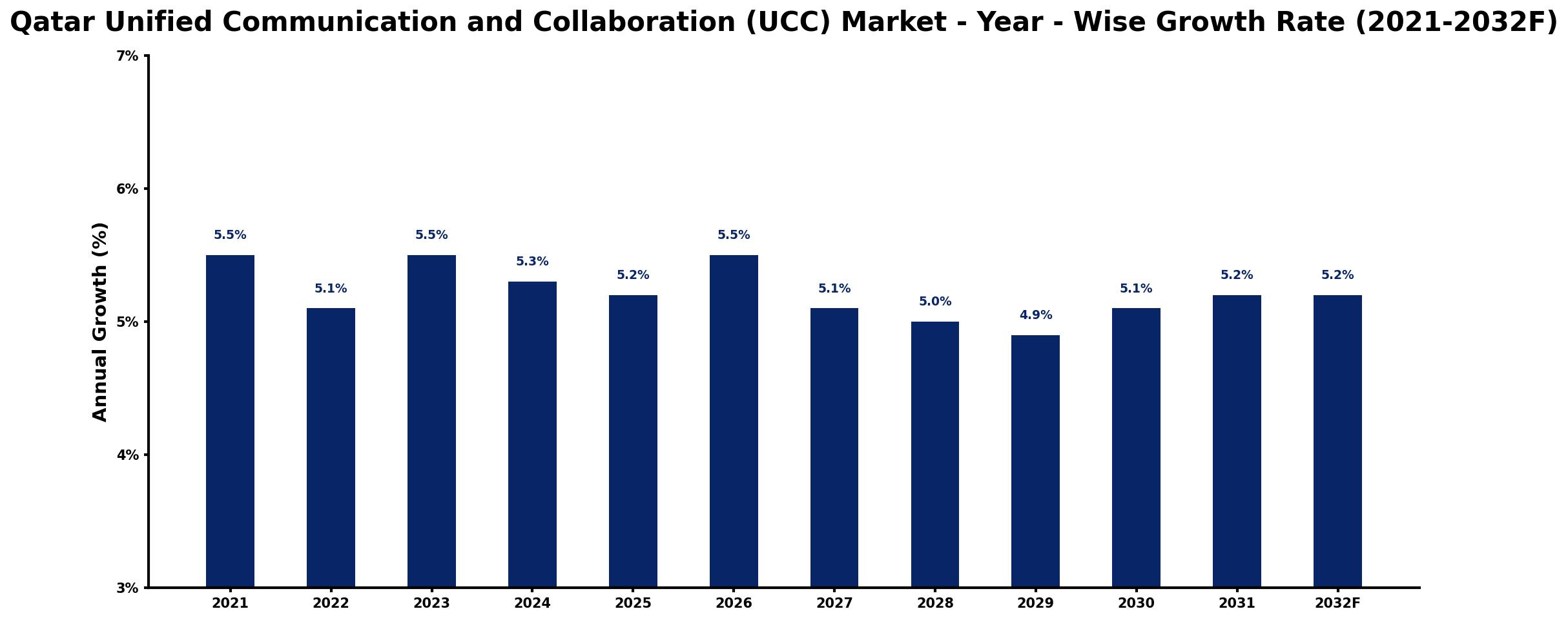
The table below presents the year‑wise growth rates along with the key drivers influencing the market
| Year | Growth Rate | Major Drivers |
| 2021 | 5.5% | Increased remote work adoption globally |
| 2022 | 5.1% | Rising demand for digital solutions |
| 2023 | 5.5% | Growth in cloud infrastructure investments |
| 2024 | 5.3% | Expansion of mobile workforce capabilities |
| 2025 | 5.2% | Enhanced focus on employee engagement |
| 2026 | 5.5% | Emergence of advanced integration technologies |
| 2027 | 5.1% | Stronger emphasis on security protocols |
| 2028 | 5.0% | Investment in user experience enhancements |
| 2029 | 4.9% | Shift towards hybrid work environments |
| 2030 | 5.1% | Increased reliance on video conferencing |
| 2031 | 5.2% | Demand for real-time data analytics |
| 2032 | 5.2% | Focus on sustainability initiatives globally |
Note: Market size estimations and growth projections presented in this report are based on 6Wresearch's proprietary forecasting methodology, utilizing the latest available industry data, government publications, and primary research inputs.
Qatar Unified Communication and Collaboration (UCC) Market Synopsis
Currently, the most powerful force shaping the Qatar UCC Market is the accelerating shift towards cloud-based solutions. Organizations across various sectors are adopting these technologies to ensure seamless, flexible communication that enhances workforce productivity, irrespective of location. As remote work continues to thrive, the need for robust UCC tools is becoming more pronounced.
Moreover, the integration of advanced features, such as AI-driven analytics and security measures, is becoming essential. These innovations not only improve communication efficiency but also address growing concerns around data security and privacy, which are critical as organizations navigate the complexities of a distributed workforce.
Qatar Unified Communication and Collaboration (UCC) Market Key Takeaways
- The market is projected to grow from USD 427 Million in 2025 to USD 579 Million by 2032.
- Cloud-based solutions are driving a significant shift in communication practices across industries.
- Adoption of UCC tools enhances productivity and operational efficiency within organizations.
- AI integration and enhanced security features are emerging as key trends in UCC solutions.
- The remote work trend continues to influence UCC technology development and deployment.
Evaluation of Restraints in Qatar Unified Communication and Collaboration (UCC) Market
Despite the promising growth trajectory, the Qatar UCC Market faces constraints that could impede its full potential. One of the primary challenges is the integration of UCC solutions into existing systems, which often requires substantial changes in workflows. Furthermore, organizations are confronted with user adoption issues, as employees may resist transitioning to new platforms or technologies. Addressing these issues necessitates a strategic approach, including comprehensive training programs and ongoing support to facilitate a smoother integration process.
Qatar Unified Communication and Collaboration (UCC) Market Trends
A significant trend shaping the UCC landscape in Qatar is the increasing emphasis on artificial intelligence and machine learning to enhance user experience. Businesses are investing in solutions that offer intelligent assistance and predictive analytics to drive decision-making. Furthermore, the demand for mobile-friendly UCC solutions is on the rise, catering to a growing workforce that operates from diverse locations. Integration with collaboration tools is also becoming a focal point, as organizations seek to create a unified experience for their employees.
Qatar Unified Communication and Collaboration (UCC) Market Opportunities
There is substantial opportunity for growth in the Qatar UCC Market, especially with the increasing demand for hybrid work models. Companies that offer customized UCC solutions designed to meet the unique needs of various industries are well-positioned to capitalize on this trend. Additionally, as organizations seek to enhance their cybersecurity measures, there is a rising demand for UCC providers who can deliver secure and compliant solutions, paving the way for significant investment potential in advanced technology offerings.
Government Initiatives in the Qatar Unified Communication and Collaboration (UCC) Market
The Qatari government has been proactive in promoting digital transformation, which directly supports the UCC market. Initiatives aimed at enhancing the nation's digital infrastructure encourage businesses to adopt advanced communication technologies. Public spending in sectors related to technology development and innovation has created an environment conducive to the growth of UCC solutions, underscoring the government's commitment to boosting productivity and competitiveness within the workforce.
Future Insights of the Qatar Unified Communication and Collaboration (UCC) Market
Looking ahead to 2026-2032, the Qatar UCC Market is poised for continued growth as companies increasingly embrace technological advancements. The ongoing integration of AI and machine learning into UCC platforms will drive enhanced user engagement and operational efficiency. Additionally, as businesses navigate an ever-evolving work landscape, there will be a greater need for flexible, scalable, and secure communication solutions that can adapt to shifting workforce dynamics.
Qatar Unified Communication and Collaboration (UCC) Market Latest Developments (2025 - 2026)
Recent developments in the Qatar UCC Market indicate a growing trend towards the adoption of hybrid solutions that combine on-premises and cloud technologies. This approach allows organizations to maintain flexibility while enhancing communication efficiency. Furthermore, providers are focusing on developing user-friendly interfaces that simplify adoption for a diverse workforce. Security enhancements remain a top priority, with providers investing in advanced encryption and compliance solutions to mitigate risks associated with data management.
Qatar Unified Communication and Collaboration (UCC) Market - Key Attractiveness of the Report
- 10 Years of Market Numbers
- Historical Data Starting from 2022 to 2025
- Base Year: 2025
- Forecast Data until 2032
- Key Performance Indicators Impacting the Market
- Major Upcoming Developments and Projects
Key Highlights of the Report:
- Qatar Unified Communication and Collaboration (UCC) Market Outlook
- Market Size of Qatar Unified Communication and Collaboration (UCC) Market, 2025
- Forecast of Qatar Unified Communication and Collaboration (UCC) Market, 2032
- Historical Data and Forecast of Qatar Unified Communication and Collaboration (UCC) Revenues & Volume for the Period 2022-2032F
- Qatar Unified Communication and Collaboration (UCC) Market Trend Evolution
- Qatar Unified Communication and Collaboration (UCC) Market Drivers and Challenges
- Qatar Unified Communication and Collaboration (UCC) Price Trends
- Qatar Unified Communication and Collaboration (UCC) Porter's Five Forces
- Qatar Unified Communication and Collaboration (UCC) Industry Life Cycle
- Historical Data and Forecast of Qatar Unified Communication and Collaboration (UCC) Market Revenues & Volume By Components for the Period 2022-2032F
- Historical Data and Forecast of Qatar Unified Communication and Collaboration (UCC) Market Revenues & Volume By Types for the Period 2022-2032F
- Historical Data and Forecast of Qatar Unified Communication and Collaboration (UCC) Market Revenues & Volume By Services for the Period 2022-2032F
- Historical Data and Forecast of Qatar Unified Communication and Collaboration (UCC) Market Revenues & Volume By Types for the Period 2022-2032F
- Historical Data and Forecast of Qatar Unified Communication and Collaboration (UCC) Market Revenues & Volume By UCaaS for the Period 2022-2032F
- Historical Data and Forecast of Qatar Unified Communication and Collaboration (UCC) Market Revenues & Volume By IP Telephony for the Period 2022-2032F
- Historical Data and Forecast of Qatar Unified Communication and Collaboration (UCC) Market Revenues & Volume By Video Conferencing Systems for the Period 2022-2032F
- Historical Data and Forecast of Qatar Unified Communication and Collaboration (UCC) Market Revenues & Volume By Services for the Period 2022-2032F
- Historical Data and Forecast of Qatar Unified Communication and Collaboration (UCC) Market Revenues & Volume By UC Managed Services for the Period 2022-2032F
- Historical Data and Forecast of Qatar Unified Communication and Collaboration (UCC) Market Revenues & Volume By Professional Services for the Period 2022-2032F
- Historical Data and Forecast of Qatar Unified Communication and Collaboration (UCC) Market Revenues & Volume By Deployment Mode for the Period 2022-2032F
- Historical Data and Forecast of Qatar Unified Communication and Collaboration (UCC) Market Revenues & Volume By On-premises for the Period 2022-2032F
- Historical Data and Forecast of Qatar Unified Communication and Collaboration (UCC) Market Revenues & Volume By Public Cloud for the Period 2022-2032F
- Historical Data and Forecast of Qatar Unified Communication and Collaboration (UCC) Market Revenues & Volume By Hybrid Cloud for the Period 2022-2032F
- Historical Data and Forecast of Qatar Unified Communication and Collaboration (UCC) Market Revenues & Volume By Organization Size for the Period 2022-2032F
- Historical Data and Forecast of Qatar Unified Communication and Collaboration (UCC) Market Revenues & Volume By Large Enterprises for the Period 2022-2032F
- Historical Data and Forecast of Qatar Unified Communication and Collaboration (UCC) Market Revenues & Volume By Small and Medium- Sized Enterprises (SMEs) for the Period 2022-2032F
- Historical Data and Forecast of Qatar Unified Communication and Collaboration (UCC) Market Revenues & Volume By Vertical for the Period 2022-2032F
- Historical Data and Forecast of Qatar Unified Communication and Collaboration (UCC) Market Revenues & Volume By BFSI for the Period 2022-2032F
- Historical Data and Forecast of Qatar Unified Communication and Collaboration (UCC) Market Revenues & Volume By IT and Telecom for the Period 2022-2032F
- Historical Data and Forecast of Qatar Unified Communication and Collaboration (UCC) Market Revenues & Volume By Retail and Consumer Goods for the Period 2022-2032F
- Historical Data and Forecast of Qatar Unified Communication and Collaboration (UCC) Market Revenues & Volume By Healthcare for the Period 2022-2032F
- Historical Data and Forecast of Qatar Unified Communication and Collaboration (UCC) Market Revenues & Volume By Public Sector and Utilities for the Period 2022-2032F
- Historical Data and Forecast of Qatar Unified Communication and Collaboration (UCC) Market Revenues & Volume By Logistics and Transportation for the Period 2022-2032F
- Historical Data and Forecast of Qatar Unified Communication and Collaboration (UCC) Market Revenues & Volume By Travel and Hospitality for the Period 2022-2032F
- Historical Data and Forecast of Qatar Unified Communication and Collaboration (UCC) Market Revenues & Volume By Other Verticals (Education, Manufacturing and Media and Entertainment) for the Period 2022-2032F
- Qatar Unified Communication and Collaboration (UCC) Import Export Trade Statistics
- Market Opportunity Assessment By Components
- Market Opportunity Assessment By Types
- Market Opportunity Assessment By Services
- Market Opportunity Assessment By Deployment Mode
- Market Opportunity Assessment By Organization Size
- Market Opportunity Assessment By Vertical
- Qatar Unified Communication and Collaboration (UCC) Top Companies Market Share
- Qatar Unified Communication and Collaboration (UCC) Competitive Benchmarking By Technical and Operational Parameters
- Qatar Unified Communication and Collaboration (UCC) Company Profiles
- Qatar Unified Communication and Collaboration (UCC) Key Strategic Recommendations






































