Qatar Warm Air Heating and Air Conditioning Market Summary
The qatar warm air heating and air conditioning market was estimated at USD 728 Million in 2025 and is projected to reach USD 1234 Million by 2032, growing at a CAGR of 9.0% from 2026 to 2032.
Qatar Warm Air Heating and Air Conditioning Market Year-wise Growth Rate and Key Drivers
This graph highlights how the Qatar Warm Air Heating and Air Conditioning Market has steadily grown over the past five years, supported by major growth factors.
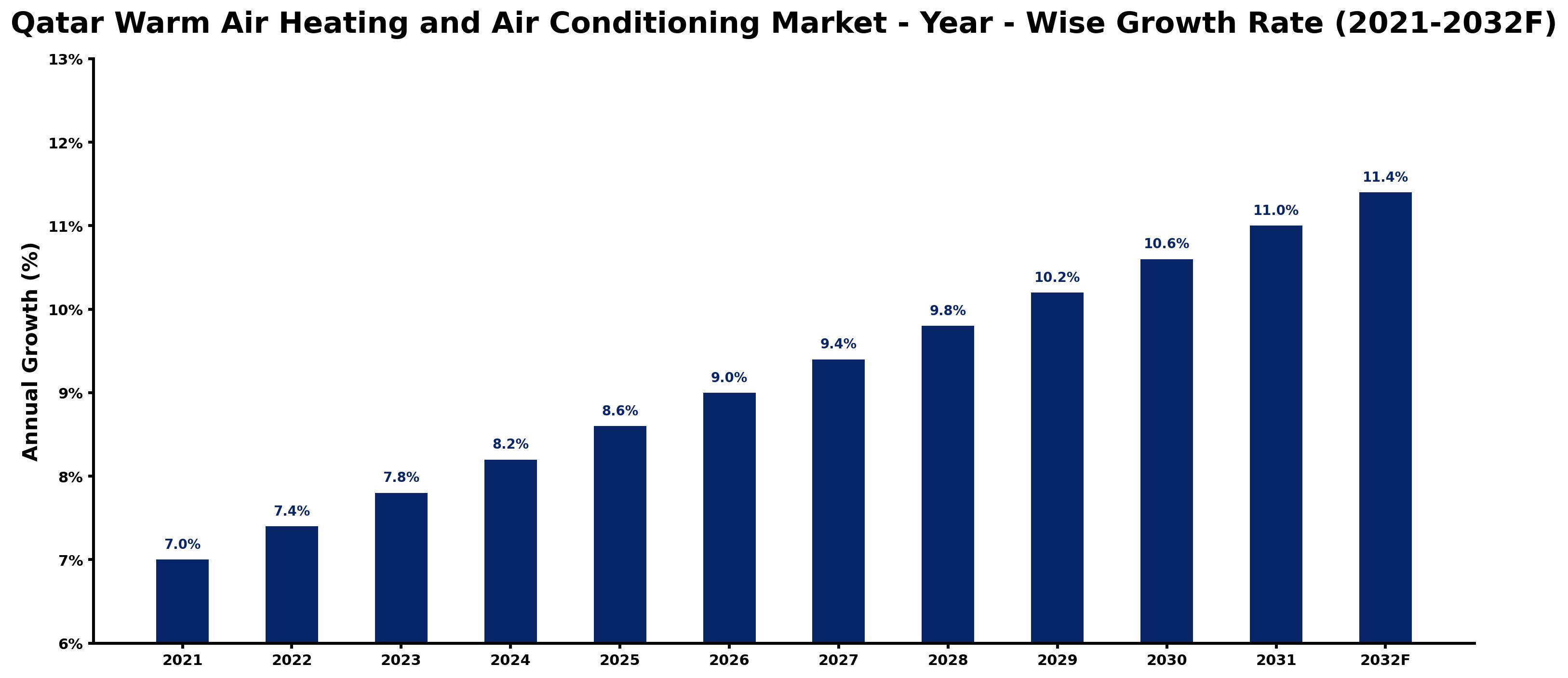
The table below presents the year wise growth rates along with the key drivers influencing the market
| Year | Growth Rate | Major Drivers |
| 2021 | 7.0% | Post-lockdown retail projects initiate significant infrastructure enhancements across Qatar's urban areas. |
| 2022 | 7.4% | Hospitality sector expansion results in increased demand for energy-efficient HVAC systems. |
| 2023 | 7.8% | Construction of mega-projects like the World Cup facilities drives air conditioning installations. |
| 2024 | 8.2% | Emerging smart building technologies evolve demand for advanced HVAC control solutions. |
| 2025 | 8.6% | Changing consumer preferences lean heavily toward environmentally friendly heating options. |
| 2026 | 9.0% | Rising temperatures consistently highlight the necessity for effective cooling systems year-round. |
| 2027 | 9.4% | Government focus on sustainability promotes investments in renewable energy-driven HVAC solutions. |
| 2028 | 9.8% | Local manufacturing capabilities begin reducing dependency on imported heating and cooling systems. |
| 2029 | 10.2% | Energy efficiency standards tighten, pushing industry players toward more innovative solutions. |
| 2030 | 10.6% | Increased urbanization leads to higher residential and commercial air conditioning demands. |
| 2031 | 11.0% | Integration of IoT technology reshapes how consumers interact with their HVAC systems. |
| 2032 | 11.4% | Collaboration among stakeholders further enhances operational efficiency and customer satisfaction. |
Note - Market size estimations and growth projections presented in this report are based on 6Wresearch's advanced forecasting approach, validated with industry datasets as of June 2026.
Qatar Warm Air Heating and Air Conditioning Market Synopsis
The Qatar Warm Air Heating and Air Conditioning Market is projected to reach 9.0% and witness significant growth during the forecast period (2026-2032). This small yet economically dynamic nation in the Middle East boasts a population of approximately 2.6 million and an expansive area of 11,586 square kilometers (about 4,471 square miles). Known for its high per-capita income, largely driven by natural gas and oil exports, Qatar serves as a pivotal regional trade hub. The country's hot climate contributes to a robust demand for warm air heating and air conditioning systems, making this market a critical component of its infrastructure development.
Qatar Warm Air Heating and Air Conditioning Market Growth Drivers
Several factors are propelling the Qatar Warm Air Heating and Air Conditioning Market forward:
- Significant investments from both foreign and local companies in residential and commercial construction projects are driving demand for HVAC systems, particularly in luxury developments such as hotels and shopping malls.
- A growing focus on energy efficiency has led to an increased adoption of advanced technologies like variable refrigerant flow (VRF) systems, which enable precise climate control across different areas within a building.
- Favorable government policies aimed at promoting the installation of energy-efficient HVAC systems have created an environment conducive to market growth, ensuring compliance with modern environmental standards.
- Changing lifestyle patterns among the population, with a shift towards luxury living, have heightened the demand for high-end HVAC products, including split-type air conditioners, which are favored for their efficiency and aesthetics.
- Robust urbanization and infrastructure development projects continue to stimulate the HVAC market, as new buildings require sophisticated heating and cooling solutions to ensure occupant comfort.
Qatar Warm Air Heating and Air Conditioning Market Challenges and Restraints
While the market shows great potential, it is not without its challenges:
- A lack of stringent enforcement of installation quality regulations, particularly regarding ductwork design and sealing, can lead to poor system performance, resulting in customer dissatisfaction and a decline in future orders.
- The increasing competition among suppliers has led to a price war, prompting some companies to cut costs at the expense of product quality, thereby eroding profitability and long-term viability.
- Transitioning to alternative refrigerants, especially the transition from R22, poses potential risks if not managed correctly, potentially leading to equipment malfunctions that negatively affect customer comfort.
- Economic fluctuations and external geopolitical factors can impact foreign investment in Qatar's construction sector, indirectly affecting the HVAC market.
- The ongoing need for workforce training and skill development in advanced HVAC technologies remains a challenge, as the market demands higher levels of expertise to ensure optimal system installation and maintenance.
Qatar Warm Air Heating and Air Conditioning Market Government Investment and Initiatives
The Qatar government has introduced several initiatives to enhance the HVAC market:
- The government promotes sustainable infrastructure development, leading to a focus on energy-efficient air conditioning systems in all new public and private buildings.
- Public spending is prioritized in upcoming projects, particularly related to urban development, which will necessitate increased investments in warm air heating and air conditioning systems.
- Policies encouraging the adoption of renewable energy sources for HVAC applications demonstrate the government's commitment to reducing carbon emissions and promoting environmental sustainability.
- Incentives for businesses to invest in advanced HVAC technologies are being implemented, aligning with Qatar's broader vision for economic diversification.
- Collaboration with international organizations aims to enhance the regulatory framework surrounding energy efficiency standards, driving market development for innovative HVAC solutions.
Qatar Warm Air Heating and Air Conditioning Market Latest Developments (May 2025 - June 2026)
Recent developments in the Qatar Warm Air Heating and Air Conditioning Market highlight the sector's adaptability and resilience:
- With the gradual recovery from the COVID-19 pandemic, construction activities have resumed, boosting demand for HVAC installations across residential and commercial sectors.
- Innovations in smart home technologies are becoming more integrated with HVAC systems, enhancing user experience through improved energy management and remote control capabilities.
- Supply chain adjustments were made to address previous disruptions caused by the pandemic, ensuring a more robust flow of components required for HVAC system manufacturing and installation.
- A focus on local manufacturing has increased, aimed at decreasing dependency on imports and establishing a more sustainable and resilient supply chain within Qatar.
- Emerging trends towards health-focused HVAC solutions, such as air purification features, are gaining traction as consumer awareness of indoor air quality continues to rise.
Qatar Warm Air Heating and Air Conditioning Market - Key Attractiveness of the Report
- 10 Years of Market Numbers
- Historical Data Starting from 2022 to 2025
- Base Year: 2025
- Forecast Data until 2032
- Key Performance Indicators Impacting the Market
- Major Upcoming Developments and Projects
Key Highlights of the Report:
- Qatar Warm Air Heating and Air Conditioning Market Outlook
- Market Size of Qatar Warm Air Heating and Air Conditioning Market, 2025
- Forecast of Qatar Warm Air Heating and Air Conditioning Market, 2032
- Historical Data and Forecast of Qatar Warm Air Heating and Air Conditioning Revenues & Volume for the Period 2022-2032F
- Qatar Warm Air Heating and Air Conditioning Market Trend Evolution
- Qatar Warm Air Heating and Air Conditioning Market Drivers and Challenges
- Qatar Warm Air Heating and Air Conditioning Price Trends
- Qatar Warm Air Heating and Air Conditioning Porter's Five Forces
- Qatar Warm Air Heating and Air Conditioning Industry Life Cycle
- Historical Data and Forecast of Qatar Warm Air Heating and Air Conditioning Market Revenues & Volume By Components for the Period 2022-2032F
- Historical Data and Forecast of Qatar Warm Air Heating and Air Conditioning Market Revenues & Volume By Sensors for the Period 2022-2032F
- Historical Data and Forecast of Qatar Warm Air Heating and Air Conditioning Market Revenues & Volume By Controllers & Constrolled Devices for the Period 2022-2032F
- Historical Data and Forecast of Qatar Warm Air Heating and Air Conditioning Market Revenues & Volume By Applications for the Period 2022-2032F
- Historical Data and Forecast of Qatar Warm Air Heating and Air Conditioning Market Revenues & Volume By Residential for the Period 2022-2032F
- Historical Data and Forecast of Qatar Warm Air Heating and Air Conditioning Market Revenues & Volume By Commercial for the Period 2022-2032F
- Historical Data and Forecast of Qatar Warm Air Heating and Air Conditioning Market Revenues & Volume By Industrial for the Period 2022-2032F
- Qatar Warm Air Heating and Air Conditioning Import Export Trade Statistics
- Market Opportunity Assessment By Components
- Market Opportunity Assessment By Applications
- Qatar Warm Air Heating and Air Conditioning Top Companies Market Share
- Qatar Warm Air Heating and Air Conditioning Competitive Benchmarking By Technical and Operational Parameters
- Qatar Warm Air Heating and Air Conditioning Company Profiles
- Qatar Warm Air Heating and Air Conditioning Key Strategic Recommendations






































