Qatar Water & Wastewater Treatment Market Summary
The qatar water & wastewater treatment market was estimated at USD 947 Million in 2025 and is projected to reach USD 1364 Million by 2032, growing at a CAGR of 6.2% from 2026 to 2032.
Qatar Water & Wastewater Treatment Market Year-wise Growth Rate and Key Drivers
This graph highlights how the Qatar Water & Wastewater Treatment Market has steadily grown over the past five years, supported by major growth factors.
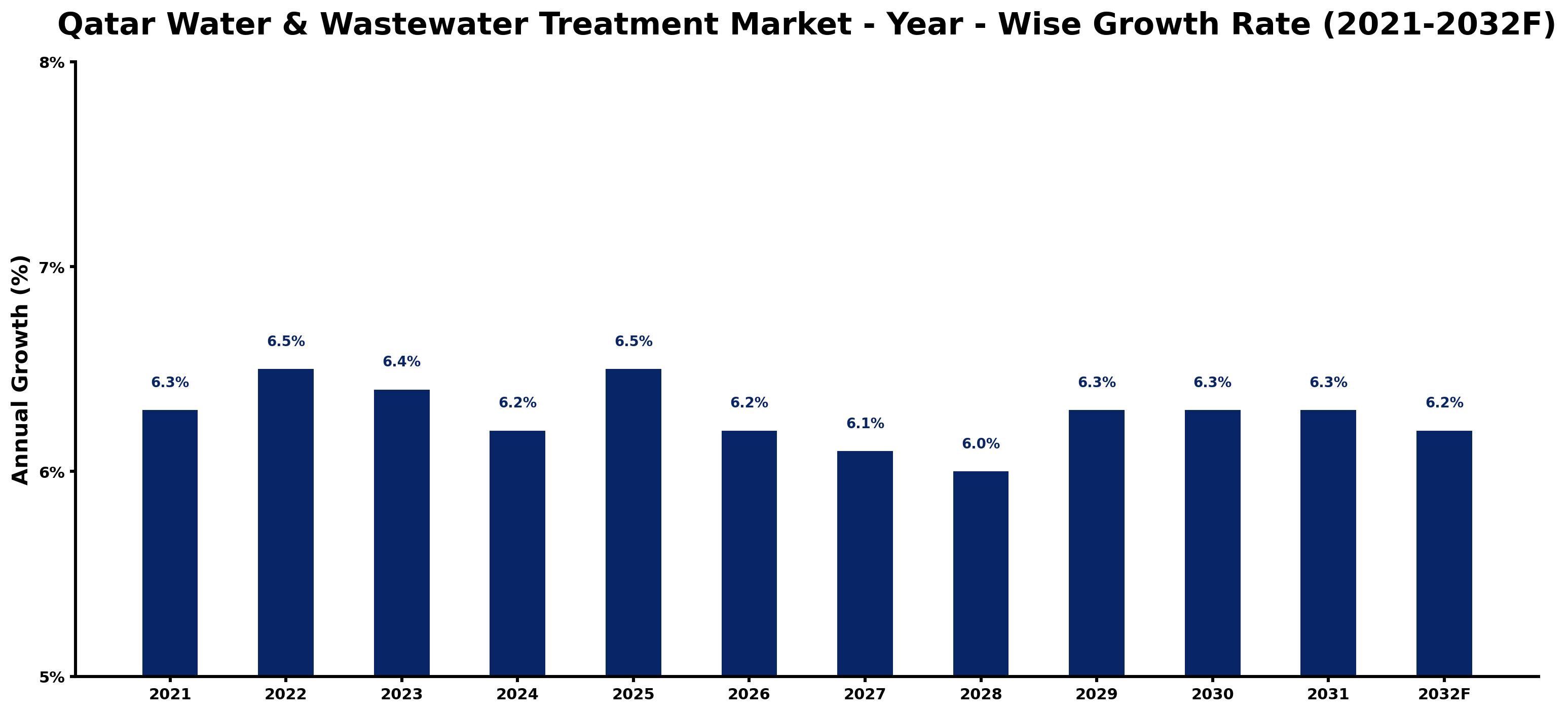
The table below presents the year wise growth rates along with the key drivers influencing the market
| Year | Growth Rate | Major Drivers |
| 2021 | 6.3% | Post-pandemic recovery ignited infrastructure investments in Qatar's water systems. |
| 2022 | 6.5% | New construction projects in Qatar spurred the need for modern wastewater solutions. |
| 2023 | 6.4% | Hot climate conditions intensified discussions on sustainable water management practices. |
| 2024 | 6.2% | Technological advancements improved efficiency in existing water treatment facilities. |
| 2025 | 6.5% | Investments in desalination technologies became vital for water scarcity alleviation. |
| 2026 | 6.2% | Partnerships with international firms enhanced local expertise in wastewater solutions. |
| 2027 | 6.1% | The FIFA World Cup legacy prompted upgrades to water infrastructure nationwide. |
| 2028 | 6.0% | Increased urbanization led to a surge in residential water treatment needs. |
| 2029 | 6.3% | Environmental concerns shifted focus toward sustainable and energy-efficient technologies. |
| 2030 | 6.3% | Public-private partnerships emerged as key drivers for large-scale treatment projects. |
| 2031 | 6.3% | Legislation incentivized the adoption of innovative wastewater recycling initiatives. |
| 2032 | 6.2% | Growing awareness of climate change underscored the importance of resilient water systems. |
Note - Market size estimations and growth projections presented in this report are based on 6Wresearch's advanced forecasting approach, validated with industry datasets as of June 2026.
Qatar Water & Wastewater Treatment Market Synopsis
The Qatar Water Wastewater Treatment Market is projected to reach 6.2% and witness significant growth during the forecast period (2026-2032). As one of the most water-stressed nations globally, Qatar faces pressing challenges regarding water scarcity and the management of wastewater. In response, the country has committed substantial investments toward enhancing its wastewater treatment infrastructure, including initiatives aimed at expanding desalination facilities and implementing advanced water recycling systems.
Qatar Water & Wastewater Treatment Market Growth Drivers
Several factors are driving the expansion of the Qatar Water & Wastewater Treatment Market. Urbanization in Qatar is escalating, leading to increased demand for efficient wastewater management solutions. This urban influx necessitates robust infrastructure capable of supporting a growing population, thereby elevating the need for improved sewage systems.
- Government initiatives focusing on environmental sustainability are promoting advanced wastewater management practices, further stimulating the market.
- Investment in new sewage networks is being prioritized to address existing infrastructure deficiencies and enhance service delivery.
- Compliance with stringent environmental regulations regarding sewage disposal encourages industries to adopt innovative treatment solutions.
- Increased public awareness about the significance of water conservation and waste management is driving demand for advanced technologies, including membrane bioreactors (MBRs).
- The industrial sector's growth, particularly in construction and manufacturing, emphasizes the need for effective water treatment and reuse strategies.
Qatar Water & Wastewater Treatment Market Challenges and Restraints
Despite the positive growth outlook, the Qatar Water & Wastewater Treatment Market faces several challenges. One significant hurdle is the shortage of skilled professionals, which complicates the implementation of advanced treatment technologies. This gap in expertise can lead to inefficiencies in operations and hinder the advancement of treatment systems.
- The high costs associated with the installation and maintenance of sophisticated wastewater treatment systems are prohibitive for small-scale industries, limiting widespread adoption.
- Operational issues can arise due to unpredictable climatic conditions, complicating the establishment of new facilities designed for optimal performance.
- Resistance to change within certain sectors can stall the transition to more efficient waste management practices.
- Funding constraints may impact the pace of development for large-scale infrastructure projects necessary for comprehensive wastewater treatment solutions.
- The ongoing impact of global economic factors may pose additional risks to investment levels in the sector.
Qatar Water & Wastewater Treatment Market Government Investment and Initiatives
The government of Qatar plays a crucial role in the development of the Water & Wastewater Treatment Market. A series of national policies and development plans have been introduced to not only enhance water treatment infrastructure but also to promote sustainable practices. Significant public spending has been targeted at upgrading existing wastewater systems and investing in new technologies, reflecting the government's commitment to addressing water scarcity and environmental concerns.
- The National Development Strategy outlines strategic priorities aimed at improving the quality and efficiency of water services.
- Government incentives for private sector participation are designed to attract investments and foster innovation in wastewater management solutions.
- Funding from international organizations for sustainable water projects provides additional resources to boost market growth.
- Collaboration between government agencies and private enterprises is emphasized to enhance knowledge sharing and operational efficiency.
- Promotion of research and development initiatives focused on water treatment technologies is vital to advancing the sector.
Qatar Water & Wastewater Treatment Market Latest Developments (May 2025 - June 2026)
Recent developments within the Qatar Water & Wastewater Treatment Market indicate a focus on resilience and adaptability in response to evolving challenges. Initiatives aimed at upgrading municipal sewerage networks have resumed, following previous delays caused by the global pandemic, indicating a renewed commitment to enhancing sanitation infrastructure.
- The implementation of desalination projects continues to gain momentum as a critical component of Qatar's water security strategy.
- Innovation in chemical dosing and filtration processes is being explored to improve efficiency and reduce operational costs.
- There is a noticeable increase in partnerships between local entities and international technology providers, fostering knowledge transfer and expertise.
- The government is intensifying its focus on regulatory frameworks to ensure compliance with environmental standards during wastewater treatment.
- Awareness campaigns aimed at the public have been initiated to promote better water conservation practices among residents.
Qatar Water & Wastewater Treatment Market - Key Attractiveness of the Report
- 10 Years of Market Numbers
- Historical Data Starting from 2022 to 2025
- Base Year: 2025
- Forecast Data until 2032
- Key Performance Indicators Impacting the Market
- Major Upcoming Developments and Projects
Key Highlights of the Report:
- Qatar Water & Wastewater Treatment Market Outlook
- Market Size of Qatar Water & Wastewater Treatment Market, 2025
- Forecast of Qatar Water & Wastewater Treatment Market, 2032
- Historical Data and Forecast of Qatar Water & Wastewater Treatment Revenues & Volume for the Period 2022-2032F
- Qatar Water & Wastewater Treatment Market Trend Evolution
- Qatar Water & Wastewater Treatment Market Drivers and Challenges
- Qatar Water & Wastewater Treatment Price Trends
- Qatar Water & Wastewater Treatment Porter's Five Forces
- Qatar Water & Wastewater Treatment Industry Life Cycle
- Historical Data and Forecast of Qatar Water & Wastewater Treatment Market Revenues & Volume By Product Category????????????? for the Period 2022-2032F
- Historical Data and Forecast of Qatar Water & Wastewater Treatment Market Revenues & Volume By Treatment Technologies for the Period 2022-2032F
- Historical Data and Forecast of Qatar Water & Wastewater Treatment Market Revenues & Volume By Delivery Equipment for the Period 2022-2032F
- Historical Data and Forecast of Qatar Water & Wastewater Treatment Market Revenues & Volume By Treatment Chemicals for the Period 2022-2032F
- Historical Data and Forecast of Qatar Water & Wastewater Treatment Market Revenues & Volume By Instrumentation for the Period 2022-2032F
- Historical Data and Forecast of Qatar Water & Wastewater Treatment Market Revenues & Volume By Applications for the Period 2022-2032F
- Historical Data and Forecast of Qatar Water & Wastewater Treatment Market Revenues & Volume By Municipal for the Period 2022-2032F
- Historical Data and Forecast of Qatar Water & Wastewater Treatment Market Revenues & Volume By Industrial for the Period 2022-2032F
- Qatar Water & Wastewater Treatment Import Export Trade Statistics
- Market Opportunity Assessment By Product Category?????????????
- Market Opportunity Assessment By Applications
- Qatar Water & Wastewater Treatment Top Companies Market Share
- Qatar Water & Wastewater Treatment Competitive Benchmarking By Technical and Operational Parameters
- Qatar Water & Wastewater Treatment Company Profiles
- Qatar Water & Wastewater Treatment Key Strategic Recommendations






































