Qatar Welding Consumables Market Size, Share & Growth Rate
The Qatar Welding Consumables Market was estimated at USD 227 Million in 2025 and is projected to reach USD 316 Million by 2032, growing at a CAGR of 4.8% from 2026 to 2032. This growth trajectory is predominantly driven by the burgeoning construction sector, fueled by major infrastructural projects leading up to significant events such as the FIFA World Cup. Additionally, the ongoing industrialization efforts in Qatar are contributing to an uptick in demand for diverse welding consumables across various sectors.
Qatar Welding Consumables Market Year-wise Growth Rate and Key Drivers
This graph highlights how the Qatar Welding Consumables Market has steadily grown over the years, supported by major growth factors.
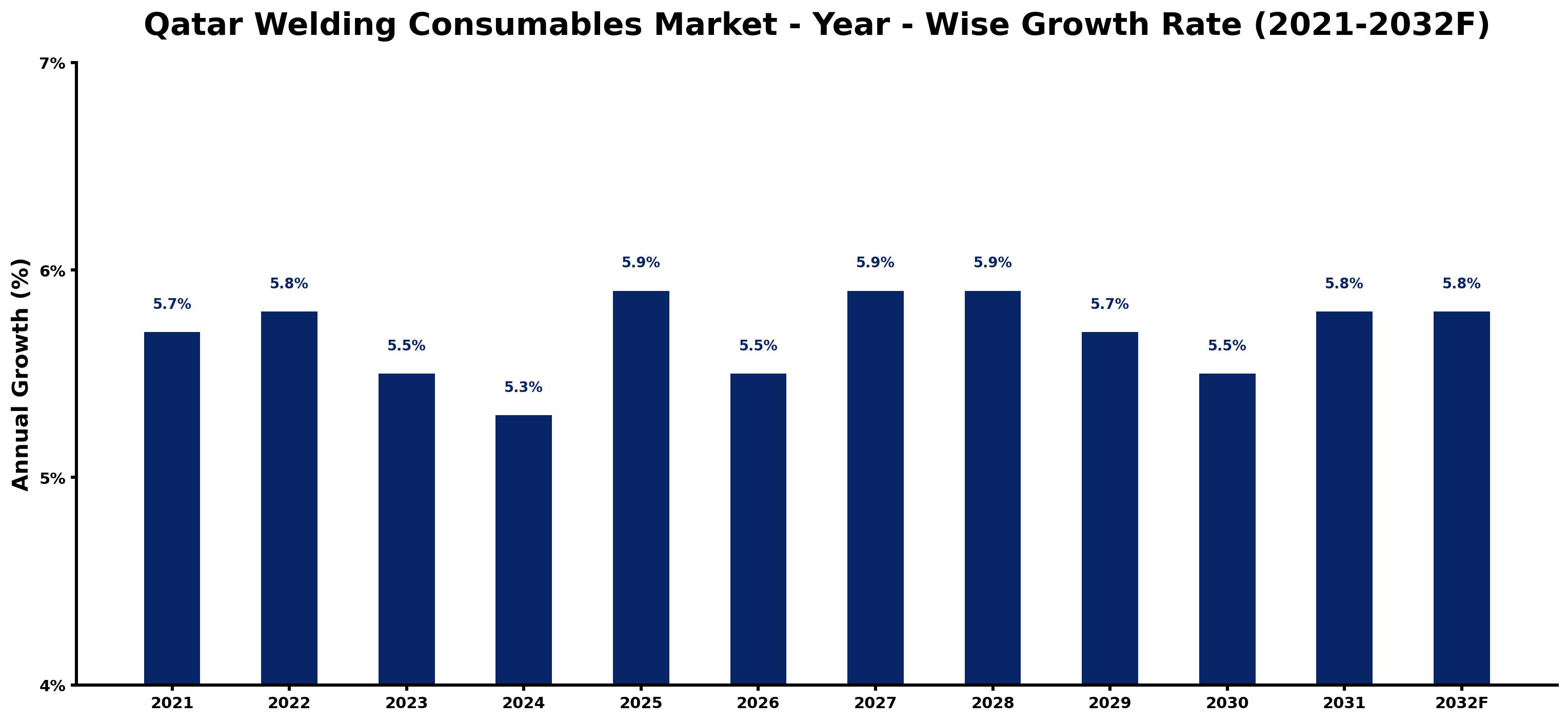
The table below presents the year‑wise growth rates along with the key drivers influencing the market
| Year | Growth Rate | Major Drivers |
| 2021 | 5.7% | Expansion of commercial construction activities |
| 2022 | 5.8% | Growing urbanization and commercial development |
| 2023 | 5.5% | Expansion of commercial construction activities |
| 2024 | 5.3% | Expansion of transportation and logistics networks |
| 2025 | 5.9% | Increasing industrial automation investments |
| 2026 | 5.5% | Government infrastructure modernization initiatives |
| 2027 | 5.9% | Increasing adoption of advanced technologies |
| 2028 | 5.9% | Growing renewable energy integration projects |
| 2029 | 5.7% | Increasing industrial infrastructure investments |
| 2030 | 5.5% | Expansion of transportation and logistics networks |
| 2031 | 5.8% | Expansion of manufacturing activities |
| 2032 | 5.8% | Increasing smart city development projects |
Note - Market size estimations and growth projections presented in this report are based on 6Wresearch’s advanced forecasting approach, validated with industry datasets as of June 2026.
Qatar Welding Consumables Market Synopsis
The need for advanced welding consumables in Qatar is surging as the nation embarks on an ambitious journey of infrastructure development. Key investments in construction are not only fostering a favorable market climate but also shaping innovative welding solutions that meet the specific requirements of large-scale projects.
Amidst the challenges presented by price fluctuations and labor shortages, the market has shown remarkable resilience. The strategic direction of companies in the welding consumables sector reflects a commitment to delivering high-quality products designed to meet the evolving demands of the construction and industrial sectors.
Qatar Welding Consumables Market Key Takeaways
- Strong growth anticipated, driven by construction and industrial expansion.
- Investment in infrastructure projects is a key demand driver.
- Innovative welding solutions are transforming market dynamics.
- Fluctuating raw material prices continue to pose challenges.
- Resilience against external shocks, including pandemic-related disruptions.
Evaluation of Restraints in Qatar Welding Consumables Market
While the Qatar welding consumables market is poised for growth, it faces several notable restraints. The volatility of raw material prices significantly impacts production costs, presenting a challenge for manufacturers in maintaining profitability and competitive pricing. Furthermore, the skilled labor shortage poses a serious concern; the industry requires a growing pool of trained professionals capable of delivering quality work to support complex projects. Addressing these issues is vital for sustaining growth and maximizing the potential of the market.
Qatar Welding Consumables Market Trends
Several trends are currently shaping the Qatar welding consumables market. A notable shift towards automation and robotics in welding processes is on the rise, enhancing efficiency and precision. Additionally, there is an increased emphasis on sustainability, prompting manufacturers to develop eco-friendly consumables that minimize environmental impact. Technological advancements in welding techniques, coupled with a focus on quality assurance, are also emerging as critical factors influencing market dynamics.
Qatar Welding Consumables Market Opportunities
The Qatar welding consumables market presents lucrative growth opportunities, particularly in sectors such as automotive, aerospace, and oil and gas. As the government continues to diversify the economy beyond oil dependency, non-oil sectors are expected to drive demand for specialized welding solutions. The influx of foreign investments in manufacturing and infrastructure also signifies potential avenues for expansion, encouraging businesses to explore innovative products and technologies.
Government Initiatives in the Qatar Welding Consumables Market
The Qatari government is actively fostering a conducive environment for the welding consumables market through various initiatives and public spending programs. Policies aimed at enhancing infrastructure and promoting industrial growth are instrumental in driving the demand for welding products. Government investments in major projects emphasize the importance of skilled labor and quality standards in welding, aligning with the country's broader vision for sustainable economic development.
Future Insights of the Qatar Welding Consumables Market
Looking ahead to 2026-2032, the Qatar welding consumables market is expected to maintain its upward trajectory as infrastructure development remains a priority. The ongoing push for industrial diversification and innovation will likely drive further demand for welding consumables. The market's ability to adapt to new technologies and methodologies will be crucial in capitalizing on emerging opportunities and enhancing the overall competitiveness of the sector.
Qatar Welding Consumables Market Latest Developments (May 2025 - June 2026)
Recent developments in the Qatar welding consumables market indicate a strengthening focus on innovation and sustainability. Companies are investing in research and development to introduce advanced welding solutions that cater to the evolving requirements of the construction and industrial sectors. Collaborative efforts between industry stakeholders and educational institutions are also gaining momentum, aiming to address the skilled labor gap and enhance workforce training in welding technologies.
Qatar Welding Consumables Market - Key Attractiveness of the Report
- 10 Years of Market Numbers
- Historical Data Starting from 2022 to 2025
- Base Year: 2025
- Forecast Data until 2032
- Key Performance Indicators Impacting the Market
- Major Upcoming Developments and Projects
Key Highlights of the Report:
- Qatar Welding Consumables Market Outlook
- Market Size of Qatar Welding Consumables Market, 2025
- Forecast of Qatar Welding Consumables Market, 2032
- Historical Data and Forecast of Qatar Welding Consumables Revenues & Volume for the Period 2022-2032F
- Qatar Welding Consumables Market Trend Evolution
- Qatar Welding Consumables Market Drivers and Challenges
- Qatar Welding Consumables Price Trends
- Qatar Welding Consumables Porter's Five Forces
- Qatar Welding Consumables Industry Life Cycle
- Historical Data and Forecast of Qatar Welding Consumables Market Revenues & Volume By Type for the Period 2022-2032F
- Historical Data and Forecast of Qatar Welding Consumables Market Revenues & Volume By Stick Electrodes for the Period 2022-2032F
- Historical Data and Forecast of Qatar Welding Consumables Market Revenues & Volume By Solid Wires for the Period 2022-2032F
- Historical Data and Forecast of Qatar Welding Consumables Market Revenues & Volume By Flux Cored Wires for the Period 2022-2032F
- Historical Data and Forecast of Qatar Welding Consumables Market Revenues & Volume By SAW Wires & Fluxes for the Period 2022-2032F
- Historical Data and Forecast of Qatar Welding Consumables Market Revenues & Volume By End-user Industry for the Period 2022-2032F
- Historical Data and Forecast of Qatar Welding Consumables Market Revenues & Volume By Aerospace & Defense for the Period 2022-2032F
- Historical Data and Forecast of Qatar Welding Consumables Market Revenues & Volume By Automotive & Transportation for the Period 2022-2032F
- Historical Data and Forecast of Qatar Welding Consumables Market Revenues & Volume By Construction for the Period 2022-2032F
- Historical Data and Forecast of Qatar Welding Consumables Market Revenues & Volume By Energy for the Period 2022-2032F
- Historical Data and Forecast of Qatar Welding Consumables Market Revenues & Volume By Heavy Machinery for the Period 2022-2032F
- Historical Data and Forecast of Qatar Welding Consumables Market Revenues & Volume By Shipbuilding for the Period 2022-2032F
- Historical Data and Forecast of Qatar Welding Consumables Market Revenues & Volume By Process & Others for the Period 2022-2032F
- Historical Data and Forecast of Qatar Welding Consumables Market Revenues & Volume By Welding Technique for the Period 2022-2032F
- Historical Data and Forecast of Qatar Welding Consumables Market Revenues & Volume By Arc Welding for the Period 2022-2032F
- Historical Data and Forecast of Qatar Welding Consumables Market Revenues & Volume By Resistance Welding for the Period 2022-2032F
- Historical Data and Forecast of Qatar Welding Consumables Market Revenues & Volume By Oxy-fuel Welding for the Period 2022-2032F
- Historical Data and Forecast of Qatar Welding Consumables Market Revenues & Volume By Laser-beam Welding for the Period 2022-2032F
- Historical Data and Forecast of Qatar Welding Consumables Market Revenues & Volume By Others for the Period 2022-2032F
- Qatar Welding Consumables Import Export Trade Statistics
- Market Opportunity Assessment By Type
- Market Opportunity Assessment By End-user Industry
- Market Opportunity Assessment By Welding Technique
- Qatar Welding Consumables Top Companies Market Share
- Qatar Welding Consumables Competitive Benchmarking By Technical and Operational Parameters
- Qatar Welding Consumables Company Profiles
- Qatar Welding Consumables Key Strategic Recommendations






































