Qatar Wireless Charging Market Size, Share & Growth Rate
The Qatar Wireless Charging Market was estimated at USD 514 Million in 2025 and is projected to reach USD 739 Million by 2032, growing at a CAGR of 5.3% from 2026 to 2032. This upward trajectory is largely fueled by the rapid proliferation of smartphones and IoT devices in the region, which have created a pressing need for efficient and convenient charging solutions. Moreover, government initiatives aimed at enhancing smart infrastructure and promoting sustainable technologies are further driving market expansion.
Qatar Wireless Charging Market Year-wise Growth Rate and Key Drivers
This graph highlights how the Qatar Wireless Charging Market has steadily grown over the years, supported by major growth factors.
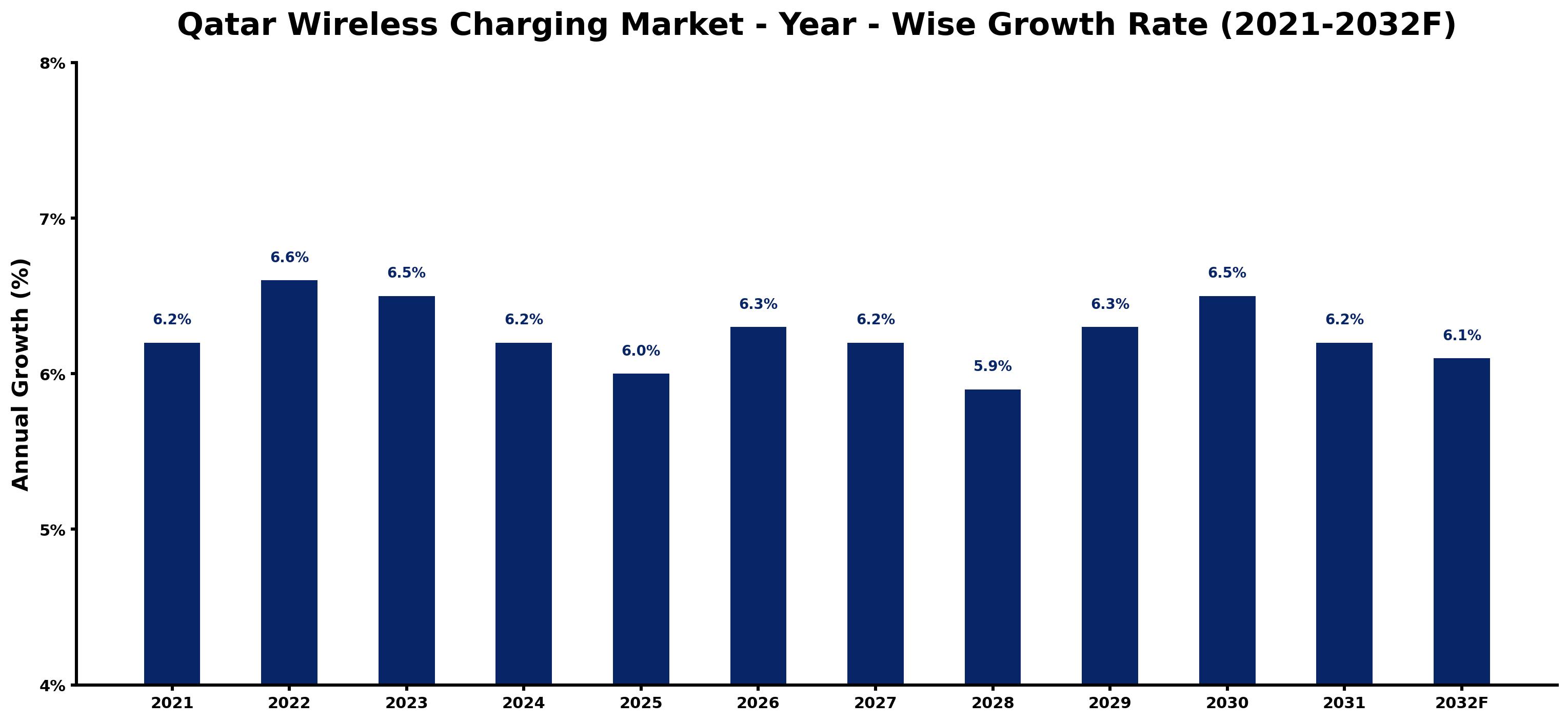
The table below presents the year‑wise growth rates along with the key drivers influencing the market
| Year | Growth Rate | Major Drivers |
| 2021 | 6.2% | Expansion of commercial construction activities |
| 2022 | 6.6% | Rising electricity demand across industries |
| 2023 | 6.5% | Increasing industrial infrastructure investments |
| 2024 | 6.2% | Increasing adoption of advanced technologies |
| 2025 | 6.0% | Growing renewable energy integration projects |
| 2026 | 6.3% | Increasing industrial automation investments |
| 2027 | 6.2% | Expansion of manufacturing activities |
| 2028 | 5.9% | Increasing industrial infrastructure investments |
| 2029 | 6.3% | Expansion of transportation and logistics networks |
| 2030 | 6.5% | Increasing industrial automation investments |
| 2031 | 6.2% | Expansion of transportation and logistics networks |
| 2032 | 6.1% | Increasing industrial automation investments |
Note - Market size estimations and growth projections presented in this report are based on 6Wresearch’s advanced forecasting approach, validated with industry datasets as of June 2026.
Qatar Wireless Charging Market Synopsis
In recent years, the Qatar wireless charging market has gained remarkable momentum, propelled by the increasing demand for mobile devices and innovative charging methods. However, as the market evolves, it is poised for broader applications across various sectors, including automotive and healthcare, thereby expanding its reach beyond consumer electronics.
The integration of wireless charging solutions within smart products and the Internet of Things (IoT) devices signifies a transformative shift in technology adoption. As consumers and businesses alike seek greater convenience, the market is set for accelerated growth in the coming years, indicating a promising future.
Qatar Wireless Charging Market Key Takeaways
- The market is experiencing robust growth due to the rising demand for mobile devices and wireless solutions.
- Government initiatives play a crucial role in promoting sustainable technologies and smart infrastructure.
- Integration of wireless charging in automotive and healthcare sectors is enhancing the market's scope.
- Challenges include the higher initial costs and compatibility issues with existing devices.
- The COVID-19 pandemic influenced demand positively due to increased remote working and reliance on wireless devices.
Evaluation of Restraints in Qatar Wireless Charging Market
While the Qatar wireless charging market is on an upward trajectory, it faces significant challenges that could limit its full potential. The higher costs associated with establishing wireless charging infrastructure compared to traditional methods can deter adoption among budget-conscious consumers and businesses. Additionally, compatibility concerns with older devices pose a barrier to seamless integration. Slower charging speeds for certain wireless technologies further complicate their acceptance in fast-paced environments, making consumers hesitant to fully commit to this innovative charging solution.
Qatar Wireless Charging Market Trends
A surge in the adoption of smart devices is fueling current trends in the Qatar wireless charging market. Consumers increasingly favor seamless, cable-free experiences, driving demand for integrated charging solutions. Moreover, advancements in technology are facilitating the development of faster and more efficient wireless charging methods. The automotive sector is witnessing a notable shift, with electric vehicles (EVs) adopting wireless charging capabilities to enhance user convenience. As sustainability becomes a priority, eco-friendly wireless charging technologies are also gaining traction, aligning with global trends towards greener solutions.
Qatar Wireless Charging Market Opportunities
The Qatar wireless charging market presents numerous opportunities for growth and investment. With the ongoing digitization of various sectors, companies can capitalize on the demand for wireless solutions in automotive, healthcare, and consumer electronics. The development of more affordable charging infrastructure could significantly enhance adoption rates, while collaboration with tech firms to integrate wireless capabilities into new devices could open up additional avenues for growth. Furthermore, as government initiatives prioritize smart technologies, businesses aligned with these goals are likely to thrive in this evolving market landscape.
Government Initiatives in the Qatar Wireless Charging Market
The Qatari government is committed to promoting sustainable technologies and smart infrastructure, which directly supports the growth of the wireless charging market. Public spending on innovative technologies is increasing, and initiatives are in place to encourage the adoption of eco-friendly practices across various sectors. By facilitating partnerships between public and private entities, the government aims to create an environment conducive to the development and integration of wireless charging solutions. These strategies are critical as Qatar positions itself as a leader in technological advancement and sustainability.
Future Insights of the Qatar Wireless Charging Market
Looking ahead to the years 2026-2032, the Qatar wireless charging market is poised for significant transformation. As technology evolves, faster and more versatile charging solutions will likely emerge, catering to the demands of consumers and businesses alike. The continued integration of wireless charging in electric vehicles and IoT devices will broaden its applications and enhance user experiences. Additionally, with government backing, the market can expect to witness accelerated innovation, leading to a more comprehensive adoption of wireless charging solutions across various sectors.
Qatar Wireless Charging Market Latest Developments (May 2025 - June 2026)
Recent developments in the Qatar wireless charging market reflect a strong focus on innovation and sustainability. Companies are increasingly launching initiatives aimed at integrating wireless charging into public infrastructure, including airports and shopping centers. Research and development efforts are intensifying, resulting in improved charging speeds and compatibility with a broader range of devices. The growing collaboration between technology firms and local authorities is also notable, as they aim to establish a seamless wireless charging ecosystem that aligns with Qatar's vision for smart technology integration.
Qatar Wireless Charging Market - Key Attractiveness of the Report
- 10 Years of Market Numbers
- Historical Data Starting from 2022 to 2025
- Base Year: 2025
- Forecast Data until 2032
- Key Performance Indicators Impacting the Market
- Major Upcoming Developments and Projects
Key Highlights of the Report:
- Qatar Wireless Charging Market Outlook
- Market Size of Qatar Wireless Charging Market, 2025
- Forecast of Qatar Wireless Charging Market, 2032
- Historical Data and Forecast of Qatar Wireless Charging Revenues & Volume for the Period 2022-2032F
- Qatar Wireless Charging Market Trend Evolution
- Qatar Wireless Charging Market Drivers and Challenges
- Qatar Wireless Charging Price Trends
- Qatar Wireless Charging Porter's Five Forces
- Qatar Wireless Charging Industry Life Cycle
- Historical Data and Forecast of Qatar Wireless Charging Market Revenues & Volume By Technology for the Period 2022-2032F
- Historical Data and Forecast of Qatar Wireless Charging Market Revenues & Volume By Resonant for the Period 2022-2032F
- Historical Data and Forecast of Qatar Wireless Charging Market Revenues & Volume By RF for the Period 2022-2032F
- Historical Data and Forecast of Qatar Wireless Charging Market Revenues & Volume By Inductive for the Period 2022-2032F
- Historical Data and Forecast of Qatar Wireless Charging Market Revenues & Volume By Others for the Period 2022-2032F
- Historical Data and Forecast of Qatar Wireless Charging Market Revenues & Volume By Applications for the Period 2022-2032F
- Historical Data and Forecast of Qatar Wireless Charging Market Revenues & Volume By Healthcare for the Period 2022-2032F
- Historical Data and Forecast of Qatar Wireless Charging Market Revenues & Volume By Automotive for the Period 2022-2032F
- Historical Data and Forecast of Qatar Wireless Charging Market Revenues & Volume By Consumer Electronics for the Period 2022-2032F
- Historical Data and Forecast of Qatar Wireless Charging Market Revenues & Volume By Industrial for the Period 2022-2032F
- Historical Data and Forecast of Qatar Wireless Charging Market Revenues & Volume By Others for the Period 2022-2032F
- Qatar Wireless Charging Import Export Trade Statistics
- Market Opportunity Assessment By Technology
- Market Opportunity Assessment By Applications
- Qatar Wireless Charging Top Companies Market Share
- Qatar Wireless Charging Competitive Benchmarking By Technical and Operational Parameters
- Qatar Wireless Charging Company Profiles
- Qatar Wireless Charging Key Strategic Recommendations






































