Qatar Wireless Network Security Market Size & Growth Rate (2026-2032)
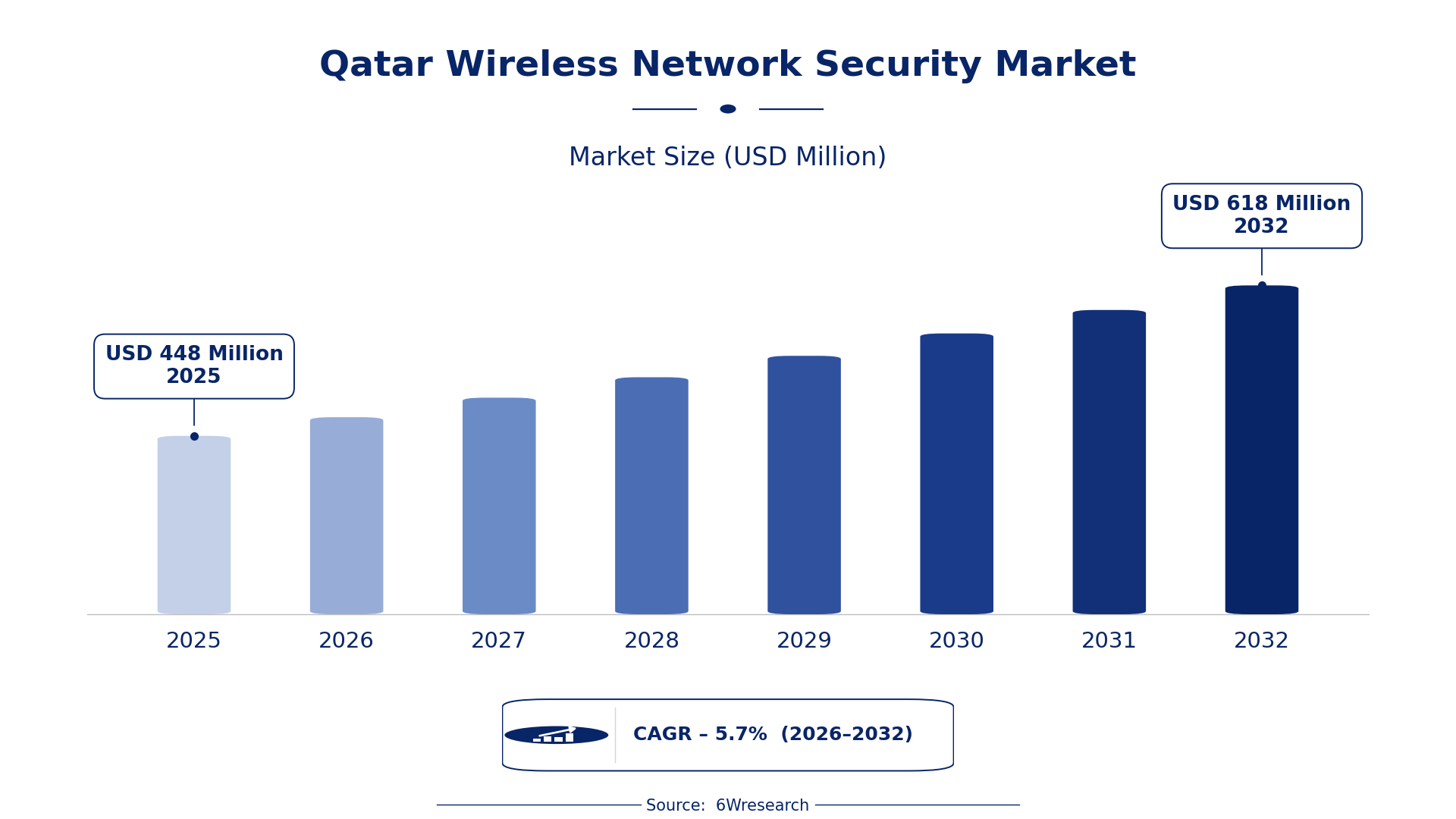
The Qatar Wireless Network Security Market was estimated at USD 448 Million in 2025 and is projected to reach USD 618 Million by 2032, growing at a CAGR of 5.7% from 2026 to 2032.
Qatar Wireless Network Security Market Synopsis
The wireless network security environment in Qatar has become crucial as the country rapidly embraces digital transformation. Organizations are increasingly aware that protecting their wireless networks from cyber threats is not optional—it's a necessity. With the deployment of advanced wireless technologies and the rise of remote working, demand for sophisticated security solutions is at an all-time high.
As both public and private sectors escalate their wireless connectivity initiatives, the market for wireless network security solutions continues to expand. Encryption methods, secure access controls, and intrusion detection systems are being integrated to safeguard sensitive information from unauthorized access. This growing urgency for protection positions the Qatar Wireless Network Security Market for substantial growth in the coming years.
Qatar Wireless Network Security Market Year-wise Growth Rate and Key Drivers
This graph illustrates the annual growth rates of the Qatar Wireless Network Security Market from 2021 to 2032, highlighting a steady upward trajectory and projected expansion over the forecast period.
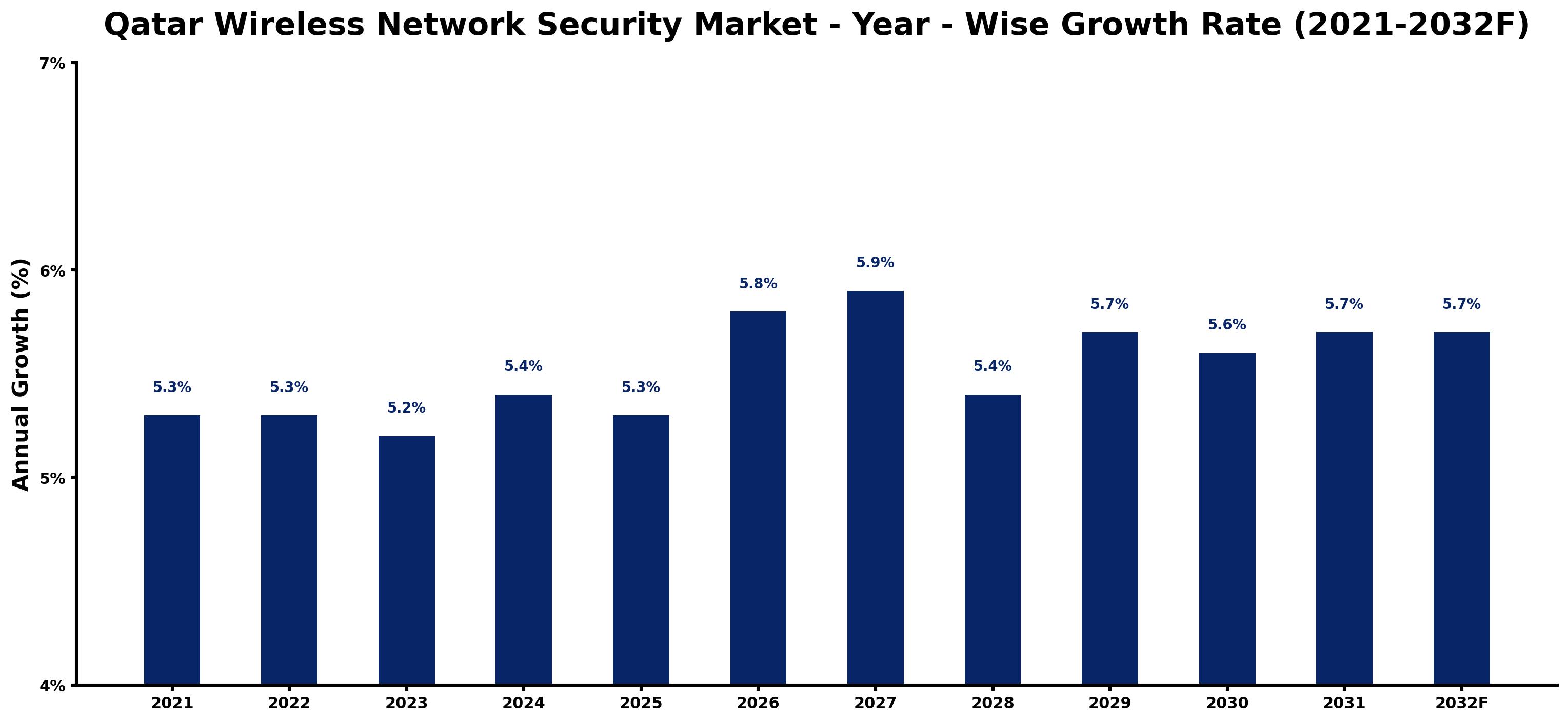
The table below presents the year‑wise growth rates along with the key drivers influencing the market
| Year | Growth Rate | Major Drivers |
| 2021 | 5.3% | Qatar National Cybersecurity Strategy promotes network security investments. |
| 2022 | 5.3% | Increased cyber threats linked to FIFA World Cup preparations. |
| 2023 | 5.2% | Growing adoption of IoT devices necessitates enhanced security measures. |
| 2024 | 5.4% | Qatar's focus on digital infrastructure boosts security demand. |
| 2025 | 5.3% | Local enterprises increase security budgets amid rising cyberattacks. |
| 2026 | 5.8% | Government initiatives prioritize information security for critical sectors. |
| 2027 | 5.9% | Public awareness campaigns drive demand for wireless security solutions. |
| 2028 | 5.4% | Telecommunications sector regulations mandate improved network protections. |
| 2029 | 5.7% | Emergence of smart city projects heightens cybersecurity requirements. |
| 2030 | 5.6% | Increased reliance on remote work increases cybersecurity investments. |
| 2031 | 5.7% | National Cybersecurity Agency leads training programs for businesses. |
| 2032 | 5.7% | Corporate compliance with GDPR influences local wireless security strategies. |
Note: Market size estimations and growth projections presented in this report are based on 6Wresearch's proprietary forecasting methodology, utilizing the latest available industry data, government publications, and primary research inputs.
Qatar Wireless Network Security Market Key Takeaways
Below are some of the specific key takeaways from the market, including:
- The market is experiencing heightened demand due to the proliferation of wireless technologies.
- Companies are increasingly investing in solutions that ensure data protection and compliance.
- Security measures are evolving to counteract the sophisticated nature of cyber threats.
- Increased government focus on regulatory frameworks is driving market growth.
- Collaboration between technology firms and telecommunications companies is enhancing service offerings.
Evaluation of Restraints in Qatar Wireless Network Security Market
Despite the growth potential, several factors impede the Qatar Wireless Network Security Market. The rapid increase in wireless devices introduces more vulnerabilities, making it difficult for organizations to maintain robust security measures. Many enterprises struggle to keep pace with the latest threats and often lack the skilled personnel necessary for effective security management. Additionally, budget constraints can limit investments in advanced security technologies, leaving networks exposed to potential attacks.
Qatar Wireless Network Security Market Trends
Several trends are shaping the Qatar Wireless Network Security Market, starting with the rise of 5G technology, which introduces new capabilities but also new security challenges. Organizations are increasingly prioritizing multi-factor authentication (MFA) and zero-trust security models to ensure that only authorized users can access critical systems. There's also a growing emphasis on artificial intelligence and machine learning to enhance threat detection and response times. Businesses are recognizing that a proactive rather than reactive approach to security is essential for safeguarding their assets.
Qatar Wireless Network Security Market Opportunities
The opportunities in the Qatar Wireless Network Security Market are significant, particularly for companies willing to innovate. As businesses transition to remote work, the demand for secure access solutions will only grow. Companies can explore partnerships with governmental and regulatory bodies to develop standardized security protocols that ensure comprehensive protection across sectors. The push for smart city initiatives also opens avenues for integrated security solutions tailored for urban environments.
Government Initiatives in the Qatar Wireless Network Security Market
The Qatari government is actively influencing the Wireless Network Security Market through a series of strategic initiatives aimed at enhancing cybersecurity across the nation. Recognizing the critical importance of secure digital infrastructure, the government has prioritized regulatory frameworks and public sector projects to safeguard wireless communications. These measures not only reflect current security needs but also lay the groundwork for future developments, ensuring a resilient cyber environment.
- A national digital infrastructure upgrade programme now in its rollout phase emphasizes improving cybersecurity across public services.
- A regulatory framework introduced in 2025 mandates enhanced security measures for critical infrastructure providers.
- A current initiative focuses on developing a national cybersecurity strategy aimed at fostering collaboration between public and private sectors.
- A planned public-private partnership aims to bolster wireless security solutions, set to begin implementation by 2027.
- Ongoing efforts include workshops and training programs designed to enhance the skill sets of cybersecurity professionals across various industries.
Future Insights of the Qatar Wireless Network Security Market
Looking ahead to 2026-2032, the Qatar Wireless Network Security Market is expected to evolve significantly. The increasing digitization of services across both public and private sectors will demand more sophisticated security solutions. With cyber threats becoming more complex, organizations will prioritize investment in advanced technologies, including AI-driven analytics and automated response systems. The market's trajectory suggests not just growth in numbers but also a transformation in how security solutions are perceived and implemented.
Qatar Wireless Network Security Market Latest Developments
In the last year, the Qatar Wireless Network Security Market has seen a surge in activities, indicating a heightened focus on security solutions amidst evolving threats. Organizations are reacting to the increasing risks associated with wireless communications by investing in new technologies and partnerships. As the threat landscape changes, stakeholders are prioritizing strategic moves to fortify their security infrastructures.
- A major technology vendor launched an AI-based security solution in Q1 2025, aimed at enhancing threat detection capabilities.
- In early 2025, a leading regional operator completed a wireless network upgrade, incorporating state-of-the-art security features.
- Currently ongoing is a collaborative initiative between telecommunications firms focusing on developing unified security protocols for 5G networks.
- A new training program designed for cybersecurity specialists is scheduled to launch in mid-2026, aimed at building local expertise.
- An upcoming public-private initiative to enhance secure wireless communications in smart cities is set to start planning phases in late 2026.
Qatar Wireless Network Security Market - Key Attractiveness of the Report
- 10 Years of Market Numbers
- Historical Data Starting from 2022 to 2025
- Base Year: 2025
- Forecast Data until 2032
- Key Performance Indicators Impacting the Market
- Major Upcoming Developments and Projects
Key Highlights of the Report:
- Qatar Wireless Network Security Market Outlook
- Market Size of Qatar Wireless Network Security Market, 2025
- Forecast of Qatar Wireless Network Security Market, 2032
- Historical Data and Forecast of Qatar Wireless Network Security Revenues & Volume for the Period 2022-2032F
- Qatar Wireless Network Security Market Trend Evolution
- Qatar Wireless Network Security Market Drivers and Challenges
- Qatar Wireless Network Security Price Trends
- Qatar Wireless Network Security Porter's Five Forces
- Qatar Wireless Network Security Industry Life Cycle
- Historical Data and Forecast of Qatar Wireless Network Security Market Revenues & Volume By Solutions for the Period 2022-2032F
- Historical Data and Forecast of Qatar Wireless Network Security Market Revenues & Volume By Firewall for the Period 2022-2032F
- Historical Data and Forecast of Qatar Wireless Network Security Market Revenues & Volume By IPS/IDS for the Period 2022-2032F
- Historical Data and Forecast of Qatar Wireless Network Security Market Revenues & Volume By Encryption for the Period 2022-2032F
- Historical Data and Forecast of Qatar Wireless Network Security Market Revenues & Volume By I&AM for the Period 2022-2032F
- Historical Data and Forecast of Qatar Wireless Network Security Market Revenues & Volume By UTM for the Period 2022-2032F
- Historical Data and Forecast of Qatar Wireless Network Security Market Revenues & Volume By Services for the Period 2022-2032F
- Historical Data and Forecast of Qatar Wireless Network Security Market Revenues & Volume By Security Operations for the Period 2022-2032F
- Historical Data and Forecast of Qatar Wireless Network Security Market Revenues & Volume By Consulting for the Period 2022-2032F
- Historical Data and Forecast of Qatar Wireless Network Security Market Revenues & Volume By Managed Security Services for the Period 2022-2032F
- Qatar Wireless Network Security Import Export Trade Statistics
- Market Opportunity Assessment By Solutions
- Market Opportunity Assessment By Services
- Qatar Wireless Network Security Top Companies Market Share
- Qatar Wireless Network Security Competitive Benchmarking By Technical and Operational Parameters
- Qatar Wireless Network Security Company Profiles
- Qatar Wireless Network Security Key Strategic Recommendations






































