Republic Of Macedonia Anise Seed Market
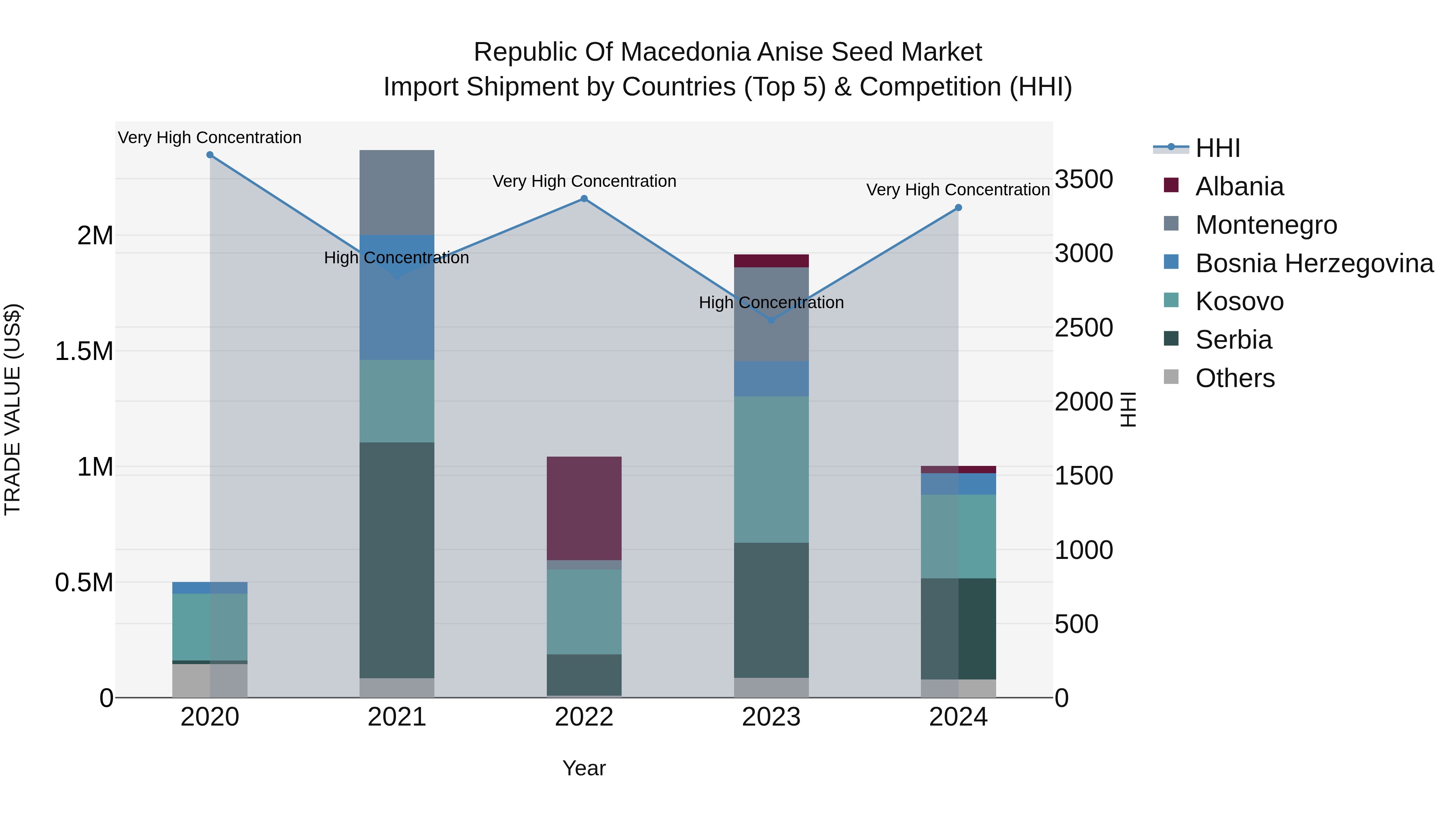
The Republic of North Macedonia saw a significant increase in anise seed imports in 2024, with top exporting countries being Serbia, Kosovo, Bosnia Herzegovina, Albania, and Bulgaria. The market concentration, as measured by the Herfindahl-Hirschman Index (HHI), reached very high levels in 2024, indicating a highly concentrated market. Despite a negative growth rate in 2024 compared to the previous year, the compound annual growth rate (CAGR) from 2020 to 2024 was impressive at 19.01%, showcasing a strong overall upward trend in anise seed imports in the region.
Key Highlights of the Report:
- Republic of Macedonia Anise Seed Market Outlook
- Market Size of Republic of Macedonia Anise Seed Market, 2024
- Forecast of Republic of Macedonia Anise Seed Market, 2031
- Historical Data and Forecast of Republic of Macedonia Anise Seed Revenues & Volume for the Period 2021-2031
- Republic of Macedonia Anise Seed Market Trend Evolution
- Republic of Macedonia Anise Seed Market Drivers and Challenges
- Republic of Macedonia Anise Seed Price Trends
- Republic of Macedonia Anise Seed Porter`s Five Forces
- Republic of Macedonia Anise Seed Industry Life Cycle
- Historical Data and Forecast of Republic of Macedonia Anise Seed Market Revenues & Volume By Form for the Period 2021-2031
- Historical Data and Forecast of Republic of Macedonia Anise Seed Market Revenues & Volume By Whole for the Period 2021-2031
- Historical Data and Forecast of Republic of Macedonia Anise Seed Market Revenues & Volume By Ground for the Period 2021-2031
- Historical Data and Forecast of Republic of Macedonia Anise Seed Market Revenues & Volume By Oil for the Period 2021-2031
- Historical Data and Forecast of Republic of Macedonia Anise Seed Market Revenues & Volume By Application for the Period 2021-2031
- Historical Data and Forecast of Republic of Macedonia Anise Seed Market Revenues & Volume By Pharma for the Period 2021-2031
- Historical Data and Forecast of Republic of Macedonia Anise Seed Market Revenues & Volume By Food and beverages for the Period 2021-2031
- Historical Data and Forecast of Republic of Macedonia Anise Seed Market Revenues & Volume By Personal care & Cosmetic for the Period 2021-2031
- Historical Data and Forecast of Republic of Macedonia Anise Seed Market Revenues & Volume By Others for the Period 2021-2031
- Historical Data and Forecast of Republic of Macedonia Anise Seed Market Revenues & Volume By Distribution Channel for the Period 2021-2031
- Historical Data and Forecast of Republic of Macedonia Anise Seed Market Revenues & Volume By Business to Business (B2B) for the Period 2021-2031
- Historical Data and Forecast of Republic of Macedonia Anise Seed Market Revenues & Volume By Business to Consumers (B2C) for the Period 2021-2031
- Republic of Macedonia Anise Seed Import Export Trade Statistics
- Market Opportunity Assessment By Form
- Market Opportunity Assessment By Application
- Market Opportunity Assessment By Distribution Channel
- Republic of Macedonia Anise Seed Top Companies Market Share
- Republic of Macedonia Anise Seed Competitive Benchmarking By Technical and Operational Parameters
- Republic of Macedonia Anise Seed Company Profiles
- Republic of Macedonia Anise Seed Key Strategic Recommendations






































