Republic Of Macedonia Automotive Engine Market
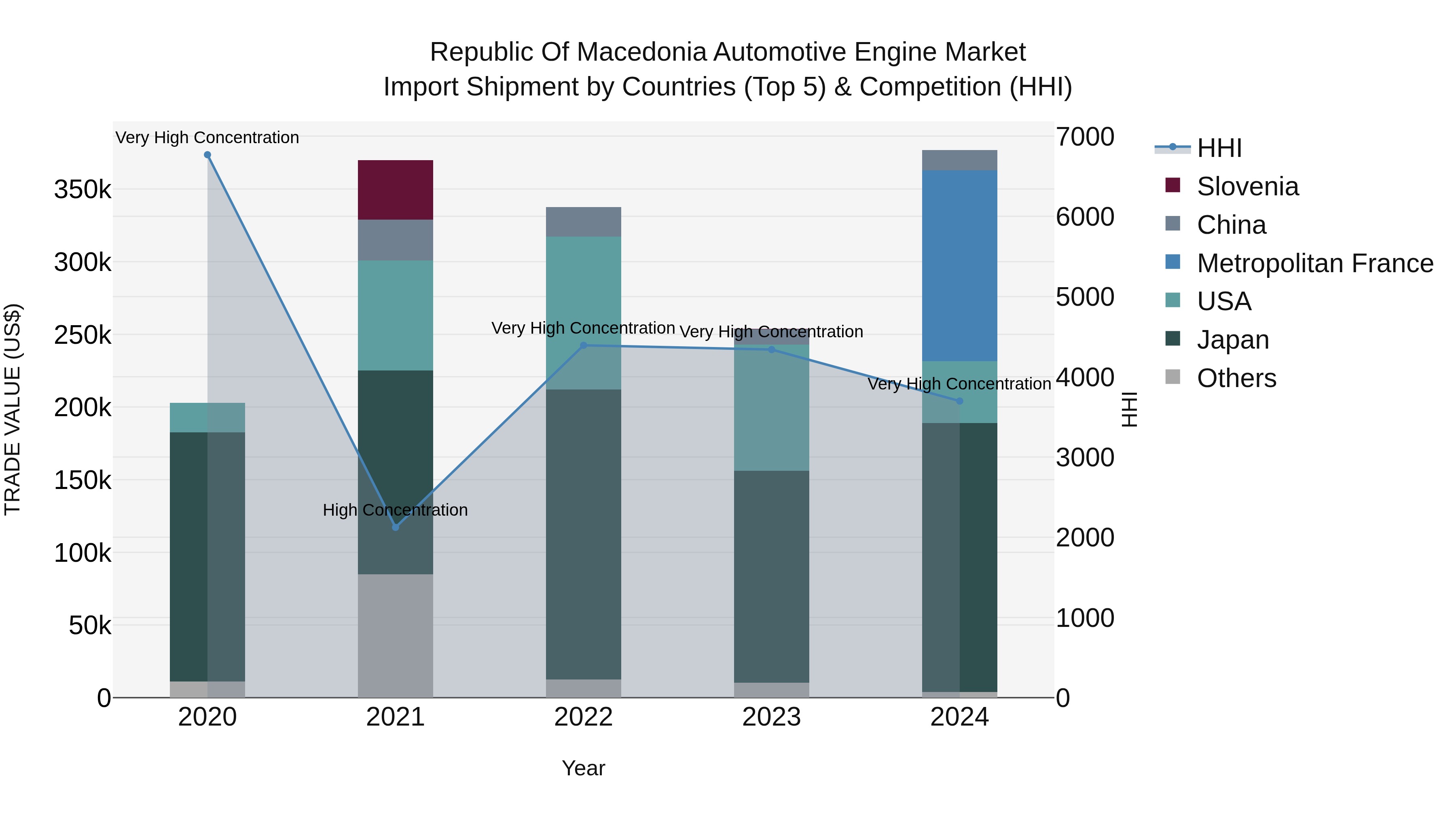
In 2024, the Republic of Macedonia continued to experience strong growth in automotive engine imports, with a notable concentration of shipments from top exporters: Japan, Metropolitan France, USA, China, and Italy. The high Herfindahl-Hirschman Index (HHI) indicates a market dominated by these key players. The impressive compound annual growth rate (CAGR) of 16.72% from 2020 to 2024 and a significant growth rate of 48.4% from 2023 to 2024 suggest a thriving market with promising opportunities for both suppliers and buyers in the automotive engine sector.
Key Highlights of the Report:
- Republic of Macedonia Automotive Engine Market Outlook
- Market Size of Republic of Macedonia Automotive Engine Market, 2024
- Forecast of Republic of Macedonia Automotive Engine Market, 2031
- Historical Data and Forecast of Republic of Macedonia Automotive Engine Revenues & Volume for the Period 2021-2031
- Republic of Macedonia Automotive Engine Market Trend Evolution
- Republic of Macedonia Automotive Engine Market Drivers and Challenges
- Republic of Macedonia Automotive Engine Price Trends
- Republic of Macedonia Automotive Engine Porter`s Five Forces
- Republic of Macedonia Automotive Engine Industry Life Cycle
- Historical Data and Forecast of Republic of Macedonia Automotive Engine Market Revenues & Volume By Placement Type for the Period 2021-2031
- Historical Data and Forecast of Republic of Macedonia Automotive Engine Market Revenues & Volume By In-line Engine for the Period 2021-2031
- Historical Data and Forecast of Republic of Macedonia Automotive Engine Market Revenues & Volume By W Engine for the Period 2021-2031
- Historical Data and Forecast of Republic of Macedonia Automotive Engine Market Revenues & Volume By V-Type for the Period 2021-2031
- Historical Data and Forecast of Republic of Macedonia Automotive Engine Market Revenues & Volume By Vehicle Type for the Period 2021-2031
- Historical Data and Forecast of Republic of Macedonia Automotive Engine Market Revenues & Volume By Passenger Car for the Period 2021-2031
- Historical Data and Forecast of Republic of Macedonia Automotive Engine Market Revenues & Volume By Commercial Vehicle for the Period 2021-2031
- Historical Data and Forecast of Republic of Macedonia Automotive Engine Market Revenues & Volume By Fuel Type for the Period 2021-2031
- Historical Data and Forecast of Republic of Macedonia Automotive Engine Market Revenues & Volume By Gasoline for the Period 2021-2031
- Historical Data and Forecast of Republic of Macedonia Automotive Engine Market Revenues & Volume By Diesel for the Period 2021-2031
- Historical Data and Forecast of Republic of Macedonia Automotive Engine Market Revenues & Volume By Other Fuel Types for the Period 2021-2031
- Republic of Macedonia Automotive Engine Import Export Trade Statistics
- Market Opportunity Assessment By Placement Type
- Market Opportunity Assessment By Vehicle Type
- Market Opportunity Assessment By Fuel Type
- Republic of Macedonia Automotive Engine Top Companies Market Share
- Republic of Macedonia Automotive Engine Competitive Benchmarking By Technical and Operational Parameters
- Republic of Macedonia Automotive Engine Company Profiles
- Republic of Macedonia Automotive Engine Key Strategic Recommendations






































