Republic Of Macedonia Automotive Paints Market
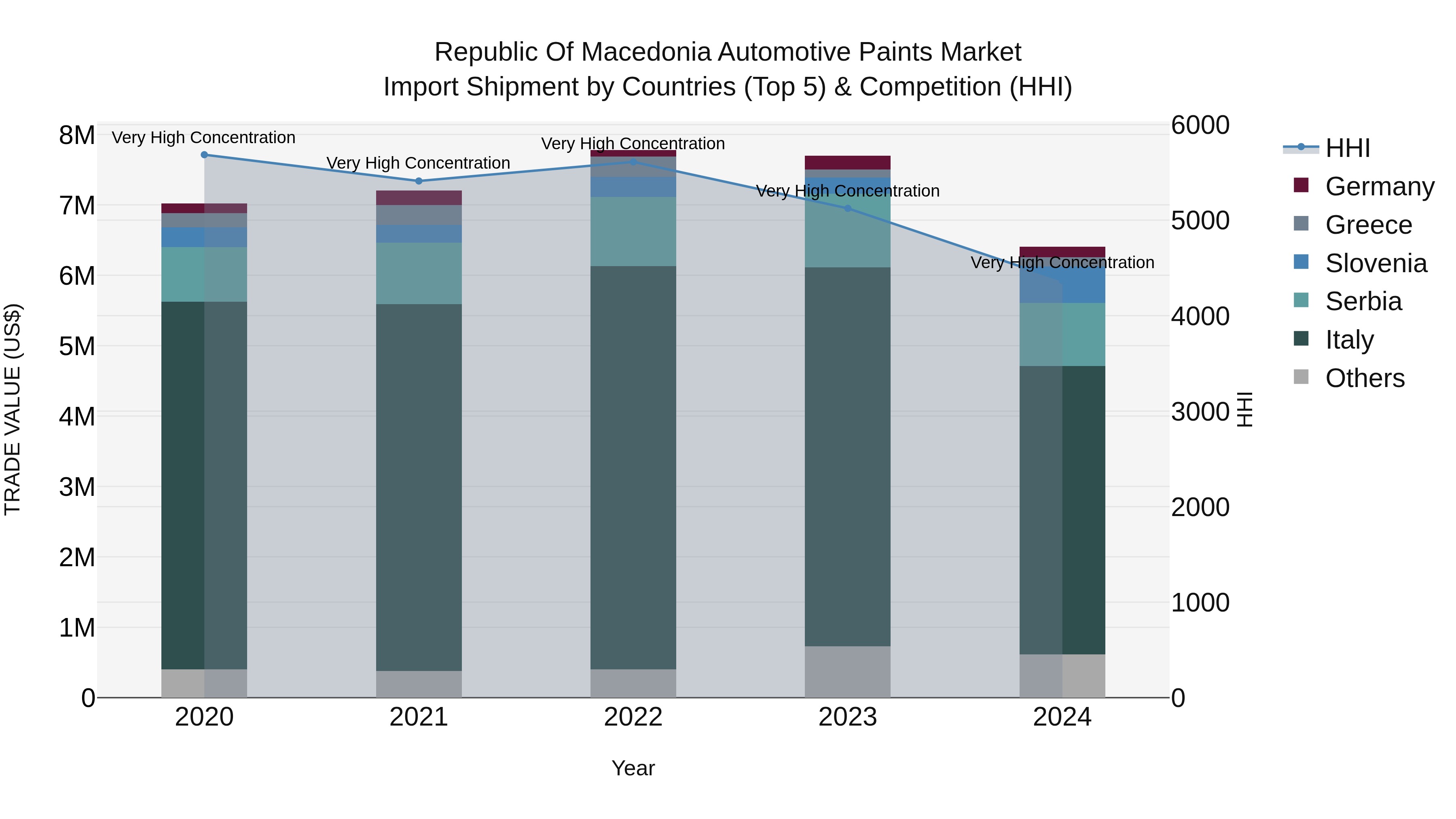
Despite a decline in the growth rate in 2024, the Republic of Macedonia continued to import automotive paints predominantly from Italy, Serbia, Slovenia, Germany, and Bulgaria. The high Herfindahl-Hirschman Index (HHI) indicates a concentrated market, potentially leading to competitive challenges. The negative Compound Annual Growth Rate (CAGR) from 2020 to 2024 suggests a contraction in the market. The significant decrease in growth rate from 2023 to 2024 highlights a challenging year for the automotive paints import sector in North Macedonia. Strategic planning and market diversification may be essential for future growth in this industry.
Key Highlights of the Report:
- Republic of Macedonia Automotive Paints Market Outlook
- Market Size of Republic of Macedonia Automotive Paints Market, 2024
- Forecast of Republic of Macedonia Automotive Paints Market, 2031
- Historical Data and Forecast of Republic of Macedonia Automotive Paints Revenues & Volume for the Period 2021-2031
- Republic of Macedonia Automotive Paints Market Trend Evolution
- Republic of Macedonia Automotive Paints Market Drivers and Challenges
- Republic of Macedonia Automotive Paints Price Trends
- Republic of Macedonia Automotive Paints Porter`s Five Forces
- Republic of Macedonia Automotive Paints Industry Life Cycle
- Historical Data and Forecast of Republic of Macedonia Automotive Paints Market Revenues & Volume By Type for the Period 2021-2031
- Historical Data and Forecast of Republic of Macedonia Automotive Paints Market Revenues & Volume By E-coat for the Period 2021-2031
- Historical Data and Forecast of Republic of Macedonia Automotive Paints Market Revenues & Volume By Primer for the Period 2021-2031
- Historical Data and Forecast of Republic of Macedonia Automotive Paints Market Revenues & Volume By Basecoat for the Period 2021-2031
- Historical Data and Forecast of Republic of Macedonia Automotive Paints Market Revenues & Volume By Clearcoat for the Period 2021-2031
- Historical Data and Forecast of Republic of Macedonia Automotive Paints Market Revenues & Volume By Resin for the Period 2021-2031
- Historical Data and Forecast of Republic of Macedonia Automotive Paints Market Revenues & Volume By PU for the Period 2021-2031
- Historical Data and Forecast of Republic of Macedonia Automotive Paints Market Revenues & Volume By Epoxy for the Period 2021-2031
- Historical Data and Forecast of Republic of Macedonia Automotive Paints Market Revenues & Volume By Acrylic for the Period 2021-2031
- Historical Data and Forecast of Republic of Macedonia Automotive Paints Market Revenues & Volume By Technology for the Period 2021-2031
- Historical Data and Forecast of Republic of Macedonia Automotive Paints Market Revenues & Volume By Solvent for the Period 2021-2031
- Historical Data and Forecast of Republic of Macedonia Automotive Paints Market Revenues & Volume By Water for the Period 2021-2031
- Historical Data and Forecast of Republic of Macedonia Automotive Paints Market Revenues & Volume By Powder for the Period 2021-2031
- Republic of Macedonia Automotive Paints Import Export Trade Statistics
- Market Opportunity Assessment By Type
- Market Opportunity Assessment By Resin
- Market Opportunity Assessment By Technology
- Republic of Macedonia Automotive Paints Top Companies Market Share
- Republic of Macedonia Automotive Paints Competitive Benchmarking By Technical and Operational Parameters
- Republic of Macedonia Automotive Paints Company Profiles
- Republic of Macedonia Automotive Paints Key Strategic Recommendations






































