Republic Of Macedonia Aviation Fuel Market
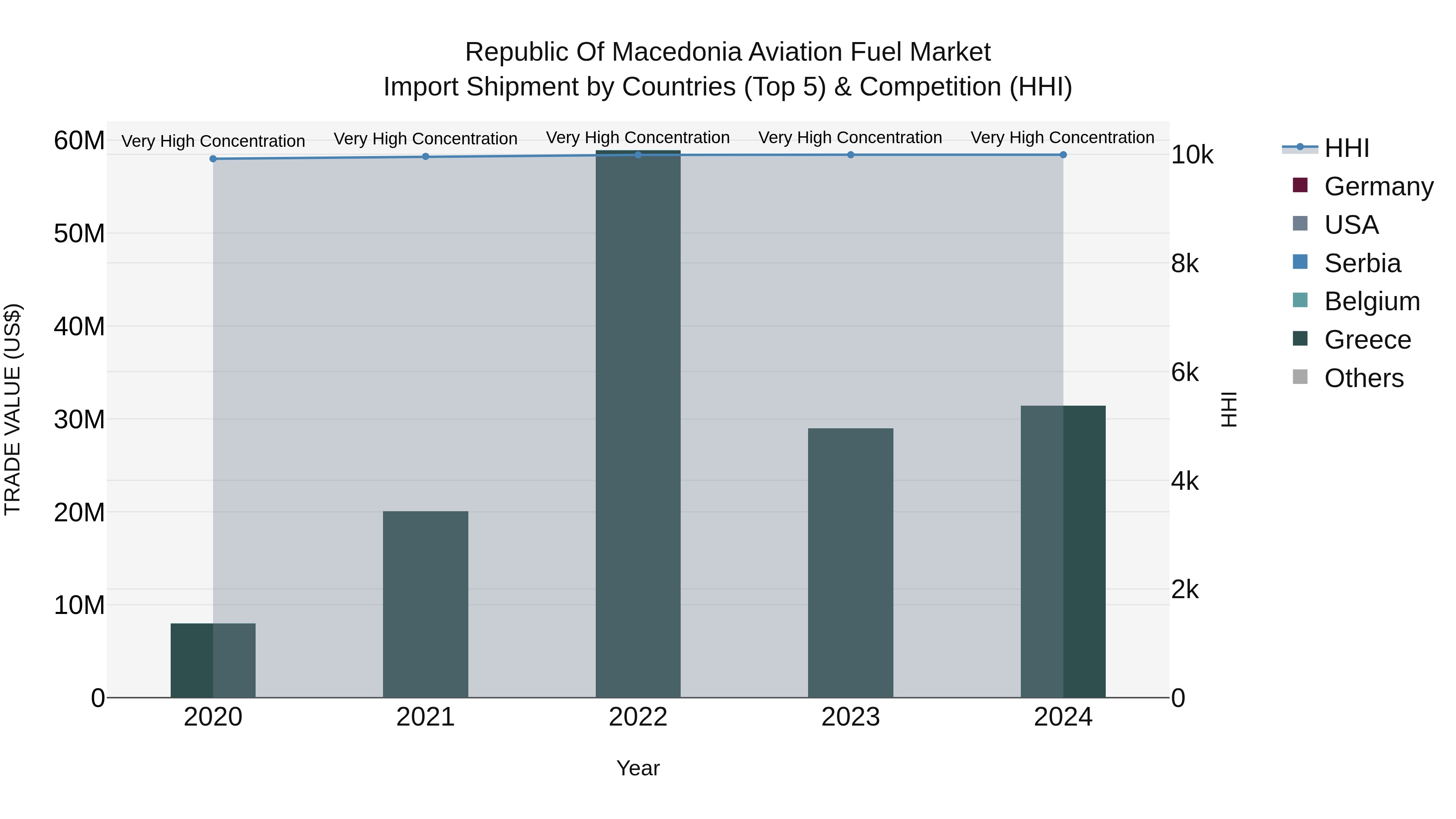
The Republic of Macedonia continues to rely on key countries such as Greece, Serbia, Belgium, Germany, and the USA for its aviation fuel imports in 2024. Despite high market concentration indicated by a high Herfindahl-Hirschman Index (HHI), the industry shows strong growth with a remarkable compound annual growth rate (CAGR) of 40.74% from 2020 to 2024. Additionally, the growth rate for 2023-24 stands at 8.45%, indicating sustained momentum in the aviation fuel import sector in North Macedonia.
Key Highlights of the Report:
- Republic of Macedonia Aviation Fuel Market Outlook
- Market Size of Republic of Macedonia Aviation Fuel Market, 2024
- Forecast of Republic of Macedonia Aviation Fuel Market, 2031
- Historical Data and Forecast of Republic of Macedonia Aviation Fuel Revenues & Volume for the Period 2021- 2031
- Republic of Macedonia Aviation Fuel Market Trend Evolution
- Republic of Macedonia Aviation Fuel Market Drivers and Challenges
- Republic of Macedonia Aviation Fuel Price Trends
- Republic of Macedonia Aviation Fuel Porter's Five Forces
- Republic of Macedonia Aviation Fuel Industry Life Cycle
- Historical Data and Forecast of Republic of Macedonia Aviation Fuel Market Revenues & Volume By Fuel Type for the Period 2021- 2031
- Historical Data and Forecast of Republic of Macedonia Aviation Fuel Market Revenues & Volume By Air Turbine Fuel (ATF) for the Period 2021- 2031
- Historical Data and Forecast of Republic of Macedonia Aviation Fuel Market Revenues & Volume By Aviation Biofuel for the Period 2021- 2031
- Historical Data and Forecast of Republic of Macedonia Aviation Fuel Market Revenues & Volume By Others for the Period 2021- 2031
- Historical Data and Forecast of Republic of Macedonia Aviation Fuel Market Revenues & Volume By Application for the Period 2021- 2031
- Historical Data and Forecast of Republic of Macedonia Aviation Fuel Market Revenues & Volume By Commercial Aircraft for the Period 2021- 2031
- Historical Data and Forecast of Republic of Macedonia Aviation Fuel Market Revenues & Volume By Military Aircraft for the Period 2021- 2031
- Historical Data and Forecast of Republic of Macedonia Aviation Fuel Market Revenues & Volume By General Aviation for the Period 2021- 2031
- Republic of Macedonia Aviation Fuel Import Export Trade Statistics
- Market Opportunity Assessment By Fuel Type
- Market Opportunity Assessment By Application
- Republic of Macedonia Aviation Fuel Top Companies Market Share
- Republic of Macedonia Aviation Fuel Competitive Benchmarking By Technical and Operational Parameters
- Republic of Macedonia Aviation Fuel Company Profiles
- Republic of Macedonia Aviation Fuel Key Strategic Recommendations






































