Republic Of Macedonia Building Automation Systems Market
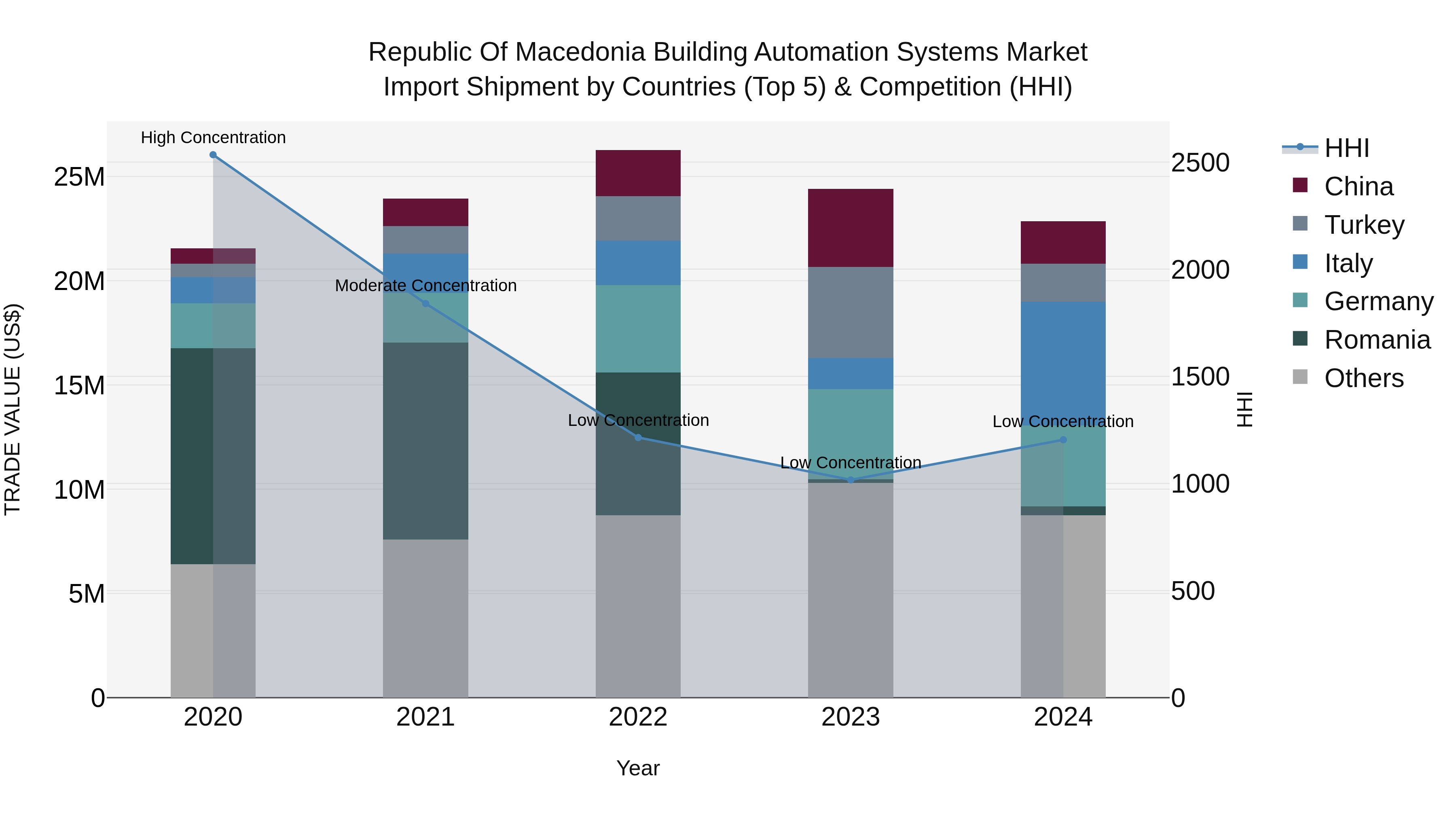
In 2024, the Republic of North Macedonia continued to see a steady increase in building automation systems imports, with top exporting countries being Italy, Germany, China, Turkey, and Poland. Despite the diverse sources of imports, the market remains competitive with a low Herfindahl-Hirschman Index (HHI) concentration. The compound annual growth rate (CAGR) from 2020 to 2024 stood at 1.49%, indicating gradual expansion. However, there was a slight decline in growth rate from 2023 to 2024 at -6.32%, suggesting a potential shift in market dynamics. Monitoring these trends can provide valuable insights for businesses operating in the building automation systems sector in North Macedonia.
Key Highlights of the Report:
- Republic of Macedonia Building Automation Systems Market Outlook
- Market Size of Republic of Macedonia Building Automation Systems Market, 2024
- Forecast of Republic of Macedonia Building Automation Systems Market, 2031
- Historical Data and Forecast of Republic of Macedonia Building Automation Systems Revenues & Volume for the Period 2021-2031
- Republic of Macedonia Building Automation Systems Market Trend Evolution
- Republic of Macedonia Building Automation Systems Market Drivers and Challenges
- Republic of Macedonia Building Automation Systems Price Trends
- Republic of Macedonia Building Automation Systems Porter`s Five Forces
- Republic of Macedonia Building Automation Systems Industry Life Cycle
- Historical Data and Forecast of Republic of Macedonia Building Automation Systems Market Revenues & Volume By Offering for the Period 2021-2031
- Historical Data and Forecast of Republic of Macedonia Building Automation Systems Market Revenues & Volume By Facility Management Systems for the Period 2021-2031
- Historical Data and Forecast of Republic of Macedonia Building Automation Systems Market Revenues & Volume By Security & Access Controls for the Period 2021-2031
- Historical Data and Forecast of Republic of Macedonia Building Automation Systems Market Revenues & Volume By Fire Protection Systems for the Period 2021-2031
- Historical Data and Forecast of Republic of Macedonia Building Automation Systems Market Revenues & Volume By BEM Software for the Period 2021-2031
- Historical Data and Forecast of Republic of Macedonia Building Automation Systems Market Revenues & Volume By BAS Services for the Period 2021-2031
- Historical Data and Forecast of Republic of Macedonia Building Automation Systems Market Revenues & Volume By Communication Technology for the Period 2021-2031
- Historical Data and Forecast of Republic of Macedonia Building Automation Systems Market Revenues & Volume By Wireless Technology for the Period 2021-2031
- Historical Data and Forecast of Republic of Macedonia Building Automation Systems Market Revenues & Volume By Wired Technology for the Period 2021-2031
- Historical Data and Forecast of Republic of Macedonia Building Automation Systems Market Revenues & Volume By Application for the Period 2021-2031
- Historical Data and Forecast of Republic of Macedonia Building Automation Systems Market Revenues & Volume By Commercial for the Period 2021-2031
- Historical Data and Forecast of Republic of Macedonia Building Automation Systems Market Revenues & Volume By Residential for the Period 2021-2031
- Historical Data and Forecast of Republic of Macedonia Building Automation Systems Market Revenues & Volume By Industrial for the Period 2021-2031
- Republic of Macedonia Building Automation Systems Import Export Trade Statistics
- Market Opportunity Assessment By Offering
- Market Opportunity Assessment By Communication Technology
- Market Opportunity Assessment By Application
- Republic of Macedonia Building Automation Systems Top Companies Market Share
- Republic of Macedonia Building Automation Systems Competitive Benchmarking By Technical and Operational Parameters
- Republic of Macedonia Building Automation Systems Company Profiles
- Republic of Macedonia Building Automation Systems Key Strategic Recommendations






































